
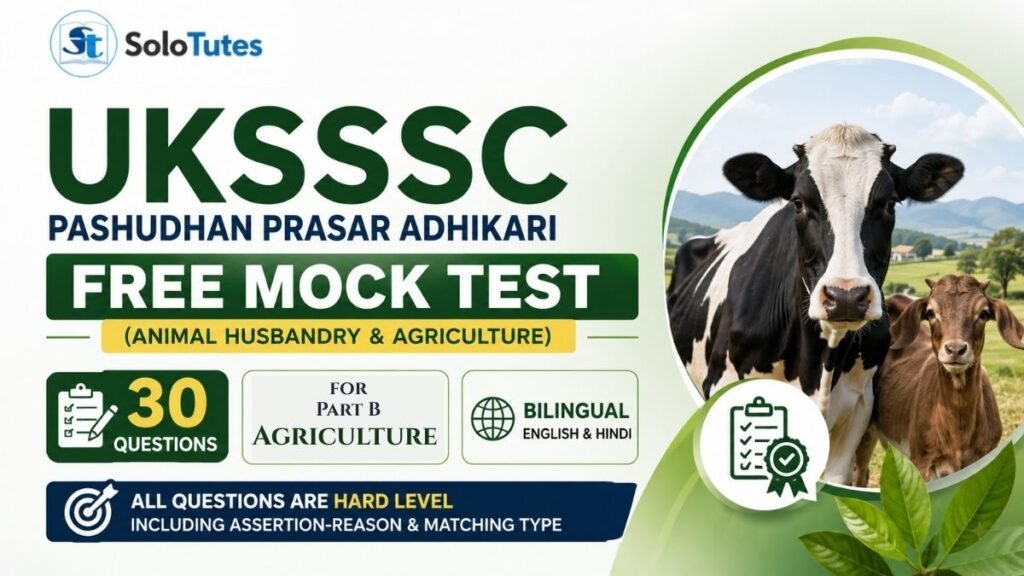
UKSSSC Pashudhan Prasar Adhikari Free Mock Test (Part B – Animal Husbandry & Agriculture)
Practice Mode
Solve instantly below. Get immediate feedback and detailed explanations without any timer.
Start Practice ↓Full Exam Mode
Take this test in a strict timed environment with negative marking and detailed analytics.
Take Assessment →List-I A. Ranikhet B. Fowl Cholera C. Coccidiosis D. Aspergillosis | List-II 1. Bacteria 2. Virus 3. Fungi 4. Protozoa |
सूची-I A. रानीखेत B. फाउल हैजा (Fowl Cholera) C. कॉक्सिडियोसिस D. एस्परजिलोसिस | सूची-II 1. जीवाणु 2. वायरस 3. कवक 4. प्रोटोजोआ |
1. It aimed to increase milk production in India.
2. It was implemented by the National Dairy Development Board (NDDB).
3. Phase-I was funded by the sale of skimmed milk powder donated by the EU.
Which of the statements given above are correct? /ऑपरेशन फ्लड के संबंध में निम्नलिखित कथनों पर विचार करें:
1. इसका उद्देश्य भारत में दुग्ध उत्पादन बढ़ाना था।
2. इसे राष्ट्रीय डेयरी विकास बोर्ड (NDDB) द्वारा लागू किया गया था।
3. चरण-I को EU द्वारा दान किए गए स्किम्ड मिल्क पाउडर की बिक्री से वित्त पोषित किया गया था।
उपर्युक्त कथनों में से कौन-से सही हैं?
List-I A. Pashmina B. Mohair C. Chevon D. Pork | List-II 1. Angora goat hair 2. Meat of goat 3. Meat of pig 4. Changthangi goat wool |
सूची-I A. पश्मीना B. मोहायर C. शेवॉन (Chevon) D. पोर्क (Pork) | सूची-II 1. अंगोरा बकरी के बाल 2. बकरी का मांस 3. सूअर का मांस 4. चांगथांगी बकरी की ऊन |
1. Murrah
2. Bhadawari
3. Surti
4. Mehsana
Which breed is renowned for the highest fat percentage in its milk? /भैंस की निम्नलिखित नस्लों पर विचार करें:
1. मुर्रा
2. भदावरी
3. सुरती
4. मेहसाणा
कौन सी नस्ल अपने दूध में उच्चतम वसा (fat) प्रतिशत के लिए प्रसिद्ध है?
List-I A. NDRI B. IVRI C. CSWRI D. CARI | List-II 1. Izatnagar, Bareilly 2. Karnal, Haryana 3. Avikanagar, Rajasthan 4. Izatnagar, Bareilly (Avian) |
सूची-I A. NDRI (डेयरी) B. IVRI (पशु चिकित्सा) C. CSWRI (भेड़ और ऊन) D. CARI (एवियन) | सूची-II 1. इज्जतनगर, बरेली 2. करनाल, हरियाणा 3. अविकानगर, राजस्थान 4. इज्जतनगर, बरेली (एवियन) |
List-I A. Insulin B. Thyroxine C. Adrenaline D. Oxytocin | List-II 1. Thyroid 2. Pancreas 3. Posterior Pituitary 4. Adrenal Medulla |
सूची-I A. इंसुलिन B. थायरोक्सिन C. एड्रेनालाईन D. ऑक्सीटोसिन | सूची-II 1. थायरॉयड 2. अग्न्याशय (Pancreas) 3. पश्च पीयूष ग्रंथि 4. एड्रेनल मेडुला |
1. Twinkling of stars
2. Bending of a stick in water
3. Mirage in deserts
Which of the above is/are caused by the refraction of light? /निम्नलिखित घटनाओं पर विचार करें:
1. तारों का टिमटिमाना
2. पानी में छड़ी का मुड़ना
3. रेगिस्तान में मृगतृष्णा (Mirage)
उपरोक्त में से कौन-सा/से प्रकाश के अपवर्तन (Refraction) के कारण होता है/होते हैं?
List-I A. Galvanometer B. Barometer C. Sphygmomanometer D. Fathometer | List-II 1. Blood pressure 2. Ocean depth 3. Atmospheric pressure 4. Small electric currents |
सूची-I A. गैल्वेनोमीटर B. बैरोमीटर C. स्फिग्मोमैनोमीटर D. फैथोमीटर | सूची-II 1. रक्तचाप (Blood pressure) 2. समुद्र की गहराई 3. वायुमंडलीय दबाव 4. छोटी विद्युत धाराएँ |
1. It reduces the chromosome number to half.
2. It results in the formation of somatic cells.
Which of the statements given above is/are correct? /अर्धसूत्री विभाजन (Meiosis) के संबंध में निम्नलिखित कथनों पर विचार करें:
1. यह गुणसूत्र संख्या को आधा कर देता है।
2. इसके परिणामस्वरूप दैहिक कोशिकाओं (somatic cells) का निर्माण होता है।
उपर्युक्त कथनों में से कौन-सा/से सही है/हैं?
List-I A. Formic acid B. Citric acid C. Tartaric acid D. Lactic acid | List-II 1. Tamarind/Grapes 2. Sour milk/Curd 3. Ant sting 4. Lemon/Orange |
सूची-I A. फॉर्मिक एसिड B. साइट्रिक एसिड C. टार्टरिक एसिड D. लैक्टिक एसिड | सूची-II 1. इमली/अंगूर 2. खट्टा दूध/दही 3. चींटी का डंक 4. नींबू/संतरा |
1. Xylem
2. Phloem
3. Parenchyma
4. Collenchyma
Which of these are complex permanent tissues? /निम्नलिखित पादप ऊतकों पर विचार करें:
1. जाइलम
2. फ्लोएम
3. पैरेन्काइमा
4. कोलेनकाइमा
इनमें से कौन से जटिल स्थायी ऊतक (complex permanent tissues) हैं?
List-I A. Producers B. Primary Consumers C. Decomposers D. Apex Predators | List-II 1. Herbivores 2. Break down dead matter 3. Photosynthetic plants 4. Top of the food chain |
सूची-I A. उत्पादक (Producers) B. प्राथमिक उपभोक्ता C. अपघटक (Decomposers) D. शीर्ष शिकारी (Apex Predators) | सूची-II 1. शाकाहारी 2. मृत पदार्थों को तोड़ना 3. प्रकाश संश्लेषक पौधे 4. खाद्य श्रृंखला के शीर्ष पर |
1. It is a UNESCO World Heritage Site located in Uttarakhand.
2. It was discovered by British mountaineer Frank S. Smythe in 1931.
Which of the statements given above is/are correct? /फूलों की घाटी (Valley of Flowers) के बारे में निम्नलिखित कथनों पर विचार करें:
1. यह उत्तराखंड में स्थित यूनेस्को की विश्व धरोहर स्थल है।
2. इसकी खोज 1931 में ब्रिटिश पर्वतारोही फ्रैंक एस. स्माइथ ने की थी।
उपर्युक्त कथनों में से कौन-सा/से सही है/हैं?
List-I A. Carbon monoxide B. Chlorofluorocarbons C. Sulfur dioxide D. Lead | List-II 1. Acid rain 2. Automobile exhaust (reduces blood O2) 3. Neurological damage 4. Ozone depletion |
सूची-I A. कार्बन मोनोऑक्साइड B. क्लोरोफ्लोरोकार्बन C. सल्फर डाइऑक्साइड D. सीसा (Lead) | सूची-II 1. अम्ल वर्षा (Acid rain) 2. वाहन निकास (रक्त O2 कम करता है) 3. तंत्रिका संबंधी क्षति 4. ओजोन रिक्तीकरण |
1. Stockholm Convention (POPs)
2. Basel Convention (Hazardous Wastes)
3. Minamata Convention (Mercury)
Which of these are international environmental treaties? /निम्नलिखित सम्मेलनों पर विचार करें:
1. स्टॉकहोम कन्वेंशन (पीओपी)
2. बेसल कन्वेंशन (खतरनाक अपशिष्ट)
3. मिनामाता कन्वेंशन (पारा/Mercury)
इनमें से कौन सी अंतर्राष्ट्रीय पर्यावरण संधियाँ हैं?
List-I A. Bhagirathi B. Alaknanda C. Mandakini D. Yamuna | List-II 1. Satopanth Glacier 2. Gangotri Glacier 3. Yamunotri Glacier 4. Chorabari Glacier |
सूची-I A. भागीरथी B. अलकनंदा C. मंदाकिनी D. यमुना | सूची-II 1. सतोपंथ ग्लेशियर 2. गंगोत्री ग्लेशियर 3. यमुनोत्री ग्लेशियर 4. चोराबरी ग्लेशियर |
UKSSSC Pashudhan Prasar Adhikari (Livestock Extension officer) 2026
This test is part of a larger series. Explore other tests in this bundle.
About this Assessment
Attempt this free 30-question sectional mock test for the UKSSSC Livestock Extension Officer (Pashudhan Prasar Adhikari) exam. This bilingual mock test is specially designed for the Animal Husbandry and Uttarakhand Agriculture section and covers important topics from Animal Husbandry, Basic Veterinary Science, Dairy Farming, Poultry Farming, Livestock Breeds, Animal Diseases, Artificial Insemination (AI), Dairy Development, Operation Flood, and Uttarakhand Agriculture.
All 30 questions are designed at a hard level to provide exam-oriented practice. The test includes standard MCQs as well as Match the Following, Assertion-Reason, and statement-based questions to test conceptual understanding and analytical ability. Questions are provided in both Hindi and English, making the test useful for bilingual exam preparation.
After completing the test, check the detailed explanations to understand the correct answers, revise important concepts, and identify your weak areas. This UKSSSC Pashudhan Prasar Adhikari mock test is a useful practice resource for candidates preparing for the Livestock Extension Officer (LEO) examination and looking for high-level practice in Animal Husbandry and Uttarakhand Agriculture.

Categorized Under
💬 Discuss this Topic
Have a doubt or want to share something? Drop a comment below!
Related Similar Tests
Biology Practice Test 13 – Unit 4 (Ecology & Evolution…
📅 October 7, 2026 36 views
UKSSSC Pashudhan Prasar Adhikari Mock Test 3: Part 2 (Biology…
📅 May 16, 2026 455 views
Biology Practice Test 8 – Unit 2 (Biochemistry & Molecular…
📅 September 20, 2026 112 views
Biology Practice Test 10 – Unit 3 (Microbiology & Immunology…
📅 September 21, 2026 76 views
Ready to Practice More?
Explore notes, one-liners, and other materials related to this topic.
Biology Interactive Quiz: Unit 1 (Cytology & Molecular Biology) –…
Biology Interactive Quiz: Unit 1 (Cytology & Molecular Biology) –…
Biology Revision Set 7 – Taxonomy, Systematics & Evolution –…
 one_liner
100 Questions on Ecology and Evolution | Biology One Liners
📺 Watch & Learn
Visual explanations and related video classes.
🎥 Video Resources
UKSSSC पशुधन प्रसार अधिकारी 2026 की तैयारी कैसे करें? | पूरा सिलेबस + 90 दिन की रणनीति

UKSSSC पशुधन प्रसार अधिकारी 2026 की तैयारी कैसे करें? | पूरा सिलेबस + 90 दिन की रणनीति

पशुधन प्रसार अधिकारी परीक्षा | Mock Test Series | Part 19 | UKSSSC

पशुधन प्रसार अधिकारी परीक्षा | Mock test series | Part 2 | UKSSSC

UKSSSC LEO 2026🔥 | पशुधन प्रसार अधिकारी | Animal Breeds Class 1 | Uttarakhand LEO Exam ll LEO Exam

पशुधन प्रसार अधिकारी परीक्षा | Mock Test Series | Part 20| UKSSSC
UKSSSC Livestock Extension Officer 2026: 2 Months Study Plan & Preparation Strategy
0 Discussion(s)
You must be logged in to join the discussion.