Smart Online Assessments For Serious Exam Preparation
Start Assessment ➔

What do you want to learn today?

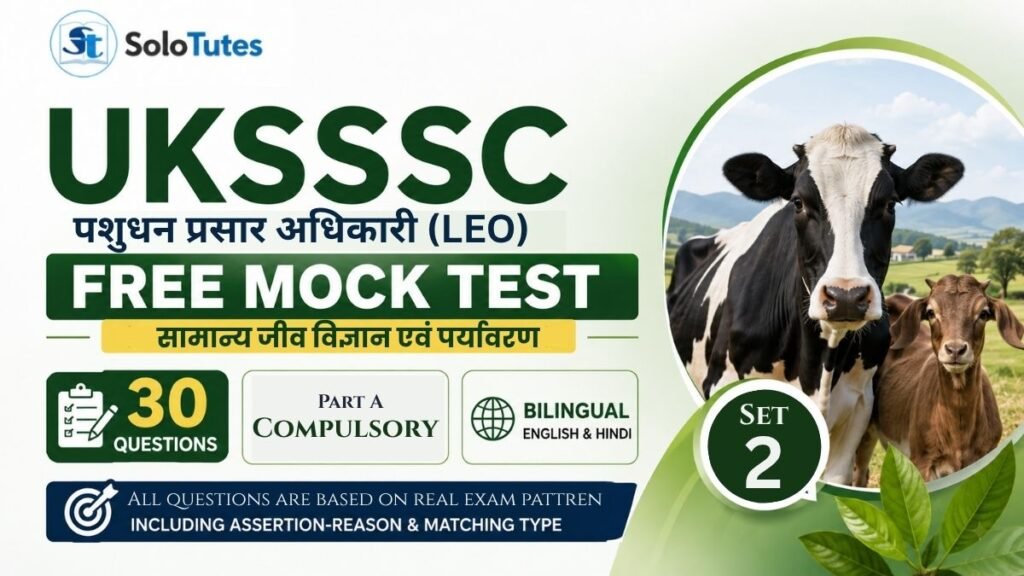
UKSSSC Pashudhan Prasar Adhikari – Part A Mock Test 2

UKSSSC Pashudhan Prasar Adhikari – Part A Mock Test 2

Prakash Joshi May 11, 2026 1.1k views 30 Questions
Download PDF
🎯 Practice: Earn +4 Pts for right answers, auto-save wrong ones (-1 Pt) to your Mistake Bank & unlock +50 Daily Bonus! Login to Track Streak →
⚡

Practice Mode (+4 / -1 Pts)

Solve instantly below with live points (+4 Right, -1 Wrong), detailed explanations & Mistake Bank sync.

Start Practice ↓
🎯

Full Exam Mode

Take this test in a strict timed environment with negative marking and detailed analytics.

Take Assessment →
- Advertisement -
Guest User
Score 0 / 30
Pts 0
Q1. Which component of the plasma membrane is primarily responsible for providing structural stability and preventing it from becoming too fluid? /प्लाज्मा झिल्ली का कौन सा घटक मुख्य रूप से संरचनात्मक स्थिरता प्रदान करने और इसे बहुत तरल होने से रोकने के लिए जिम्मेदार है?
Q2. The 80S ribosome found in eukaryotes is composed of which two subunits? /यूकेरियोट्स में पाया जाने वाला 80S राइबोसोम किन दो उपइकाइयों (subunits) से बना है?
Q3. Which of the following elements forms the core of the chlorophyll molecule? /निम्नलिखित में से कौन सा तत्व क्लोरोफिल अणु का मूल (core) बनाता है?
Q4. The suffix "-opsida" in plant taxonomy is used to denote which category? /पादप वर्गिकी (taxonomy) में प्रत्यय (suffix) "-opsida" का उपयोग किस श्रेणी को दर्शाने के लिए किया जाता है?
Q5. In the Solanaceae family (potato family), the condition where stamens are attached to the petals is called: /सोलेनेसी कुल (आलू कुल) में, उस स्थिति को क्या कहा जाता है जहाँ पुंकेसर पंखुड़ियों से जुड़े होते हैं?
Q6. The tissue responsible for secondary growth (increase in girth) in dicot stems is the: /द्विबीजपत्री तनों में द्वितीयक वृद्धि (परिधि में वृद्धि) के लिए जिम्मेदार ऊतक कौन सा है?
Q7. Match List-I (Cell Division Phase) with List-II (Key Event):
List-I
A. Prophase
B. Metaphase
C. Anaphase
D. Telophase
List-II
1. Chromosomes align at the equator
2. Nuclear envelope reforms around daughter chromosomes
3. Chromatin condenses into visible chromosomes
4. Sister chromatids are pulled apart
/सूची-I (कोशिका विभाजन चरण) को सूची-II (मुख्य घटना) के साथ सुमेलित करें:
सूची-I
A. प्रोफेज
B. मेटाफेज
C. एनाफेज
D. टीलोफेज
सूची-II
1. गुणसूत्र भूमध्य रेखा पर संरेखित होते हैं
2. बेटी गुणसूत्रों के चारों ओर परमाणु लिफाफा फिर से बनता है
3. क्रोमैटिन दृश्य गुणसूत्रों में संघनित होता है
4. सिस्टर क्रोमैटिड्स अलग हो जाते हैं
Q8. The upward movement of water through the xylem in tall trees is best explained by which theory? /ऊंचे पेड़ों में जाइलम के माध्यम से पानी की ऊपर की ओर गति को किस सिद्धांत द्वारा सबसे अच्छी तरह से समझाया गया है?
Q9. In photosynthesis, the splitting of water (photolysis) to release oxygen takes place in association with: /प्रकाश संश्लेषण में, ऑक्सीजन छोड़ने के लिए पानी का विभाजन (फोटोलिसिस) किसके सहयोग से होता है?
Q10. Which plant hormone exhibits strong "apical dominance", inhibiting the growth of lateral buds? /कौन सा पादप हार्मोन मजबूत "शीर्षस्थ प्रभाविता" (apical dominance) प्रदर्शित करता है, जो पार्श्व कलियों के विकास को रोकता है?
Q11. Which of the following serves as the male gametophyte in flowering plants (angiosperms)? /फूलों वाले पौधों (एंजियोस्पर्म) में निम्नलिखित में से कौन सा नर युग्मकोद्भिद (male gametophyte) के रूप में कार्य करता है?
Q12. In double fertilization, the fusion of a male gamete with the secondary nucleus (central cell) is known as: /दोहरे निषेचन में, द्वितीयक केंद्रक (केंद्रीय कोशिका) के साथ नर युग्मक के संलयन को क्या कहा जाता है?
Q13. The term "Eutrophication" refers to: /"यूट्रोफिकेशन" (Eutrophication) शब्द का तात्पर्य है:
Q14. Assertion (A): Plasmolysis occurs when a plant cell is placed in a hypertonic solution.
Reason (R): Water moves out of the cell due to exosmosis, causing the protoplast to shrink away from the cell wall.
/अभिकथन (A): प्लास्मोलिसिस तब होता है जब पौधे की कोशिका को हाइपरटोनिक (hypertonic) घोल में रखा जाता है।
कारण (R): एक्सोस्मोसिस (exosmosis) के कारण पानी कोशिका से बाहर निकल जाता है, जिससे प्रोटोप्लास्ट कोशिका भित्ति से सिकुड़ जाता है।
Q15. Gause’s "Competitive Exclusion Principle" states that: /गॉस (Gause) का "प्रतिस्पर्धी बहिष्करण सिद्धांत" बताता है कि:
Q16. Which specialized form of reproduction is seen in worker bees where they cannot reproduce, but they rear the colony? /कार्यकर्ता मधुमक्खियों (worker bees) में प्रजनन का कौन सा विशेष रूप देखा जाता है जहाँ वे प्रजनन नहीं कर सकती हैं, लेकिन वे कॉलोनी का पालन-पोषण करती हैं?
Q17. The enzyme Taq polymerase, widely used in PCR, is isolated from a bacterium that lives in: /पीसीआर (PCR) में व्यापक रूप से उपयोग किया जाने वाला एंजाइम टैक पॉलीमरेज़ (Taq polymerase), एक जीवाणु से अलग किया जाता है जो कहाँ रहता है?
Q18. The term "Biomagnification" is heavily associated with the toxicity of which historical pesticide? /"जैव आवर्धन" (Biomagnification) शब्द ऐतिहासिक रूप से किस कीटनाशक की विषाक्तता से भारी रूप से जुड़ा हुआ है?
Q19. In angiosperms, what represents the female gametophyte? /एंजियोस्पर्म में, मादा युग्मकोद्भिद (female gametophyte) का प्रतिनिधित्व कौन करता है?
Q20. Which major atmospheric cycle is heavily dependent on the enzyme nitrogenase found in certain bacteria? /कौन सा प्रमुख वायुमंडलीय चक्र कुछ जीवाणुओं में पाए जाने वाले एंजाइम नाइट्रोजनेज (nitrogenase) पर काफी हद तक निर्भर है?
Q21. Match List-I (Air Pollutant) with List-II (Major Impact):
List-I
A. Carbon Monoxide
B. CFCs
C. Sulfur Dioxide
D. SPM (Suspended Particulate Matter)
List-II
1. Respiratory diseases and smog
2. Acid rain
3. Ozone layer depletion
4. Reduces oxygen-carrying capacity of blood
/सूची-I (वायु प्रदूषक) को सूची-II (प्रमुख प्रभाव) के साथ सुमेलित करें:
सूची-I
A. कार्बन मोनोऑक्साइड
B. CFCs
C. सल्फर डाइऑक्साइड
D. SPM (सस्पेंडेड पार्टिकुलेट मैटर)
सूची-II
1. श्वसन रोग और स्मॉग
2. अम्लीय वर्षा
3. ओजोन परत का क्षरण
4. रक्त की ऑक्सीजन ले जाने की क्षमता को कम करता है
Q22. The basic fundamental unit of heredity and inheritance is: /आनुवंशिकता (heredity) और विरासत की मूल मूलभूत इकाई क्या है?
Q23. Which of the following groups of plants lacks seeds and vascular tissues? /निम्नलिखित में से किस पौधे के समूह में बीज और संवहनी ऊतकों (vascular tissues) का अभाव होता है?
Q24. What is the full form of ATP, the energy currency of the cell? /कोशिका की ऊर्जा मुद्रा, एटीपी (ATP) का पूर्ण रूप क्या है?
Q25. In a food chain, herbivores that eat producers directly are classified as: /खाद्य श्रृंखला में, सीधे उत्पादकों को खाने वाले शाकाहारी जीवों को किस रूप में वर्गीकृत किया जाता है?
Q26. Which of the following organelles is NOT a part of the endomembrane system? /निम्नलिखित में से कौन सा अंगक एंडोमेम्ब्रेन सिस्टम (endomembrane system) का हिस्सा नहीं है?
Q27. The process where an entire new plant can be generated from a single somatic cell in tissue culture is called: /टिश्यू कल्चर में एकल कायिक कोशिका (somatic cell) से एक संपूर्ण नया पौधा उत्पन्न करने की प्रक्रिया क्या कहलाती है?
Q28. Assertion (A): C4 plants are highly efficient and show high productivity in tropical climates.
Reason (R): They have Kranz anatomy which minimizes the wasteful process of photorespiration.
/अभिकथन (A): C4 पौधे अत्यधिक कुशल होते हैं और उष्णकटिबंधीय जलवायु में उच्च उत्पादकता दिखाते हैं।
कारण (R): उनमें क्रान्ज़ एनाटॉमी (Kranz anatomy) होती है जो प्रकाश श्वसन (photorespiration) की व्यर्थ प्रक्रिया को कम करती है।
Q29. Which pigment is responsible for absorbing far-red and red light, playing a critical role in photoperiodism in plants? /कौन सा वर्णक (pigment) सुदूर-लाल और लाल प्रकाश को अवशोषित करने के लिए जिम्मेदार है, जो पौधों में दीप्तिकालिता (photoperiodism) में महत्वपूर्ण भूमिका निभाता है?
Q30. Which species of honey bee is most commonly reared in India due to its gentle nature and high honey yield? /भारत में शहद की उच्च उपज और कोमल स्वभाव के कारण किस प्रजाति की मधुमक्खी का सबसे अधिक पालन किया जाता है?
UKSSSC LEO Agriculture Special Test Series 2026 11 tests in this series · Click to view included tests ₹49₹149
UKSSSC Pashudhan Prasar Adhikari (Livestock Extension officer) 2026 21 tests in this series · Click to view included tests ₹79₹199
The UKSSSC LEO 2026 Test Series by Solotutes is made to give you the exact feel of the real Livestock Extension Officer exam. To help you prepare fully, we have included both section-wise tests and full-length mock exams. The tests follow the latest syllabus and exam pattern. It covers the compulsory Part A, which has 30 General Science questions of the 10th and 12th-level. For Part B, you can practice according to your chosen subject—either Biology (Zoology & Botany) or Agriculture. Along with this, you will also get important questions on Animal Husbandry, Uttarakhand Agriculture, and Previous Year Questions (PYQs). Practicing these tests will help you build your speed, reduce mistakes, and get completely ready for the exam day. Buy Series

About this Assessment

Share with Your Friends too

UKSSSC Pashudhan Prasar Adhikari – Part A Mock Test 2

Prepare for the compulsory भाग A (Part A) – General Biology & Environment section of the UKSSSC Pashudhan Prasar Adhikari exam with this focused mock test. The test follows the same prescribed syllabus and includes 30 bilingual (Hindi & English) objective questions with detailed explanations for effective exam-oriented practice.

Exam-Level Practice: This mock test is designed to assess your ability to apply biological and environmental concepts rather than simply recall facts. The question set may feature Assertion-Reasoning (कथन-कारण), Match the Following (सुमेलित करें), and multi-statement questions.

Syllabus Covered (30 Questions / 30 Marks)

Questions in this test are prepared from the complete compulsory Part A syllabus, covering:

  • Cell Biology: Protoplasm, cell theory, prokaryotic and eukaryotic cells, plasma membrane, cytoplasm, organelles, cytoskeleton, chromosomes and cell division.
  • Biomolecules: Structure and classification of proteins, carbohydrates and fats.
  • Taxonomy: Species concept, nomenclature, Linnaean hierarchy, Five Kingdom Classification, Monera, Protista, Fungi and major angiosperm families.
  • Plant Anatomy: Comparative study of monocot and dicot roots, stems, leaves, inflorescence, flowers, fruits and seeds.
  • Plant Physiology: Water and mineral absorption, transpiration, carbon assimilation, photosynthesis, respiration, ETS, food translocation and storage, and plant hormones.
  • Plant Reproduction: Gametophyte development, pollination, fertilization, double fertilization, embryo and endosperm development, seed and fruit formation, seed dispersal, apomixis, parthenocarpy and polyembryony.
  • Ecology & Applied Biology: Pollution, pollution control, health impacts, biomagnification, eutrophication, ozone depletion, greenhouse effect, acid rain, Green Revolution, nitrogen cycle, apiculture, sericulture, crop pest management and microbes in human welfare.

Why Attempt This Test?

  • Exam-Oriented Practice: Solve a fresh set of questions covering the complete compulsory syllabus.
  • Higher-Level Thinking: Test your conceptual clarity through varied and application-based question formats.
  • Detailed Solutions: Identify mistakes and revise the underlying concepts with explanations for every question.

Written & Verified by Prakash Joshi

Expert Faculty

Prakash Joshi is a pharmacy professional and Zoology graduate with an interest in life sciences, biology, and competitive exam preparation. Combining his pharmacy background with his academic knowledge of Zoology, he contributes to the development of educational content, practice questions, and exam-oriented study materials at SoloTutes. His work focuses on simplifying complex concepts, providing accurate and useful learning resources, and helping students prepare effectively for competitive examinations. Through SoloTutes, he aims to make quality educational content accessible to aspirants across India.

Ratings & Reviews

Share your experience and help other students.

★★★★★No reviews yet

Please log in to your SoloTutes account to rate and review this resource.

Student reviews ★★★★★0 total

No reviews yet. Be the first to share your feedback.

- Advertisement -

💬 Discuss this Topic

Have a doubt or want to share something? Drop a comment below!

0 Discussion(s)

  1. No discussions yet. Be the first to share your thoughts!

Ready to Practice More?

Explore notes, one-liners, and other materials related to this topic.

📺 Watch & Learn

Visual explanations and related video classes.

🎥 Video Resources

पशुधन प्रसार अधिकारी, pashudhan prasar adhikari mock 2 Livestock Extension Officer important MCQ

पशुधन प्रसार अधिकारी, pashudhan prasar adhikari mock 2 Livestock Extension Officer important MCQ

Animal husbandry and Agriculture| पशुपालन एवं कृषि के महत्वपूर्ण प्रश्न |UKSSC| पशुधन प्रसार अधिकारी
कृषि एवं पशुपालन से संबंधित महत्वपूर्ण प्रश्‍न भाग - 2| UK वन दरोगा | पशुधन प्रसार अधिकारी |

पशुधन प्रसार अधिकारी || वन दरोगा || Mock test -01 जाचे अपनी तैयारी को ||uksssc
Animal husbandry Model Paper 10 | उत्तराखंड पशुधन प्रसार अधिकारी |रेशम निरीक्षक |UKSSSC|All Exam MCQ

2020- Animal Husbandry Model Paper -12 | उत्तराखंड पशुधन प्रसार अधिकारी | रेशम निरीक्षक | All MCQ

Scroll to Top