
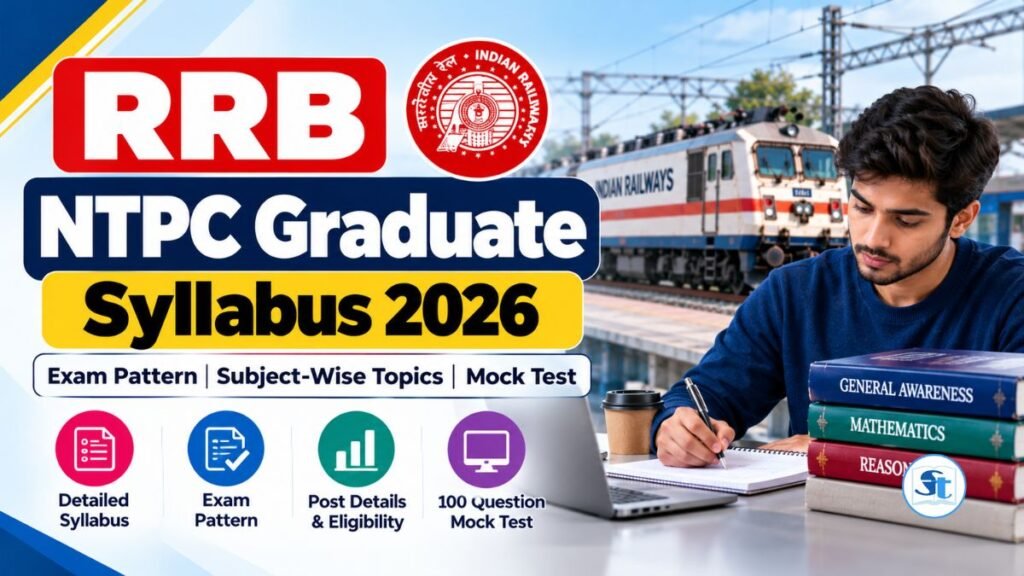
RRB NTPC Graduate Syllabus 2026: CBT 1 & CBT 2 Exam Pattern, Subject-Wise Topics and Mock Test
The RRB NTPC Graduate Syllabus 2026 is important for candidates preparing for Railway Recruitment Board Non-Technical Popular Categories graduate-level posts. The examination tests General Awareness, Mathematics and General Intelligence and Reasoning through two Computer Based Tests (CBT 1 and CBT 2).
This guide covers the RRB NTPC Graduate syllabus, CBT 1 and CBT 2 exam patterns, subject-wise topics, post-wise vacancies, salary, eligibility, age limit, application dates and preparation strategy. Candidates can also attempt a 100-question RRB NTPC Graduate CBT mock test online to practice questions, check their accuracy and improve time management.
RRB NTPC Graduate Recruitment 2026: Overview
| Particular | Details |
|---|---|
| Recruiting Organisation | Railway Recruitment Boards (RRBs) |
| Examination Name | RRB NTPC Graduate Level Examination 2026 |
| Notification Number | CEN 06/2026 |
| Posts | Chief Commercial Cum Ticket Supervisor, Goods Train Manager, Junior Accounts Assistant Cum Typist and Senior Clerk Cum Typist |
| Total Vacancies | 3,548 |
| Educational Qualification | Bachelor’s Degree from a recognised university |
| Age Limit | 18 to 33 years as on 01 January 2027, subject to applicable relaxations |
| Selection Process | CBT 1, CBT 2, Document Verification and Medical Examination, as applicable |
| Negative Marking | One-third mark deducted for each incorrect answer |
| Application Mode | Online |
| Official Website | Official RRB Website |
RRB NTPC Graduate Vacancy 2026: Post-Wise Details
| Post Name | Pay Level | Initial Basic Pay | Vacancies |
|---|---|---|---|
| Chief Commercial Cum Ticket Supervisor | Level 6 | ₹35,400 | 127 |
| Goods Train Manager | Level 5 | ₹29,200 | 2,750 |
| Junior Accounts Assistant Cum Typist | Level 5 | ₹29,200 | 300 |
| Senior Clerk Cum Typist | Level 5 | ₹29,200 | 371 |
| Total | 3,548 | ||
The figures above represent initial basic pay. Dearness Allowance, House Rent Allowance, applicable allowances and deductions may affect the actual monthly salary.
RRB NTPC Graduate Exam Pattern 2026
The RRB NTPC Graduate examination has two Computer Based Test stages. CBT 1 is used for screening and shortlisting candidates for CBT 2. CBT 2 plays the principal role in determining merit for the notified posts.
RRB NTPC CBT 1 Exam Pattern
| Subject | Questions | Marks |
|---|---|---|
| General Awareness | 40 | 40 |
| Mathematics | 30 | 30 |
| General Intelligence and Reasoning | 30 | 30 |
| Total | 100 | 100 |
- Examination duration: 90 minutes.
- PwBD candidates eligible for a scribe may receive 120 minutes, subject to applicable rules.
- Each correct answer carries one mark.
- One-third of a mark is deducted for every incorrect answer.
- CBT 1 marks are normalised where applicable.
RRB NTPC CBT 2 Exam Pattern
| Subject | Questions | Marks |
|---|---|---|
| General Awareness | 50 | 50 |
| Mathematics | 35 | 35 |
| General Intelligence and Reasoning | 35 | 35 |
| Total | 120 | 120 |
- Examination duration: 90 minutes.
- PwBD candidates eligible for a scribe may receive 120 minutes, subject to applicable rules.
- One-third of a mark is deducted for every incorrect answer.
- Final merit and post allotment are subject to the applicable recruitment rules, document verification and medical fitness.
RRB NTPC Graduate Syllabus 2026: Subject-Wise Topics
1. RRB NTPC Mathematics Syllabus
Mathematics tests numerical ability, calculation speed and problem-solving skills. Candidates should practise basic arithmetic as well as algebra, geometry, mensuration and statistics.
Number System, Decimals and Fractions
- Natural numbers, whole numbers, integers and rational numbers.
- Decimals, fractions, recurring decimals and simplification.
- BODMAS rules, divisibility rules and unit digits.
- Surds, indices, remainders and number-based problems.
LCM and HCF
- Prime factorisation and common factors.
- Calculation of Least Common Multiple and Highest Common Factor.
- Problems involving bells ringing together, circular tracks and common intervals.
- Relationship between the product of two numbers, their LCM and their HCF.
Percentage, Profit, Loss and Discount
- Percentage increase and decrease.
- Cost price, selling price, marked price and discount.
- Profit and loss percentage calculations.
- Successive percentage changes and false-weight problems.
- Partnership and related ratio calculations.
Simple Interest and Compound Interest
- Simple interest and compound interest formulas.
- Annual and half-yearly compounding.
- Difference between simple and compound interest.
- Problems involving principal, rate, time and amount.
Ratio, Proportion, Ages and Mixture
- Direct and compound ratios.
- Proportion and proportional relationships.
- Problems based on ages of family members.
- Mixture and alligation.
- Sharing amounts according to a given ratio.
Time and Work
- Individual and combined work efficiency.
- Men, days and work calculations.
- Alternate-day work problems.
- Pipes, cisterns, inlets and leakages.
Speed, Distance and Trains
- Speed, distance and time relationships.
- Conversion between kilometres per hour and metres per second.
- Train crossing a pole, platform or another train.
- Relative speed.
- Boats, streams and upstream/downstream calculations.
Mensuration, Geometry and Trigonometry
- Perimeter and area of squares, rectangles, triangles and circles.
- Surface area and volume of cubes, cuboids, cylinders, cones and spheres.
- Angles, triangles, chords, tangents and circles.
- Pythagoras theorem and right-angled triangles.
- Basic trigonometric ratios, standard angles, heights and distances.
Algebra and Quadratic Equations
- Linear equations in one or two variables.
- Algebraic identities and factorisation.
- Quadratic equations and their roots.
- Polynomial relationships and elementary algebraic expressions.
Elementary Statistics
- Mean, median, mode and range.
- Variance and standard deviation.
- Basic statistical relationships and data-based calculations.
2. RRB NTPC General Intelligence and Reasoning Syllabus
The Reasoning section tests logical thinking, pattern recognition, analytical ability and decision-making. Candidates should practise different question formats and learn to solve them accurately within a limited time.
- Analogies and Classification: Word analogies, number analogies, letter relationships and odd-one-out questions.
- Number and Alphabet Series: Missing numbers, alternating series, alphabetical sequences and pattern completion.
- Coding-Decoding: Letter shifting, reverse alphabet coding, number coding and word-based codes.
- Blood Relations: Family relationships, coded relations and questions involving family trees.
- Direction Sense: Cardinal directions, turns, shortest distance and direction-based calculations.
- Syllogism and Venn Diagrams: All, some and no statements; overlapping groups and logical conclusions.
- Seating Arrangements: Linear arrangements, circular seating and position-based puzzles.
- Logical Puzzles: Arrangement problems, condition-based reasoning and analytical deductions.
- Statement and Conclusion: Statement-assumption, statement-conclusion, course of action and decision-making.
- Mathematical Operations: Interchanging signs, balancing equations and operator-based calculations.
- Clocks and Calendars: Clock-hand angles, overlapping hands, odd days and calendar calculations.
- Ranking and Order: Position from the left or right, rank from the top or bottom and total-person calculations.
- Data Interpretation: Reading tables, charts and graphs.
- Other Topics: Word formation, jumbling, similarities, differences and basic analytical reasoning.
3. RRB NTPC General Awareness Syllabus
General Awareness has the highest weightage in both CBT stages. Preparation should include static GK, Indian history, geography, polity, economics, science, railway-related knowledge and current affairs.
General Science
- Physics: Units and measurements, motion, force, work, energy, power, gravitation, sound, heat, light, reflection, refraction, electricity and magnetism.
- Chemistry: Matter, atoms and molecules, chemical reactions, acids, bases, salts, metals, non-metals, carbon compounds, chemical formulas and the periodic table.
- Biology: Cell structure, tissues, human digestive, circulatory, respiratory and nervous systems, vitamins, deficiency diseases, nutrition, plant physiology, heredity and ecology.
- Environment: Pollution, conservation, ecosystems and environmental issues.
Indian History and Freedom Struggle
- Indus Valley Civilisation and ancient Indian history.
- Buddhism, Jainism, Maurya and Gupta dynasties.
- Delhi Sultanate and Mughal history.
- Regional kingdoms and important historical developments.
- Revolt of 1857 and the formation of the Indian National Congress.
- Major events of the freedom struggle from 1915 to 1947.
- Gandhian movements, revolutionary movements, important leaders, battles and treaties.
Indian Polity and Constitution
- Preamble, Fundamental Rights, Fundamental Duties and Directive Principles.
- President, Vice-President, Prime Minister and Council of Ministers.
- Parliament, Supreme Court, High Courts and constitutional bodies.
- Constitutional amendments and emergency provisions.
- Panchayati Raj and the 73rd and 74th Constitutional Amendments.
- Important constitutional articles and the functioning of government institutions.
Indian and World Geography
- Physical features of India, Himalayan ranges and major plateaus.
- Indian rivers, tributaries, dams and waterfalls.
- Soils, agriculture, monsoon, climate and natural vegetation.
- National parks, wildlife sanctuaries and biosphere reserves.
- States, Union Territories, neighbouring countries and important straits.
- Solar system, atmosphere and basic world geography.
Indian Railways General Knowledge
- History and development of Indian Railways.
- Railway zones and their headquarters.
- Railway production units and important locations.
- Broad Gauge and other railway track gauges.
- Vande Bharat trains, Amrit Bharat trains and railway modernisation.
- Kavach train protection system and Dedicated Freight Corridors.
- Important railway facts, projects and developments.
Indian Economy and Government Schemes
- Basic economic concepts, sectors of the economy and national income.
- RBI, monetary policy, repo rate, reverse repo rate and CRR.
- Inflation, banking, financial inclusion and basic budget terminology.
- Goods and Services Tax (GST).
- NITI Aayog and the planning process in India.
- Government schemes, including PM Jan Dhan Yojana, PM-Kisan and Ayushman Bharat.
Space, Defence, Science and Technology
- ISRO missions, including Chandrayaan-3, Aditya-L1 and Gaganyaan.
- DRDO and important defence developments.
- Missile technology, satellites and space research.
- Scientific discoveries, digital technology and important innovations.
Current Affairs and Miscellaneous GK
- National and international events.
- Important appointments, awards, honours and sports events.
- Books and authors, important days and cultural events.
- International organisations and their headquarters.
- Government initiatives and recent developments.
RRB NTPC Graduate Eligibility Criteria 2026
Educational Qualification
Candidates must possess a Bachelor’s Degree from a recognised university. The required qualification must meet the conditions and deadlines specified in the recruitment notice. Candidates awaiting their final results should check the eligibility rules carefully.
Age Limit
The age limit is 18 to 33 years as on 01 January 2027, with applicable category-wise age relaxation under the recruitment rules.
| Category | Age Relaxation |
|---|---|
| OBC-NCL | 3 years |
| SC/ST | 5 years |
| PwBD | As applicable under the recruitment rules |
Other eligible categories may receive relaxation according to the applicable rules. Candidates should verify their category-specific eligibility before applying.
Application Fee
| Category | Application Fee | Refund on Appearing in CBT 1 |
|---|---|---|
| General / OBC | ₹500 | ₹400 |
| SC / ST / Female / PwBD / EBC | ₹250 | ₹250 |
The refund is subject to the applicable recruitment rules and conditions. Candidates should follow the payment and refund instructions in the application portal.
RRB NTPC Graduate Important Dates 2026
| Event | Date |
|---|---|
| Online Application Start Date | 08 October 2026 |
| Last Date to Apply | 06 November 2026, up to 11:59 PM |
| Application Modification Fee | ₹250, subject to the notified modification window |
| CBT 1 Examination Date | Check the official RRB examination schedule |
| CBT 2 Examination Date | To be notified by the RRBs |
| Admit Card | As per the official schedule |
Dates for the examination, admit card and result should be checked through the official RRB portal. Candidates should not rely on unofficial exam-date claims.
RRB NTPC Graduate Selection Process
- CBT 1: Screening examination covering General Awareness, Mathematics and Reasoning.
- CBT 2: Second-stage examination used for determining merit according to the applicable recruitment rules.
- Document Verification: Verification of educational qualifications, identity, category and other required documents.
- Medical Examination: Assessment according to the medical standard prescribed for the allotted post.
For Senior Clerk Cum Typist and Junior Accounts Assistant Cum Typist, check the applicable notice for the provisions relating to typing proficiency and post-appointment requirements.
RRB NTPC Graduate Salary 2026
The initial basic pay depends on the post and its pay level under the 7th Central Pay Commission.
| Post | Pay Level | Initial Basic Pay |
|---|---|---|
| Chief Commercial Cum Ticket Supervisor | Level 6 | ₹35,400 per month |
| Goods Train Manager | Level 5 | ₹29,200 per month |
| Junior Accounts Assistant Cum Typist | Level 5 | ₹29,200 per month |
| Senior Clerk Cum Typist | Level 5 | ₹29,200 per month |
Actual salary includes applicable allowances and is subject to deductions and posting conditions.
RRB NTPC Graduate Mock Test 2026: Online CBT Practice
Preparing with a full-length mock test helps candidates understand the examination format, practise time management and identify weak subjects before the actual CBT.
The RRB NTPC Graduate CBT mock test on Solotutes includes 100 multiple-choice questions divided into General Awareness, Mathematics, and General Intelligence and Reasoning. It is designed for practice across the subjects covered in CBT 1.
- 100 questions for a total of 100 marks.
- 40 General Awareness questions.
- 30 Mathematics questions.
- 30 General Intelligence and Reasoning questions.
- Timed CBT-style practice.
- Answer review and explanations to help identify mistakes.
- Negative marking practice using the one-third-mark deduction rule.
- Performance tracking and All-India Rank, where available on the test platform.
Attempt RRB NTPC Graduate CBT Mock Test 2026
Practise 100 questions in an online CBT-style environment and check your preparation in General Awareness, Mathematics and Reasoning.
Start Free RRB NTPC Graduate Mock Test →
How to Prepare for RRB NTPC Graduate CBT 1
- Divide your preparation into General Awareness, Mathematics and Reasoning.
- Revise arithmetic formulas and practise numerical questions every day.
- Solve reasoning questions on series, coding-decoding, puzzles, directions and syllogisms.
- Prepare static GK and General Science alongside current affairs.
- Revise Indian Railways facts, history, geography, polity and government schemes.
- Attempt timed mock tests regularly and review every incorrect answer.
- Use negative-marking analysis to improve accuracy and avoid random guessing.
Frequently Asked Questions
1. How many questions are there in RRB NTPC Graduate CBT 1?
CBT 1 contains 100 questions: 40 from General Awareness, 30 from Mathematics and 30 from General Intelligence and Reasoning.
2. What is the duration of the CBT 1 examination?
The standard duration is 90 minutes. Eligible PwBD candidates using a scribe may receive additional time according to the applicable rules.
3. Is there negative marking in RRB NTPC Graduate CBT?
Yes. One-third of a mark is deducted for every incorrect answer.
4. What is the educational qualification for graduate-level posts?
Candidates must possess a Bachelor’s Degree from a recognised university and satisfy the other eligibility conditions.
5. What is the total vacancy count?
The total number of graduate-level vacancies listed for CEN 06/2026 is 3,548.
6. What is the last date to apply?
The scheduled last date is 06 November 2026, up to 11:59 PM.
7. Where can I practise an RRB NTPC Graduate mock test?
Candidates can use the Solotutes online CBT mock-test link provided in this article to practise questions and review their performance.
8. Where can I check official RRB NTPC updates?
Visit the official RRB website for recruitment notices, examination schedules and result updates.
Final Words
Understanding the RRB NTPC Graduate Syllabus 2026 is the first step towards a focused preparation plan. Give regular attention to General Awareness, Mathematics and Reasoning, and practise full-length CBT mock tests to improve accuracy and speed. Keep checking official RRB notices for examination dates and recruitment updates.
RRB NTPC Graduate Vacancy 2026: Post-Wise Details
| Post Name | Pay Level | Initial Basic Pay | Vacancies |
|---|---|---|---|
| Chief Commercial Cum Ticket Supervisor | Level 6 | ₹35,400 | 127 |
| Goods Train Manager | Level 5 | ₹29,200 | 2,750 |
| Junior Accounts Assistant Cum Typist | Level 5 | ₹29,200 | 300 |
| Senior Clerk Cum Typist | Level 5 | ₹29,200 | 371 |
| Total | 3,548 | ||
The figures above represent initial basic pay. Dearness Allowance, House Rent Allowance, applicable allowances and deductions may affect the actual monthly salary.
RRB NTPC Graduate Exam Pattern 2026
The RRB NTPC Graduate examination has two Computer Based Test stages. CBT 1 is used for screening and shortlisting candidates for CBT 2. CBT 2 plays the principal role in determining merit for the notified posts.
RRB NTPC CBT 1 Exam Pattern
| Subject | Questions | Marks |
|---|---|---|
| General Awareness | 40 | 40 |
| Mathematics | 30 | 30 |
| General Intelligence and Reasoning | 30 | 30 |
| Total | 100 | 100 |
- Examination duration: 90 minutes.
- PwBD candidates eligible for a scribe may receive 120 minutes, subject to applicable rules.
- Each correct answer carries one mark.
- One-third of a mark is deducted for every incorrect answer.
- CBT 1 marks are normalised where applicable.
RRB NTPC CBT 2 Exam Pattern
| Subject | Questions | Marks |
|---|---|---|
| General Awareness | 50 | 50 |
| Mathematics | 35 | 35 |
| General Intelligence and Reasoning | 35 | 35 |
| Total | 120 | 120 |
- Examination duration: 90 minutes.
- PwBD candidates eligible for a scribe may receive 120 minutes, subject to applicable rules.
- One-third of a mark is deducted for every incorrect answer.
- Final merit and post allotment are subject to the applicable recruitment rules, document verification and medical fitness.
RRB NTPC Graduate Syllabus 2026: Subject-Wise Topics
1. RRB NTPC Mathematics Syllabus
Mathematics tests numerical ability, calculation speed and problem-solving skills. Candidates should practise basic arithmetic as well as algebra, geometry, mensuration and statistics.
Number System, Decimals and Fractions
- Natural numbers, whole numbers, integers and rational numbers.
- Decimals, fractions, recurring decimals and simplification.
- BODMAS rules, divisibility rules and unit digits.
- Surds, indices, remainders and number-based problems.
LCM and HCF
- Prime factorisation and common factors.
- Calculation of Least Common Multiple and Highest Common Factor.
- Problems involving bells ringing together, circular tracks and common intervals.
- Relationship between the product of two numbers, their LCM and their HCF.
Percentage, Profit, Loss and Discount
- Percentage increase and decrease.
- Cost price, selling price, marked price and discount.
- Profit and loss percentage calculations.
- Successive percentage changes and false-weight problems.
- Partnership and related ratio calculations.
Simple Interest and Compound Interest
- Simple interest and compound interest formulas.
- Annual and half-yearly compounding.
- Difference between simple and compound interest.
- Problems involving principal, rate, time and amount.
Ratio, Proportion, Ages and Mixture
- Direct and compound ratios.
- Proportion and proportional relationships.
- Problems based on ages of family members.
- Mixture and alligation.
- Sharing amounts according to a given ratio.
Time and Work
- Individual and combined work efficiency.
- Men, days and work calculations.
- Alternate-day work problems.
- Pipes, cisterns, inlets and leakages.
Speed, Distance and Trains
- Speed, distance and time relationships.
- Conversion between kilometres per hour and metres per second.
- Train crossing a pole, platform or another train.
- Relative speed.
- Boats, streams and upstream/downstream calculations.
Mensuration, Geometry and Trigonometry
- Perimeter and area of squares, rectangles, triangles and circles.
- Surface area and volume of cubes, cuboids, cylinders, cones and spheres.
- Angles, triangles, chords, tangents and circles.
- Pythagoras theorem and right-angled triangles.
- Basic trigonometric ratios, standard angles, heights and distances.
Algebra and Quadratic Equations
- Linear equations in one or two variables.
- Algebraic identities and factorisation.
- Quadratic equations and their roots.
- Polynomial relationships and elementary algebraic expressions.
Elementary Statistics
- Mean, median, mode and range.
- Variance and standard deviation.
- Basic statistical relationships and data-based calculations.
2. RRB NTPC General Intelligence and Reasoning Syllabus
The Reasoning section tests logical thinking, pattern recognition, analytical ability and decision-making. Candidates should practise different question formats and learn to solve them accurately within a limited time.
- Analogies and Classification: Word analogies, number analogies, letter relationships and odd-one-out questions.
- Number and Alphabet Series: Missing numbers, alternating series, alphabetical sequences and pattern completion.
- Coding-Decoding: Letter shifting, reverse alphabet coding, number coding and word-based codes.
- Blood Relations: Family relationships, coded relations and questions involving family trees.
- Direction Sense: Cardinal directions, turns, shortest distance and direction-based calculations.
- Syllogism and Venn Diagrams: All, some and no statements; overlapping groups and logical conclusions.
- Seating Arrangements: Linear arrangements, circular seating and position-based puzzles.
- Logical Puzzles: Arrangement problems, condition-based reasoning and analytical deductions.
- Statement and Conclusion: Statement-assumption, statement-conclusion, course of action and decision-making.
- Mathematical Operations: Interchanging signs, balancing equations and operator-based calculations.
- Clocks and Calendars: Clock-hand angles, overlapping hands, odd days and calendar calculations.
- Ranking and Order: Position from the left or right, rank from the top or bottom and total-person calculations.
- Data Interpretation: Reading tables, charts and graphs.
- Other Topics: Word formation, jumbling, similarities, differences and basic analytical reasoning.
3. RRB NTPC General Awareness Syllabus
General Awareness has the highest weightage in both CBT stages. Preparation should include static GK, Indian history, geography, polity, economics, science, railway-related knowledge and current affairs.
General Science
- Physics: Units and measurements, motion, force, work, energy, power, gravitation, sound, heat, light, reflection, refraction, electricity and magnetism.
- Chemistry: Matter, atoms and molecules, chemical reactions, acids, bases, salts, metals, non-metals, carbon compounds, chemical formulas and the periodic table.
- Biology: Cell structure, tissues, human digestive, circulatory, respiratory and nervous systems, vitamins, deficiency diseases, nutrition, plant physiology, heredity and ecology.
- Environment: Pollution, conservation, ecosystems and environmental issues.
Indian History and Freedom Struggle
- Indus Valley Civilisation and ancient Indian history.
- Buddhism, Jainism, Maurya and Gupta dynasties.
- Delhi Sultanate and Mughal history.
- Regional kingdoms and important historical developments.
- Revolt of 1857 and the formation of the Indian National Congress.
- Major events of the freedom struggle from 1915 to 1947.
- Gandhian movements, revolutionary movements, important leaders, battles and treaties.
Indian Polity and Constitution
- Preamble, Fundamental Rights, Fundamental Duties and Directive Principles.
- President, Vice-President, Prime Minister and Council of Ministers.
- Parliament, Supreme Court, High Courts and constitutional bodies.
- Constitutional amendments and emergency provisions.
- Panchayati Raj and the 73rd and 74th Constitutional Amendments.
- Important constitutional articles and the functioning of government institutions.
Indian and World Geography
- Physical features of India, Himalayan ranges and major plateaus.
- Indian rivers, tributaries, dams and waterfalls.
- Soils, agriculture, monsoon, climate and natural vegetation.
- National parks, wildlife sanctuaries and biosphere reserves.
- States, Union Territories, neighbouring countries and important straits.
- Solar system, atmosphere and basic world geography.
Indian Railways General Knowledge
- History and development of Indian Railways.
- Railway zones and their headquarters.
- Railway production units and important locations.
- Broad Gauge and other railway track gauges.
- Vande Bharat trains, Amrit Bharat trains and railway modernisation.
- Kavach train protection system and Dedicated Freight Corridors.
- Important railway facts, projects and developments.
Indian Economy and Government Schemes
- Basic economic concepts, sectors of the economy and national income.
- RBI, monetary policy, repo rate, reverse repo rate and CRR.
- Inflation, banking, financial inclusion and basic budget terminology.
- Goods and Services Tax (GST).
- NITI Aayog and the planning process in India.
- Government schemes, including PM Jan Dhan Yojana, PM-Kisan and Ayushman Bharat.
Space, Defence, Science and Technology
- ISRO missions, including Chandrayaan-3, Aditya-L1 and Gaganyaan.
- DRDO and important defence developments.
- Missile technology, satellites and space research.
- Scientific discoveries, digital technology and important innovations.
Current Affairs and Miscellaneous GK
- National and international events.
- Important appointments, awards, honours and sports events.
- Books and authors, important days and cultural events.
- International organisations and their headquarters.
- Government initiatives and recent developments.
RRB NTPC Graduate Eligibility Criteria 2026
Educational Qualification
Candidates must possess a Bachelor’s Degree from a recognised university. The required qualification must meet the conditions and deadlines specified in the recruitment notice. Candidates awaiting their final results should check the eligibility rules carefully.
Age Limit
The age limit is 18 to 33 years as on 01 January 2027, with applicable category-wise age relaxation under the recruitment rules.
| Category | Age Relaxation |
|---|---|
| OBC-NCL | 3 years |
| SC/ST | 5 years |
| PwBD | As applicable under the recruitment rules |
Other eligible categories may receive relaxation according to the applicable rules. Candidates should verify their category-specific eligibility before applying.
Application Fee
| Category | Application Fee | Refund on Appearing in CBT 1 |
|---|---|---|
| General / OBC | ₹500 | ₹400 |
| SC / ST / Female / PwBD / EBC | ₹250 | ₹250 |
The refund is subject to the applicable recruitment rules and conditions. Candidates should follow the payment and refund instructions in the application portal.
RRB NTPC Graduate Important Dates 2026
| Event | Date |
|---|---|
| Online Application Start Date | 08 October 2026 |
| Last Date to Apply | 06 November 2026, up to 11:59 PM |
| Application Modification Fee | ₹250, subject to the notified modification window |
| CBT 1 Examination Date | Check the official RRB examination schedule |
| CBT 2 Examination Date | To be notified by the RRBs |
| Admit Card | As per the official schedule |
Dates for the examination, admit card and result should be checked through the official RRB portal. Candidates should not rely on unofficial exam-date claims.
RRB NTPC Graduate Selection Process
- CBT 1: Screening examination covering General Awareness, Mathematics and Reasoning.
- CBT 2: Second-stage examination used for determining merit according to the applicable recruitment rules.
- Document Verification: Verification of educational qualifications, identity, category and other required documents.
- Medical Examination: Assessment according to the medical standard prescribed for the allotted post.
For Senior Clerk Cum Typist and Junior Accounts Assistant Cum Typist, check the applicable notice for the provisions relating to typing proficiency and post-appointment requirements.
RRB NTPC Graduate Salary 2026
The initial basic pay depends on the post and its pay level under the 7th Central Pay Commission.
| Post | Pay Level | Initial Basic Pay |
|---|---|---|
| Chief Commercial Cum Ticket Supervisor | Level 6 | ₹35,400 per month |
| Goods Train Manager | Level 5 | ₹29,200 per month |
| Junior Accounts Assistant Cum Typist | Level 5 | ₹29,200 per month |
| Senior Clerk Cum Typist | Level 5 | ₹29,200 per month |
Actual salary includes applicable allowances and is subject to deductions and posting conditions.
RRB NTPC Graduate Mock Test 2026: Online CBT Practice
Preparing with a full-length mock test helps candidates understand the examination format, practise time management and identify weak subjects before the actual CBT.
The RRB NTPC Graduate CBT mock test on Solotutes includes 100 multiple-choice questions divided into General Awareness, Mathematics, and General Intelligence and Reasoning. It is designed for practice across the subjects covered in CBT 1.
- 100 questions for a total of 100 marks.
- 40 General Awareness questions.
- 30 Mathematics questions.
- 30 General Intelligence and Reasoning questions.
- Timed CBT-style practice.
- Answer review and explanations to help identify mistakes.
- Negative marking practice using the one-third-mark deduction rule.
- Performance tracking and All-India Rank, where available on the test platform.
Attempt RRB NTPC Graduate CBT Mock Test 2026
Practise 100 questions in an online CBT-style environment and check your preparation in General Awareness, Mathematics and Reasoning.
Frequently Asked Questions
1. How many questions are there in RRB NTPC Graduate CBT 1?
CBT 1 contains 100 questions: 40 from General Awareness, 30 from Mathematics and 30 from General Intelligence and Reasoning.
2. What is the duration of the CBT 1 examination?
The standard duration is 90 minutes. Eligible PwBD candidates using a scribe may receive additional time according to the applicable rules.
3. Is there negative marking in RRB NTPC Graduate CBT?
Yes. One-third of a mark is deducted for every incorrect answer.
4. What is the educational qualification for graduate-level posts?
Candidates must possess a Bachelor’s Degree from a recognised university and satisfy the other eligibility conditions.
5. What is the total vacancy count?
The total number of graduate-level vacancies listed for CEN 06/2026 is 3,548.
6. What is the last date to apply?
The scheduled last date is 06 November 2026, up to 11:59 PM.
7. Where can I practise an RRB NTPC Graduate mock test?
Candidates can use the Solotutes online CBT mock-test link provided in this article to practise questions and review their performance.
8. Where can I check official RRB NTPC updates?
Visit the official RRB website for recruitment notices, examination schedules and result updates.
Ratings & Reviews
Share your experience and help other students.
Please log in to your SoloTutes account to rate and review this resource.
No reviews yet. Be the first to share your feedback.
Categorized Under:
More Updates on this Topic


Ready for More?
Test your knowledge with these related materials.


📺 Watch & Learn
Visual explanations and related video classes for better understanding.
🎥 Video Resources
RRB NTPC Syllabus 2026 | RRB NTPC Graduate Level Exam Pattern & Syllabus | Complete Details
RRB NTPC Syllabus 2026 | RRB NTPC Graduate Level Exam Pattern & Syllabus | Complete Details

RRB NTPC Syllabus 2026 | NTPC Exam Pattern & Syllabus CBT 1 and CBT 2 | NTPC Preparation
RRB NTPC Syllabus 2026 | RRB NTPC Undergraduate Exam Pattern & Syllabus | Complete Details
RRB NTPC New Vacancy 2026 | NTPC Syllabus Graduate & 12th Level | NTPC Syllabus & Exam Pattern 2026

RRB NTPC Syllabus 2026 | RRB NTPC Undergraduate Exam Pattern & Syllabus | Complete Details

RRB NTPC Syllabus 2026 | RRB NTPC Graduate Level Syllabus & Exam Pattern | NTPC New Vacancy 2026
💬 Discuss this Topic
Have a doubt or want to share something? Drop a comment below!
0 Discussion(s)
You must be logged in to join the discussion.