
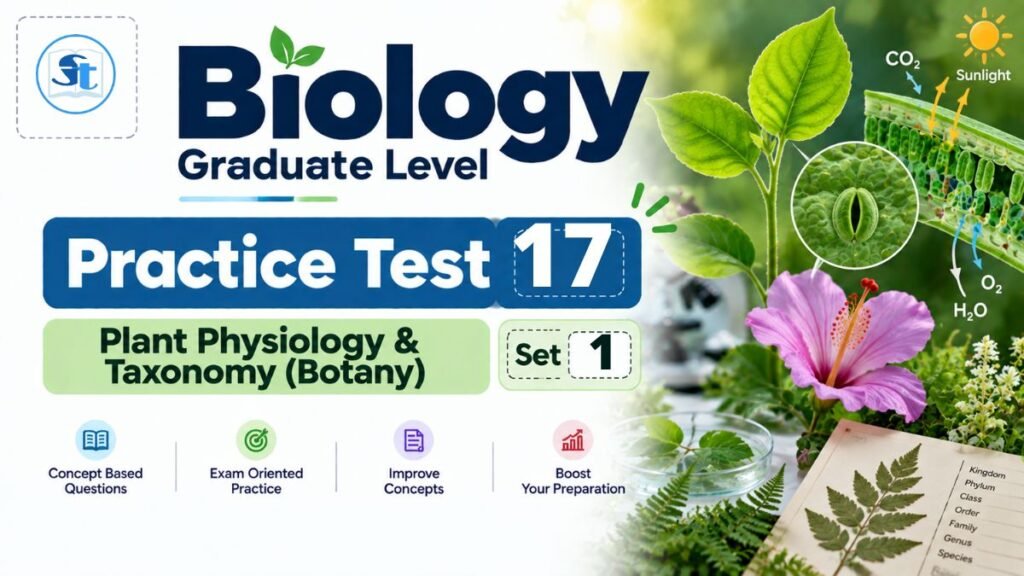
Biology Practice Test 17 – Unit 5 (Plant Physiology & Taxonomy (Botany) – SET 1/4)
Practice Mode (+4 / -1 Pts)
Solve instantly below with live points (+4 Right, -1 Wrong), detailed explanations & Mistake Bank sync.
Start Practice ↓Full Exam Mode
Take this test in a strict timed environment with negative marking and detailed analytics.
Take Assessment →List-I
A. Fabaceae (Papilionoideae)
B. Solanaceae
C. Liliaceae
List-II
1. Swollen placenta with oblique septum
2. Tricarpellary, syncarpous superior ovary
3. Vexillary aestivation (standard, wings, keel) / सूची-I (पादप कुल) का सूची-II (विशिष्ट पुष्प लक्षण) के साथ मिलान करें:
सूची-I
A. फैबेसी
B. सोलेनेसी
C. लिलिएसी
सूची-II
1. तिरछे पट के साथ सूजा हुआ बीजांडासन (Swollen placenta)
2. त्रिअंडपी, युक्तांडपी (syncarpous) ऊर्ध्ववर्ती अंडाशय
3. ध्वजीय पुष्पदल विन्यास (Vexillary aestivation)
Reason (R): Monocots exhibit highly derived features such as the loss of cambium (no secondary growth) and extremely specialized floral structures. / अभिकथन (A): आधुनिक जातिवृत्तीय वर्गीकरण प्रणालियों में, एकबीजपत्री (monocots) को द्विबीजपत्री (dicots) की तुलना में विकासवादी रूप से अधिक उन्नत (advanced) माना जाता है।
कारण (R): एकबीजपत्री अत्यधिक व्युत्पन्न विशेषताएं प्रदर्शित करते हैं जैसे कैम्बियम का नुकसान (कोई द्वितीयक वृद्धि नहीं) और अत्यंत विशिष्ट पुष्प संरचनाएं।
Reason (R): Because water is not split, cyclic photophosphorylation generates ATP but produces neither NADPH nor Oxygen. / अभिकथन (A): चक्रीय प्रकाश-फॉस्फोरिलीकरण (Cyclic photophosphorylation) में केवल फोटोसिस्टम I (PSI) शामिल होता है और इसके परिणामस्वरूप पानी का विभाजन नहीं होता है।
कारण (R): चूंकि पानी विभाजित नहीं होता है, चक्रीय प्रकाश-फॉस्फोरिलीकरण ATP उत्पन्न करता है लेकिन न तो NADPH और न ही ऑक्सीजन का उत्पादन करता है।
Biology Graduate Level (Unit Wise) 30 tests in this series · Click to view included tests ₹99 ₹249
About this Assessment
Welcome to Test 1 of Unit 5 (Plant Physiology & Taxonomy) in our Complete Biology Graduate Level Test Series. this mock test contains 30 high-quality B.Sc. standard botany questions. It covers key taxonomic systems (Bentham & Hooker, Hutchinson), International Code of Botanical Nomenclature (ICBN), floral characteristics of major angiosperm families, and core physiological processes like Water Potential, C3/C4 Photosynthesis, Phloem Transport, and Plant Hormones.
This bilingual (English-Hindi) test is expertly designed for candidates preparing for competitive exams like Lab Assistant, Forest Inspector, and Agriculture Department exams where graduation-level botany is mandatory. Each question comes with a detailed explanation to ensure robust concept clarity.

Ratings & Reviews
Share your experience and help other students.
No reviews yet. Be the first to share your feedback.
Categorized Under
💬 Discuss this Topic
Have a doubt or want to share something? Drop a comment below!
Related Similar Tests
Excretory system – (Class 11th Biology) Revision Test | MCQs…
📅 May 8, 2022 5k views

Principles of Inheritance and Variations (Class 12th – Biology) Revision…
📅 May 8, 2022 5.1k views
Uttarakhand Agriculture and Animal Husbandry Practice Test – #2
📅 August 19, 2026 463 views
UKSSSC Pashudhan Prasar Adhikari – Part A Mock Test 3
📅 May 12, 2026 810 views
Ready to Practice More?
Explore notes, one-liners, and other materials related to this topic.
Biology Revision Set 7 – Taxonomy, Systematics & Evolution –…
 one_liner
Microbiology Important Questions (One Liners Set – 1)
Fundamental principles of microbiology
Microbiology Important Questions ( One Liners )-11 b.Pharmacy
📺 Watch & Learn
Visual explanations and related video classes.
🎥 Video Resources
How to study BIOLOGY so FAST that it feels ILLEGAL

How to study BIOLOGY so FAST that it feels ILLEGAL

Physiology Practical 🩸Blood Group🩸#mbbs #medico #medicalstudent #neetmotivation #neet #cimsbilaspur

Daughter and Dad edition ❤️❤️ || #Rakshita_Singh #shorts #neet

5 Kingdom of Classification| #plant #animal #fungi#protista#bacteria

Phyllotaxy of Leaf Explained 🌿 | Class 11 Biology | NEET & Boards Preparation

How do leaves breathe ☘️ | Simple Science Experiment
0 Discussion(s)
You must be logged in to join the discussion.