
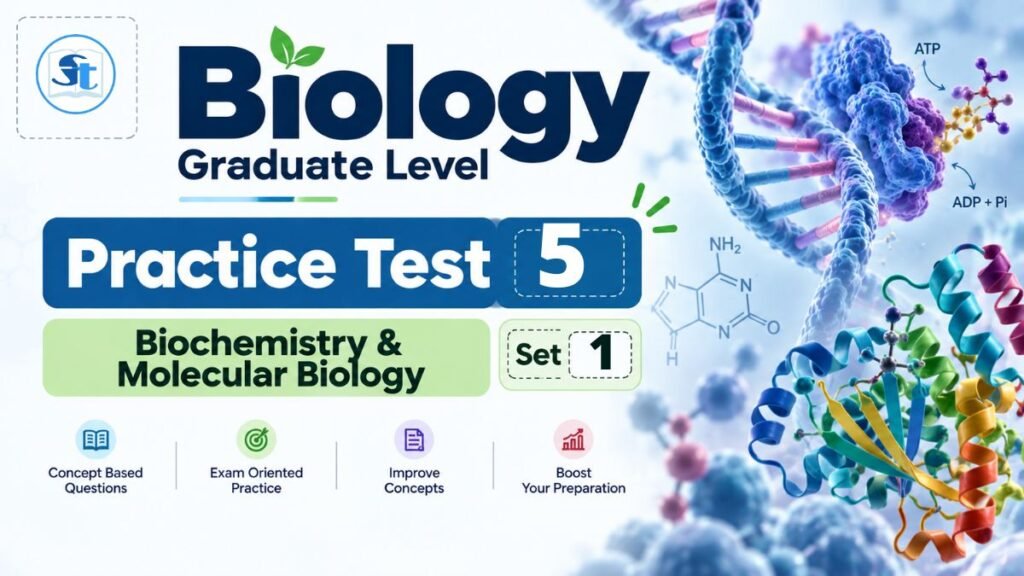
Biology Practice Test 5 – Unit 2 (Biochemistry & Molecular Biology – SET 1/4)
Practice Mode
Solve instantly below. Get immediate feedback and detailed explanations without any timer.
Start Practice ↓Full Exam Mode
Take this test in a strict timed environment with negative marking and detailed analytics.
Take Assessment →List I: P. Fixed-angle rotor
Q. Vertical tube rotor
R. Swinging-bucket rotor.
List II: 1. Tubes are held parallel to the axis of rotation
2. Best for rate-zonal studies requiring maximum resolution
3. Tubes are held at a constant angle of 14-40 degrees. /सेंट्रीफ्यूज रोटर प्रकार (सूची I) का उसके विशिष्ट डिज़ाइन/अनुप्रयोग (सूची II) के साथ मिलान करें।
सूची I
P. फिक्स्ड-एंगल रोटर
Q. वर्टिकल ट्यूब रोटर
R. स्विंगिंग-बकेट रोटर।
सूची II
1. ट्यूब रोटेशन की धुरी के समानांतर रखी जाती हैं
2. अधिकतम रिज़ॉल्यूशन की आवश्यकता वाले रेट-ज़ोनल अध्ययन के लिए सर्वश्रेष्ठ
3. ट्यूबों को 14-40 डिग्री के निरंतर कोण पर रखा जाता है।
List I: P. Plasma membrane
Q. Mitochondria
R. Lysosomes.
List II: 1. Acid phosphatase
2. Na+/K+-ATPase
3. Succinate dehydrogenase. /उपकोशिकीय अंगक (सूची I) का उसके नियमित रूप से उपयोग किए जाने वाले मार्कर एंजाइम (सूची II) के साथ मिलान करें।
सूची I
P. प्लाज्मा झिल्ली
Q. माइटोकॉन्ड्रिया
R. लाइसोसोम।
सूची II
1. एसिड फॉस्फेटेस
2. Na+/K+-ATPase
3. सक्सीनेट डिहाइड्रोजनेज।
1. The lateral resolution limit of a standard light microscope is about 0.2 to 0.5 micrometers.
2. Laser scanning confocal microscopes use a pinhole to remove out-of-focus fluorescence.
3. Electron microscopes use specialized glass lenses to focus a beam of electrons.
Which of the statements is/are TRUE? /माइक्रोस्कोपी के संबंध में निम्नलिखित कथनों पर विचार करें:
1. एक मानक प्रकाश सूक्ष्मदर्शी की पार्श्व रिज़ॉल्यूशन सीमा लगभग 0.2 से 0.5 माइक्रोमीटर होती है।
2. लेजर स्कैनिंग कॉनफोकल माइक्रोस्कोप आउट-ऑफ-फोकस प्रतिदीप्ति (fluorescence) को हटाने के लिए पिनहोल का उपयोग करते हैं।
3. इलेक्ट्रॉन माइक्रोस्कोप इलेक्ट्रॉनों के बीम को केंद्रित करने के लिए विशेष ग्लास लेंस का उपयोग करते हैं।
कौन सा/से कथन सत्य है/हैं?
List I: P. Oxidoreductases
Q. Transferases
R. Hydrolases.
List II: 1. Cleave peptide bonds using water
2. Catalyze the transfer of electrons or hydrogen ions
3. Move functional groups like phosphate from one molecule to another. /एंजाइम वर्ग (सूची I) का उसके कार्यात्मक विवरण (सूची II) के साथ मिलान करें।
सूची I
P. ऑक्सीडोरेडक्टेस
Q. ट्रांसफरेज़
R. हाइड्रोलेज़।
सूची II
1. पानी का उपयोग करके पेप्टाइड बांड को तोड़ते हैं
2. इलेक्ट्रॉनों या हाइड्रोजन आयनों के हस्तांतरण को उत्प्रेरित करते हैं
3. फॉस्फेट जैसे कार्यात्मक समूहों को एक अणु से दूसरे में ले जाते हैं।
List I: P. Primary structure
Q. Secondary structure
R. Tertiary structure.
List II: 1. Hydrogen bonds forming alpha-helices or beta-sheets
2. Peptide bonds between sequential amino acids
3. Hydrophobic interactions and disulfide bridges. /प्रोटीन संरचना स्तर (सूची I) का उसके विशिष्ट परिभाषित बंधन/अंतःक्रिया (सूची II) के साथ मिलान करें।
सूची I
P. प्राथमिक संरचना
Q. द्वितीयक संरचना
R. तृतीयक संरचना।
सूची II
1. अल्फा-हेलिक्स या बीटा-शीट बनाने वाले हाइड्रोजन बांड
2. अमीनो एसिड के बीच पेप्टाइड बांड
3. हाइड्रोफोबिक अंतःक्रिया और डाइसल्फाइड ब्रिज।
List I: P. MutS/MutL proteins
Q. DNA Glycosylase
R. UvrABC endonuclease.
List II: 1. Base Excision Repair (BER)
2. Mismatch Repair (MMR)
3. Nucleotide Excision Repair (NER). /डीएनए मरम्मत तंत्र घटक (सूची I) का उसके संबंधित मरम्मत मार्ग (सूची II) के साथ मिलान करें।
सूची I
P. MutS/MutL प्रोटीन
Q. डीएनए ग्लाइकोसिलेज
R. UvrABC एंडोन्यूक्लिएज।
सूची II
1. बेस एक्सिसन रिपेयर (BER)
2. मिसमैच रिपेयर (MMR)
3. न्यूक्लियोटाइड एक्सिसन रिपेयर (NER)।
Biology Graduate Level (Unit Wise)
This test is part of a larger series. Explore other tests in this bundle.
-
Biology Practice Test 9 – Unit 3 (Microbiology & Immunology – SET 1/4)Coming Soon
-
Biology Practice Test 10 – Unit 3 (Microbiology & Immunology – SET 2/4)Coming Soon
-
Biology Practice Test 11 – Unit 3 (Microbiology & Immunology – SET 3/4)Coming Soon
-
Biology Practice Test 12 – Unit 3 (Microbiology & Immunology – SET 4/4)Coming Soon
-
Biology Practice Test 13 – Unit 4 (Ecology & Evolution – SET 1/4)Coming Soon
-
Biology Practice Test 14 – Unit 4 (Ecology & Evolution – SET 2/4)Coming Soon
-
Biology Practice Test 15 – Unit 4 (Ecology & Evolution – SET 3/4)Coming Soon
-
Biology Practice Test 16 – Unit 4 (Ecology & Evolution – SET 4/4)Coming Soon
-
Biology Practice Test 17 – Unit 5 (Plant Physiology & Taxonomy (Botany) – SET 1/4)Coming Soon
-
Biology Practice Test 18 – Unit 5 (Plant Physiology & Taxonomy (Botany) – SET 2/4)Coming Soon
-
Biology Practice Test 19 – Unit 5 (Plant Physiology & Taxonomy (Botany) – SET 3/4)Coming Soon
-
Biology Practice Test 20 – Unit 5 (Plant Physiology & Taxonomy (Botany) – SET 4/4)Coming Soon
-
Biology Practice Test 21 – Unit 6 (Animal Physiology & Developmental Biology (Zoology) – SET 1/4)Coming Soon
-
Biology Practice Test 22 – Unit 6 (Animal Physiology & Developmental Biology (Zoology) – SET 2/4)Coming Soon
-
Biology Practice Test 23 – Unit 6 (Animal Physiology & Developmental Biology (Zoology) – SET 3/4)Coming Soon
-
Biology Practice Test 24 – Unit 6 (Animal Physiology & Developmental Biology (Zoology) – SET 4/4)Coming Soon
About this Assessment
Welcome to Test 1/4 of Biology Unit 2 (Biochemistry and Molecular Biology). This practice set contains 30 high-quality B.Sc. level questions covering advanced topics such as enzyme kinetics, analytical centrifugation, cell culture, microscopy, pH buffers, and fundamental metabolic pathways. All questions are bilingual (English and Hindi) and come with detailed, easy-to-understand explanations.
This mock test is specifically designed to help candidates prepare for their university graduation exams as well as competitive government job exams that require a strong foundation in Biology. It is an ideal resource for exams related to Lab Assistant, Forest Department, Animal Husbandry Department, and Agriculture Department.
This is Test 5 of the Biology Graduate Level (Unit Wise) Test Series, and it is the first test of Unit 2 (Biochemistry and Molecular Biology). In this complete test series, we have divided the entire biology syllabus into 6 main units, with 4 tests for each unit, making a total of more than 24 tests. This series is very helpful for college graduation exams and government job exams where biology is an important subject, such as Lab Assistant, Forest Department, Animal Husbandry, and Agriculture Department exams. Every test is available in both English and Hindi, and includes different question types like assertion-reason, match-the-following, and statement-based questions to help you prepare well for your exams.

Categorized Under
💬 Discuss this Topic
Have a doubt or want to share something? Drop a comment below!
Related Similar Tests
Biology Practice Test 4 – Unit 1 (Cell Biology &…
📅 September 19, 202642 views
Uttarakhand Agriculture and Animal Husbandry Practice Test – #3
📅 August 20, 2026160 views
Environmental Issues : Biology (Class 12th) Revision Test | MCQs…
📅 May 20, 20223k views
Biotechnology and its Applications : Biology (Class 12th) Revision test…
📅 May 16, 20225.1k views
Ready to Practice More?
Explore notes, one-liners, and other materials related to this topic.
 note
note
Breast And Mammary Glands — Structure, Morphology and Functions
 note
note
classification of organisms – taxonomy
 note
note
Human Female Reproductive System — Simplified Biology Notes
 note
note
Function and characteristics of cells
📺 Watch & Learn
Visual explanations and related video classes.
🎥 Video Resources
How to study Biology? 🧬 🧪

How to study Biology? 🧬 🧪

How to study BIOLOGY so FAST that it feels ILLEGAL

💡 AP Bio FRQ Tips! #shorts #apbio #aptest #ap #highschool

Physiology Practical 🩸Blood Group🩸#mbbs #medico #medicalstudent #neetmotivation #neet #cimsbilaspur

MCQ in Microbiology and Biotechnology

A Day in the Life of a Biology Major
0 Discussion(s)
You must be logged in to join the discussion.