To understand human reproduction, start with one simple idea:
The beginning of a new human life involves a highly organised biological process involving cells, hormones, and reproductive organs.
In this chapter, we will not simply memorise definitions. We will understand the complete process step by step — reproductive organs → gametes → puberty → sperm formation → ovulation → sexual intercourse → ejaculation → sperm journey → fertilisation → zygote → implantation → pregnancy → childbirth.
This topic includes biological terms such as vagina, penis, sperm, semen, coitus, erection, ejaculation, menstruation, and fertilisation.
These are biological terms. There is no need for embarrassment or taboo when studying them.
Biology explains the processes occurring in the body scientifically.
1. What Is Human Reproduction?
Reproduction is the biological process by which living organisms maintain the continuity of their species.
In humans, reproduction is mainly a form of sexual reproduction.
In sexual reproduction, the male and female reproductive systems produce different types of gametes.
♂ Male Gamete — Sperm
Sperm is the male reproductive cell. A human sperm normally contains 23 chromosomes.
♀ Female Gamete — Oocyte
The female reproductive cell is scientifically called an oocyte.
At school level, it is commonly referred to as an egg or ovum.
It also contains 23 chromosomes.
Most important equation:
23 chromosomes (sperm) + 23 chromosomes (oocyte)
= 46 chromosomes in a diploid zygote
2. Male Reproductive System
The main functions of the male reproductive system are:
Producing sperm
Producing male reproductive hormones
Maturing and transporting sperm
Delivering semen to the female reproductive tract during sexual intercourse
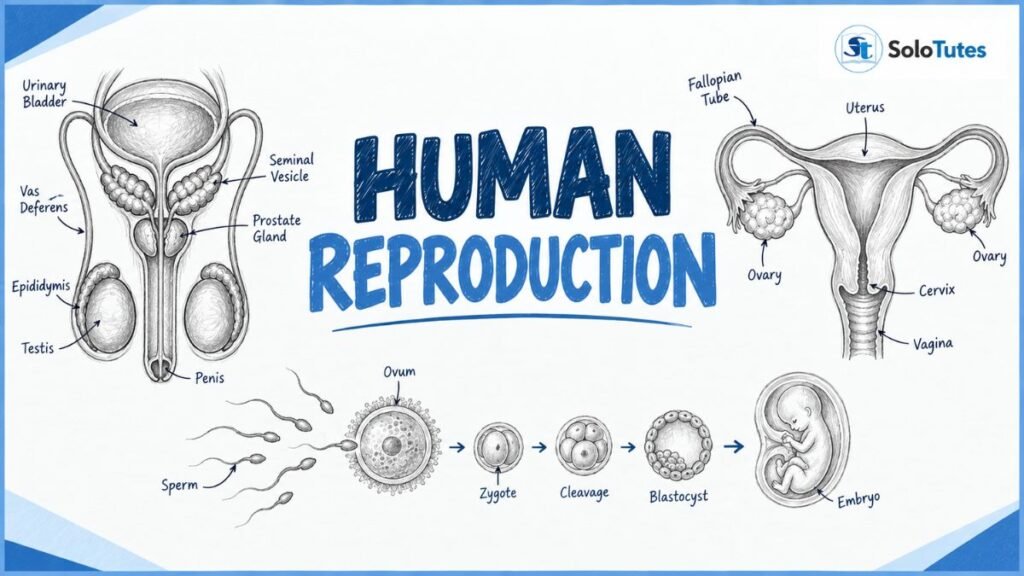
Human male reproductive system — labelled anatomical diagram.
Testes
Testes are the male gonads. Their two major reproductive functions are:
Sperm production
Testosterone production
Inside the testes are numerous seminiferous tubules.
Spermatogenesis, or sperm formation, occurs mainly within these tubules.
Scrotum
The scrotum is a pouch-like structure made of skin and associated tissues that contains the testes.
Keeping the testes at a temperature slightly below core body temperature is important for normal sperm production.
Epididymis
Sperm produced in the testes are not immediately fully functional.
They undergo maturation and storage in the epididymis.
Vas Deferens
The vas deferens is a muscular duct that transports sperm from the epididymis toward the reproductive ducts.
Seminal Vesicles
The seminal vesicles contribute a large portion of seminal fluid.
Their secretion contains substances such as fructose that can provide an energy source for sperm metabolism.
Prostate Gland
The prostate gland also contributes fluid to semen.
Its secretion contributes to sperm transport and provides a suitable chemical environment.
Urethra
The urethra is the passage through which urine leaves the body and through which semen is also released in the male reproductive system.
The two processes do not occur at the same time; internal muscular mechanisms coordinate the urinary and reproductive pathways.
Penis
The penis is the external male reproductive organ.
During sexual intercourse, an erect penis can enter the vagina, and during ejaculation, semen may be deposited in the female reproductive tract.
Remember the male reproductive pathway:
Testis → Epididymis → Vas deferens → Ejaculatory duct → Urethra
3. Structure of Sperm
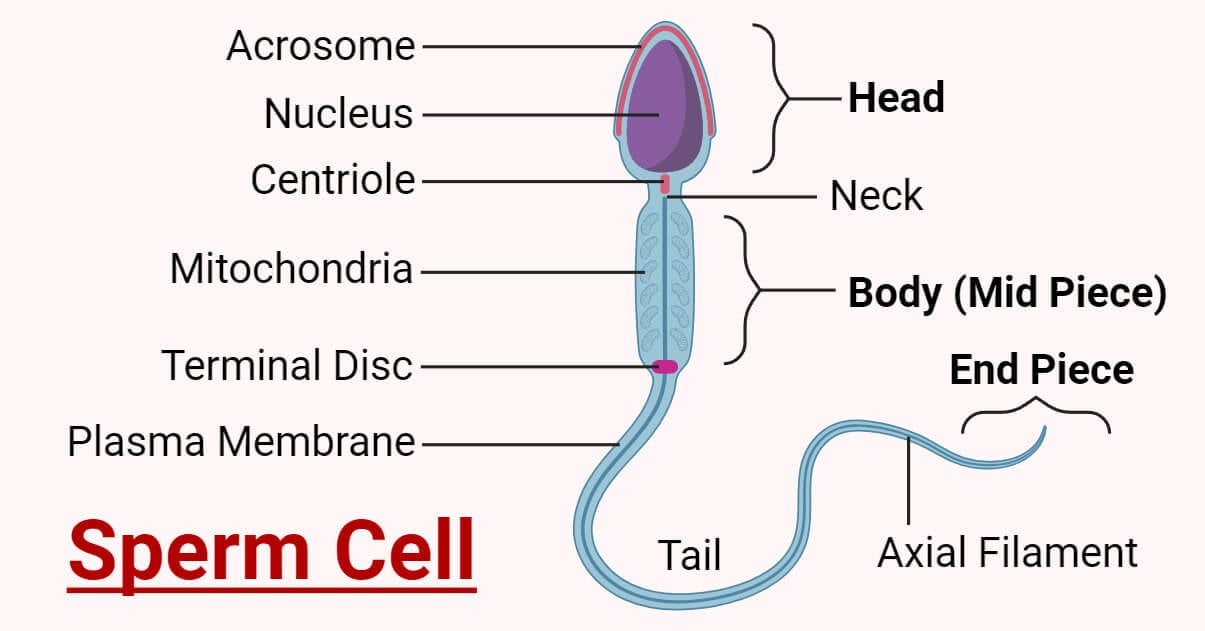
Sperm is a microscopic specialised cell whose structure is adapted for movement through the female reproductive tract and delivery of genetic material.
Structure of sperm cell.
Head
The head contains the nucleus, which carries paternal genetic material.
The anterior region contains the acrosome, which contains enzymes that play a role in the interaction between sperm and the structures surrounding the oocyte.
Middle Piece
The middle piece contains mitochondria.
They help produce ATP, which provides energy for sperm movement.
Tail / Flagellum
The rhythmic movement of the tail helps the sperm move forward.
4. Spermatogenesis — How Are Sperm Formed?
Spermatogenesis is the process in which male germ cells develop into mature spermatozoa.
It occurs mainly in the seminiferous tubules of the testes.
Spermatogenesis — sequence from a germ cell to mature sperm.
The role of the female reproductive system is not limited to egg production.
It is also important for ovulation, the pathway for fertilisation, implantation, and support of pregnancy.
Ovaries
Ovaries are the female gonads.
They contain developing oocytes and play an important role in producing reproductive hormones such as estrogen and progesterone.
Fallopian Tubes / Oviducts
The fallopian tubes are ducts located near the ovaries.
After ovulation, the tube receives the released oocyte.
Human fertilisation generally occurs in the ampullary region of the fallopian tube.
Uterus
The uterus is a muscular reproductive organ.
During pregnancy, the developing embryo and fetus develop within this organ.
Endometrium
The inner lining of the uterus is called the endometrium.
During the menstrual cycle, it thickens and remodels in response to hormonal changes.
When pregnancy is established, implantation occurs in this lining.
Cervix
The cervix is the lower portion of the uterus that connects the uterus to the vagina.
Vagina
Female reproductive system — internal anatomical view.
Vagina is a muscular canal that connects the cervix to the outside of the body.
Menstrual flow passes out through it.
During sexual intercourse, the penis can enter the vagina.
During childbirth, the vagina forms part of the birth canal.
6. Difference Between the Vagina and Vulva
These two terms are often incorrectly treated as interchangeable.
Term
Meaning
Vulva
The collective term for the external female genital structures.
Vagina
The internal muscular canal extending from the cervix to the external opening.
7. Puberty — When Does the Reproductive System Mature?
Puberty is the developmental stage during which the body moves toward reproductive maturity.
Hormonal changes produce changes in the reproductive organs and secondary sexual characteristics.
Male Puberty
Maturation of the testes and reproductive organs
Beginning of sperm production
Increased testosterone activity
Voice changes
Development of facial and body hair
Changes in muscle mass
Female Puberty
Beginning of ovarian cycles
Development of ovulatory cycles
Beginning of menstruation
Breast development
Development of pubic and underarm hair
Maturation of reproductive organs
8. Oogenesis — Female Gamete Development
The biological process of female gamete development is called oogenesis.
It differs considerably from spermatogenesis because female germ-cell development follows a different timing and pattern.
During reproductive life, oocytes develop within ovarian follicles.
In a typical menstrual cycle, one dominant follicle generally reaches ovulation.
Important:
At school level, the word “egg” is commonly used. Scientifically, the cell released at ovulation is more accurately called a secondary oocyte.
9. Menstrual Cycle — From Menstruation to Ovulation
The menstrual cycle is generally counted from the first day of one menstrual period to the first day of the next period.
A 28-day cycle is commonly used as a textbook model, but actual cycle length can vary between individuals and from cycle to cycle.
Menstrual cycle — visual representation of ovarian and uterine changes.
Phase 1 — Menstruation
If pregnancy is not established, the functional portion of the endometrial lining developed during the previous cycle is shed.
This process is called menstruation.
Phase 2 — Follicular Phase
During the early part of the cycle, ovarian follicles develop.
Estrogen levels may gradually increase, and the endometrium begins to proliferate again.
Phase 3 — Ovulation
Following the appropriate hormonal feedback associated with high estrogen levels, an LH surge occurs.
This LH surge is strongly associated with triggering ovulation.
Phase 4 — Luteal Phase
After ovulation, the ruptured follicle forms the corpus luteum.
It produces progesterone, which is important for supporting the endometrium for possible implantation.
Remember the cycle as a story:
Menstruation → Follicle growth → Estrogen rise → LH surge → Ovulation → Corpus luteum → Progesterone → If pregnancy does not occur, menstruation
10. Reproductive Hormones — Who Controls What?
Hormone
Main Role
GnRH
Released by the hypothalamus and signals the pituitary gland to release reproductive gonadotropins.
FSH
Supports ovarian follicle development in females and contributes to support of spermatogenesis in males.
LH
Supports testosterone production in males; the LH surge is strongly associated with ovulation in females.
Estrogen
Important for female reproductive development and several functions including endometrial proliferation.
Progesterone
Important for maintaining the endometrium after ovulation and supporting a pregnancy-compatible environment.
Testosterone
Important for male reproductive development, spermatogenesis, and secondary sexual characteristics.
hCG
Produced during early pregnancy by developing trophoblastic/placental tissue and supports continued progesterone production by the corpus luteum.
11. What Is Coitus / Sexual Intercourse?
Coitus / Sexual Intercourse
Coitus is a biological and medical term commonly referring to penile-vaginal sexual intercourse.
During coitus, the penis enters the vagina.
In the context of human reproduction, sexual intercourse can be important because semen may be deposited in the vagina during ejaculation, allowing sperm to enter the female reproductive tract.
Important distinction:
Coitus and fertilisation are not the same thing.
Coitus = sexual intercourse.
Fertilisation = fusion of sperm and oocyte genetic material.
12. What Is an Erection?
During sexual arousal, nervous-system signalling and increased blood flow can cause the erectile tissues of the penis to fill with blood.
As a result, the penis becomes enlarged and rigid.
This is called an erection.
An erection and ejaculation are two separate physiological events.
13. Ejaculation and Semen
Anatomical pathway involved in ejaculation in the male reproductive tract.
Ejaculation
Ejaculation is the physiological process in which semen is released from the penis through the urethra.
What Is Semen?
It is incorrect to consider semen as simply sperm. Semen = sperm + secretions from accessory reproductive glands.
Sperm are produced in the testes, while the fluid component of semen receives contributions from the seminal vesicles, prostate, and other accessory glands.
This journey is not simply a straight road.
The environment of the female reproductive tract, cervical mucus, immune responses, and sperm motility influence sperm transport and survival.
A very large number of sperm may be released during ejaculation, but only a small number reach the potential site of fertilisation.
15. What Is Ovulation?
Ovulation is the event in which a mature oocyte is released from an ovarian follicle.
To understand ovulation, follow the hormonal sequence:
After ovulation, the released oocyte can enter the fallopian tube.
If viable sperm are present in the reproductive tract at an appropriate time and suitable conditions exist, fertilisation may occur.
16. Fertilisation — How Do Sperm and Oocyte Meet?
Fertilisation is the process in which the genetic material of a sperm and an oocyte combines to form a new diploid cell.
This first cell is called the zygote.
Human fertilisation generally occurs in the ampulla of the fallopian tube.
Human fertilisation — sperm and oocyte unite to form a zygote.
Step 1 — Sperm Reaches the Oocyte
Many sperm attempt to reach the oocyte.
Sperm must interact with and pass through the surrounding structures of the oocyte.
Step 2 — Sperm-Oocyte Interaction
Specific interactions occur between molecules on the sperm surface and the structures surrounding the oocyte.
The acrosome reaction is an important part of this process.
Step 3 — One Sperm Successfully Fuses
When one sperm successfully fuses with the oocyte membrane, changes occur within the oocyte that help prevent the entry of additional sperm.
This is understood in the context of polyspermy prevention.
Step 4 — Genetic Material Combines
After the male and female genetic material combine, a diploid zygote is established.
Golden equation:
Sperm (23) + Oocyte (23) = Zygote (46)
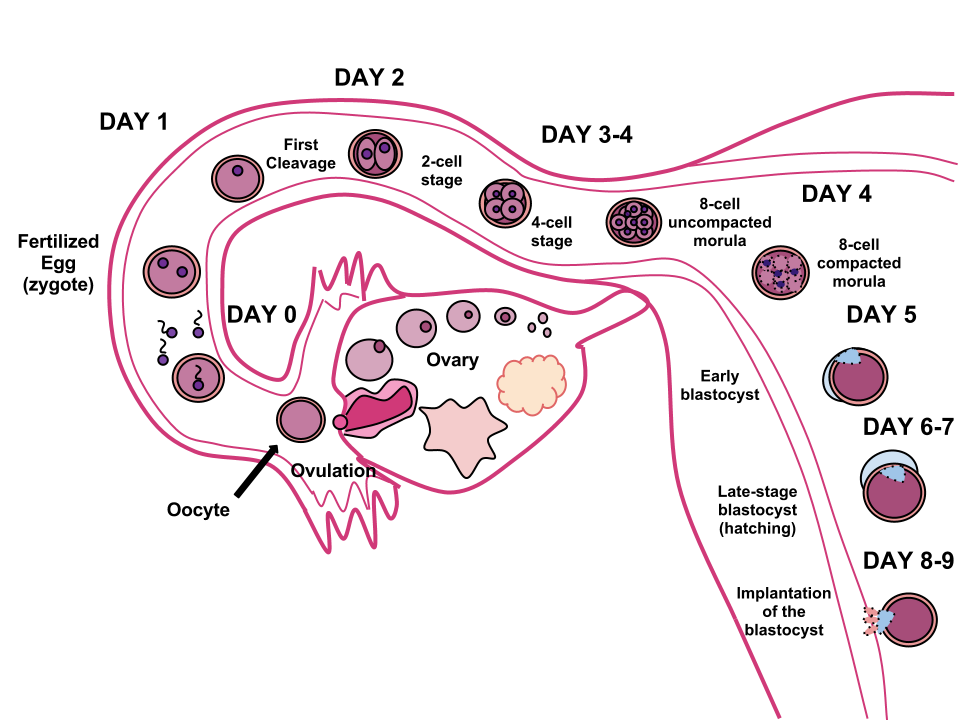
17. From Zygote to Blastocyst
After fertilisation, the zygote does not immediately become a baby.
It undergoes continuous cell divisions and developmental changes.
The zygote undergoes mitotic cell divisions and becomes a multicellular structure.
These early divisions are called cleavage.
Morula
The early embryo reaches a compact, ball-like stage called the morula.
Blastocyst
Further development produces the blastocyst stage.
The blastocyst reaches the uterus and becomes prepared for implantation.
18. What Is Implantation?
Implantation is the process in which the developing blastocyst attaches to and becomes established within the endometrial lining of the uterus.
Fertilisation ≠ Implantation
Fertilisation = fusion of sperm and oocyte.
Implantation = establishment of the blastocyst within the uterine endometrium.
Therefore, pregnancy cannot be described only as the event of fertilisation.
Successful establishment of pregnancy also requires subsequent developmental and implantation events.
19. What Happens During Pregnancy?
After successful implantation, the embryo and its supporting structures begin to develop.
During pregnancy, the uterus gradually expands and supports the developing fetus.
Placenta
The placenta is an important organ for exchange of oxygen, nutrients, and waste products between the mother and developing fetus.
It also functions as an endocrine organ.
Umbilical Cord
The umbilical cord connects the developing fetus to the placenta and contains blood vessels.
Amniotic Fluid
Amniotic fluid provides a protective fluid environment around the developing fetus.
Uterus
The uterus is the primary organ that supports the growth of the developing fetus during pregnancy.
20. Difference Between Embryo and Fetus
Term
Meaning
Embryo
The developing human organism during the early prenatal developmental stage.
Fetus
The later prenatal developmental stage during which established body structures continue to grow and mature.
21. Childbirth / Parturition
Near the end of pregnancy, the uterus produces coordinated contractions.
The cervix gradually dilates, and the fetus is delivered through the birth canal.
This overall biological process is broadly called parturition.
22. Contraception — How Can Pregnancy Be Prevented?
Understanding the basics of contraception is also important for understanding human reproductive health.
Contraceptive methods use different biological mechanisms to reduce or prevent the possibility of pregnancy.
Method Category
Basic Principle
Barrier Methods
Attempt to physically prevent sperm from reaching the reproductive tract.
Condoms are a common example.
Hormonal Methods
Alter hormonal signalling and can influence ovulation and other reproductive processes.
Intrauterine Devices
Devices placed inside the uterus that are established methods of pregnancy prevention.
Sterilisation
Surgical methods used for permanent contraception.
When choosing contraception, effectiveness, side effects, medical history, and individual circumstances are important considerations.
23. Sexually Transmitted Infections (STIs)
Some infections can be transmitted through sexual contact.
They are broadly called sexually transmitted infections.
Examples include HIV, syphilis, gonorrhoea, chlamydia, genital herpes, and HPV.
Some STIs may not cause obvious symptoms during the early stages.
Therefore, the presence or absence of an infection should not be assumed from symptoms alone.
Prevention:
Barrier protection, appropriate testing, vaccination where available, and informed sexual-health decisions can help reduce infection risk.
24. Hymen and Virginity — Scientific Fact
The hymen is a variable fold or ring of mucosal tissue around the vaginal opening.
Its shape, thickness, and opening naturally vary between individuals.
Myth: The condition of the hymen can reveal whether someone is a virgin. Fact: The appearance or condition of the hymen cannot reliably determine a person’s sexual history.
Therefore, statements such as “intact hymen = virgin” or “hymen changes = sexual intercourse” are not scientifically reliable.
25. Common Myths About Menstruation
Myth: Period blood is dirty blood. Fact: Menstrual fluid contains blood along with endometrial tissue and reproductive tract fluids. It is a normal physiological process.
Myth: A period is a disease. Fact: Menstruation is a normal part of reproductive physiology.
Myth: Every woman must have exactly a 28-day cycle. Fact: A 28-day cycle is a commonly used textbook model. Actual cycles vary between individuals.
Myth: Physical activity should be avoided during periods. Fact: If a person is comfortable and has no medical restriction, normal physical activity can generally be continued.
26. Most Important Differences
Concept 1
Concept 2
Difference
Vulva
Vagina
Vulva refers to the external female genital structures; the vagina is an internal muscular canal.
Sperm
Semen
Sperm is the male gamete; semen is a sperm-containing reproductive fluid.
Ovulation
Menstruation
Ovulation = release of an oocyte; menstruation = shedding of the endometrial lining.
Coitus
Fertilisation
Coitus = sexual intercourse; fertilisation = sperm-oocyte fusion.
Fertilisation
Implantation
Fertilisation produces a zygote; implantation establishes the blastocyst within the uterine lining.
Embryo
Fetus
Both are prenatal developmental stages, but the terms refer to different stages of development.
27. Human Reproduction — The Complete Story in One Flow
Puberty →
Gamete formation →
Ovulation →
Sexual intercourse →
Ejaculation →
Sperm transport →
Fertilisation →
Zygote →
Cleavage →
Morula →
Blastocyst →
Implantation →
Embryonic development →
Pregnancy →
Birth
28. One-Minute Revision
Male gonad = Testis
Female gonad = Ovary
Male gamete = Sperm
Female gamete = Oocyte
Sperm formation = Spermatogenesis
Female gamete development = Oogenesis
Oocyte release = Ovulation
Sexual intercourse = Coitus
Semen release = Ejaculation
Sperm + oocyte fusion = Fertilisation
First diploid cell = Zygote
Uterine attachment = Implantation
Main site of fertilisation = Ampulla of fallopian tube
Uterine inner lining = Endometrium
Major hormonal event associated with ovulation = LH surge
External female genital structures = Vulva
Male gamete-containing reproductive fluid = Semen
29. Quick Check — Test Yourself
1. What is the human male gamete?
Sperm.
2. What is the scientific term for the human female gamete?
Oocyte. The cell released during ovulation is more accurately called a secondary oocyte.
3. Where does fertilisation generally occur?
In the ampullary region of the fallopian tube.
4. Which hormonal event is strongly associated with ovulation?
LH surge.
5. What is the difference between sperm and semen?
Sperm is the male gamete; semen is a mixture of sperm and secretions from accessory reproductive glands.
6. Are fertilisation and implantation the same?
No. Fertilisation is sperm-oocyte fusion, whereas implantation is the establishment of the blastocyst within the uterine endometrium.
7. Does every sexual intercourse result in pregnancy?
No. Pregnancy requires fertilisation followed by successful embryonic development and implantation.
8. Are the vulva and vagina the same?
No. Vulva refers to the external female genital structures, while the vagina is an internal muscular canal.
30. Chapter Final Summary
Human reproduction is not a single event but a chain of connected biological processes.
During puberty, the reproductive system matures and gamete production begins.
The male reproductive system produces sperm, while the female reproductive system plays important roles in oocyte development, ovulation, and support of pregnancy.
During sexual intercourse, semen may be deposited in the female reproductive tract.
Sperm may travel through the cervix and uterus toward the fallopian tube.
If sperm and an oocyte meet under suitable conditions, fertilisation may occur and a diploid zygote is formed.
The zygote undergoes repeated cell divisions and passes through the morula and blastocyst stages.
The blastocyst reaches the uterus and may implant in the endometrium.
Embryonic and fetal development then continue, while the placenta and other supporting structures help maintain pregnancy, eventually leading to childbirth.
The Entire Process in One Line
Gamete formation → Ovulation → Sexual intercourse → Ejaculation →
Sperm transport → Fertilisation → Zygote → Cleavage → Blastocyst →
Implantation → Embryonic development → Pregnancy → Birth
Image Sources & References
The anatomical illustrations used in this article are sourced from Wikimedia Commons and other credited educational sources.
Prakash Joshi is a pharmacy professional and Zoology graduate with an interest in life sciences, biology, and competitive exam preparation. Combining his pharmacy background with his academic knowledge of Zoology, he contributes to the development of educational content, practice questions, and exam-oriented study materials at SoloTutes. His work focuses on simplifying complex concepts, providing accurate and useful learning resources, and helping students prepare effectively for competitive examinations. Through SoloTutes, he aims to make quality educational content accessible to aspirants across India.
Ratings & Reviews
Share your experience and help other students.
★★★★★No reviews yet
Please log in to your SoloTutes account to rate and review this resource.
Student reviews★★★★★0 total
No reviews yet. Be the first to share your feedback.




.png)







0 Discussion(s)
You must be logged in to join the discussion.