
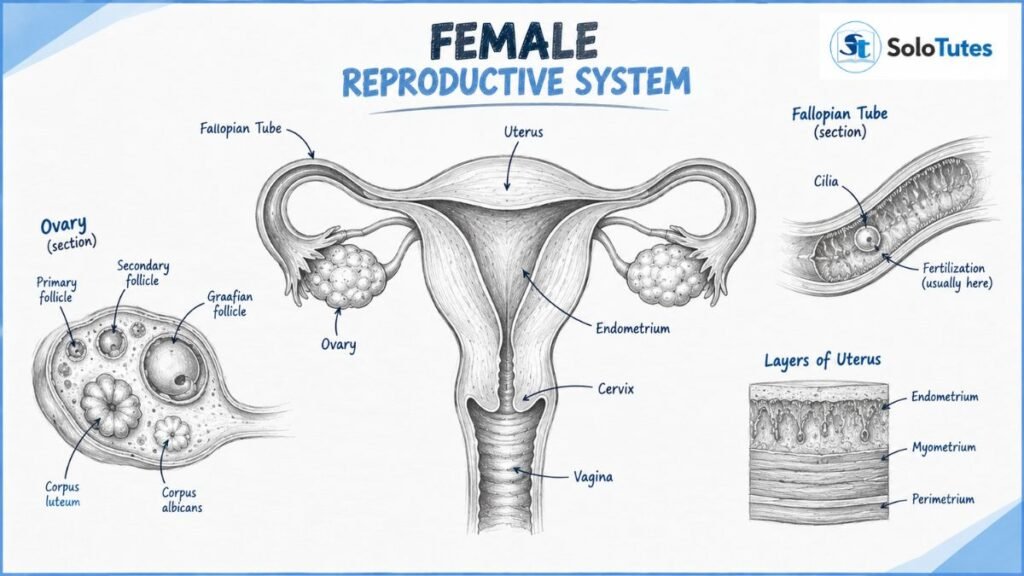
Human Female Reproductive System — Simplified Biology Notes
The Female Reproductive System is the organ system responsible for the development of female gametes (oocytes), secretion of reproductive hormones, providing the environment required for fertilisation, supporting embryo and fetal development, and contributing to childbirth.
The organs and structures of the female reproductive system can broadly be divided into external reproductive structures and internal reproductive organs.
1. Main Parts of the Female Reproductive System
The major organs and structures of the female reproductive system are:

- Ovaries
- Fallopian tubes / Uterine tubes
- Uterus
- Cervix
- Vagina
- Vulva
- Clitoris
- Labia majora
- Labia minora
- Mons pubis
- Greater vestibular glands
The breast is also an important accessory organ associated with the female reproductive system. The mammary gland and lactation are covered separately in our detailed Breast / Mammary Gland topic.
2. Main Functions of the Female Reproductive System
- Development and maturation of oocytes
- Secretion of reproductive hormones such as estrogen and progesterone
- Ovulation
- Providing a reproductive tract through which sperm can travel
- Providing a suitable environment for fertilisation
- Preparing the uterus for implantation
- Supporting embryo and fetal development
- Allowing menstrual flow to leave the body
- Contributing to childbirth
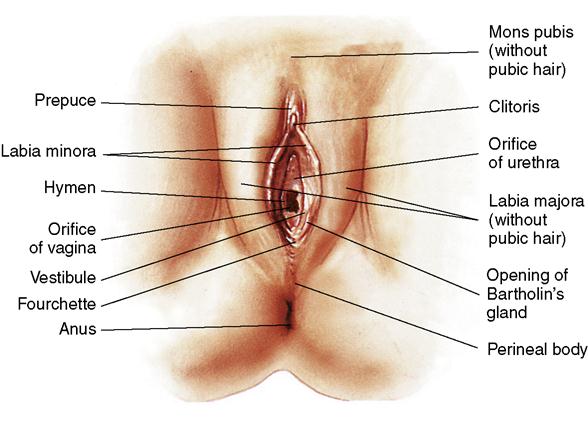
3. External Female Genitalia — Vulva
.png)
The external female genital structures are collectively called the vulva.
The vulva mainly includes the mons pubis, labia majora, labia minora, clitoris, vestibule, urethral opening, and vaginal opening.
4. Mons Pubis
Mons pubis is a rounded area of fatty tissue located over the pubic bone.
During puberty, hormonal changes lead to the development of pubic hair in this region.
Important:
Pubic hair is not itself a reproductive organ. It is an important secondary sexual characteristic that develops during puberty.
5. Pubic Hair and Its Development
During puberty, the effects of androgens and other hormonal changes stimulate hair growth in the pubic region.
The distribution and density of pubic hair naturally vary between individuals.
Pubic hair does not have a primary reproductive function. It is mainly a visible sign of secondary sexual development during puberty.
6. Labia Majora
Labia majora are the outer skin folds located on the lateral sides of the vulva.
Their major function is to provide protection to the more delicate external genital structures.
After puberty, pubic hair may develop on the outer portions of the labia majora.
7. Labia Minora
Labia minora are comparatively thin folds of tissue located inside the labia majora.
They help protect and surround structures within the vestibule, including the urethral and vaginal openings.
The size, shape, and pigmentation of the labia minora vary considerably between individuals, and such variation can be completely normal.
8. Clitoris
Clitoris is a highly sensory and erectile structure of the female external genitalia.
It contains a large number of sensory nerve endings and plays an important role in sexual sensation.
The clitoris is not limited to the small visible glans. It also contains internal erectile tissue that extends into the pelvis.
Important:
The primary role of the clitoris is related to sexual sensation. It should not be confused with either the urinary or reproductive passage.
9. Vestibule
The vaginal vestibule is the region between the labia minora.
It contains the urethral opening and vaginal opening.
Therefore, the openings of the urethra and vagina are anatomically separate structures.
10. Urethral Opening and Vaginal Opening
In the female external genital region:
- Urethral opening — the opening through which urine leaves the body.
- Vaginal opening — the external opening of the vaginal reproductive passage.
Therefore, these two openings have different functions.
11. Greater Vestibular Glands
Greater vestibular glands, also known as Bartholin’s glands, are located near the vaginal opening.
These glands produce secretions that contribute to lubrication around the vaginal entrance.
12. Hymen
The hymen is a thin fold of mucosal tissue that may surround or partially cover the vaginal opening.
Its shape and amount of tissue naturally vary between individuals. In some people, it may be minimally developed.
Very Important:
The appearance or condition of the hymen cannot be used to determine a person’s virginity. Hymenal anatomy naturally varies, and changes may occur for many reasons.
13. Internal Female Reproductive Organs
The major internal organs of the female reproductive system are:
Ovaries → Fallopian Tubes → Uterus → Cervix → Vagina

14. Ovaries
Ovaries are the female gonads. Normally, the female reproductive system contains two ovaries located on either side of the uterus.
The two major functions of the ovaries are:
- Development and maturation of oocytes
- Secretion of reproductive hormones
The ovaries play an important role in producing estrogen, progesterone, and other regulatory hormones.
15. Internal Structure of the Ovary
The ovary can broadly be divided into two regions:
- Cortex
- Medulla
The ovarian cortex contains developing ovarian follicles.
Each follicle contains a developing oocyte surrounded by follicular cells.
16. Ovarian Follicle
An ovarian follicle is a functional microscopic structure within the ovary that contains a developing oocyte.
During follicular development, follicular cells support and nourish the oocyte and also contribute to hormone production.
The major stages of follicular development include the primordial, primary, secondary, and mature/Graafian follicle stages.
17. Ovulation
When a secondary oocyte is released from a mature ovarian follicle, the process is called ovulation.
Ovulation occurs mainly in response to the LH surge.
LH Surge → Mature Follicle Rupture → Secondary Oocyte Release
18. Fallopian Tubes / Uterine Tubes
Fallopian tubes are paired tubes that extend from the uterus toward the ovaries.
Their major role is to receive and transport the oocyte after ovulation.
The major regions of the fallopian tube include:
- Infundibulum
- Fimbriae
- Ampulla
- Isthmus
Fimbriae
Fimbriae are finger-like projections near the distal end of the fallopian tube. After ovulation, they help guide the released oocyte into the uterine tube.
Ampulla
The ampulla is the relatively wider region of the fallopian tube and is generally the major site of human fertilisation.
19. Cilia and Oocyte Transport in the Fallopian Tube
Some epithelial cells lining the fallopian tube contain cilia.
Ciliary movement, together with smooth-muscle contractions, helps move the oocyte and later the early embryo toward the uterus.
20. Uterus
The uterus is a muscular, hollow organ located in the pelvic cavity.
During pregnancy, the embryo and fetus develop within the uterus.
The major regions of the uterus are:
- Fundus
- Body
- Isthmus
- Cervix
21. Layers of the Uterine Wall
The uterine wall is mainly described as having three layers:
| Layer | Characteristic |
|---|---|
| Perimetrium | The outer covering of the uterus. |
| Myometrium | The thick middle layer made mainly of smooth muscle. |
| Endometrium | The inner glandular lining that undergoes cyclic changes and provides the site for implantation. |
22. Endometrium
Endometrium is the innermost lining of the uterus. It undergoes continuous hormonal changes during the menstrual cycle.
After ovulation, progesterone helps the endometrium enter a more receptive state suitable for possible implantation.
If pregnancy is not established, the functional layer of the endometrium is shed as menstrual bleeding.
23. Myometrium
Myometrium is the thick smooth-muscle layer of the uterus.
It helps the uterus expand during pregnancy and produces strong rhythmic contractions during labour.
24. Cervix
Cervix is the lower, narrow portion of the uterus that connects the uterus to the vagina.
The cervix acts as an important gateway within the reproductive tract.
It contains cervical mucus whose consistency changes during different phases of the menstrual cycle under hormonal influence.
25. Vagina
Vagina is an elastic and muscular canal that connects the cervix with the external genital region.
Its major functions include:
- Allowing menstrual flow to leave the body
- Serving as a reproductive passage during penile-vaginal intercourse
- Serving as part of the birth canal during childbirth
26. Vagina and Vaginal Canal
The vaginal wall contains smooth muscle and connective tissue components. Its lining consists mainly of stratified squamous epithelium.
The natural microbial environment and acidic pH of the vagina help protect the reproductive tract from many potentially harmful microorganisms.
27. Support Structures of the Female Reproductive System
Several ligaments and connective-tissue structures help support and maintain the position of the internal reproductive organs.
Important examples include:
- Broad ligament
- Ovarian ligament
- Suspensory ligament of the ovary
- Round ligament of the uterus
The exact anatomical role of each structure differs, but together they contribute to the support and stabilization of the pelvic reproductive organs.
28. Female Reproductive Hormonal Control
The female reproductive system is mainly regulated by the Hypothalamus–Pituitary–Ovarian (HPO) axis.
Hypothalamus → GnRH → Anterior Pituitary → FSH + LH → Ovary → Estrogen + Progesterone
29. GnRH
GnRH (Gonadotropin-Releasing Hormone) is released by the hypothalamus.
It stimulates the anterior pituitary gland to release FSH and LH.
30. FSH
FSH (Follicle-Stimulating Hormone) plays an important role in the development and maturation of ovarian follicles.
Developing follicles contain granulosa cells that contribute to estrogen production.
31. LH
LH (Luteinizing Hormone) plays a critical role in ovulation.
A sudden and substantial increase in LH during the middle portion of the cycle is called the LH surge, which triggers ovulation.
After ovulation, the ruptured follicle develops into the corpus luteum.
32. Corpus Luteum
After ovulation, the remaining tissue of the ruptured follicle forms the corpus luteum.
The corpus luteum mainly produces progesterone along with some estrogen.
Progesterone plays an important role in maintaining the endometrium in a state suitable for possible implantation.
33. Estrogen
Estrogen is a major steroid hormone of the female reproductive system.
Its important roles include:
- Contributing to the development of the female reproductive tract
- Supporting the development of female secondary sexual characteristics
- Stimulating endometrial growth
- Participating in menstrual cycle regulation
- Contributing to bone health and other physiological functions
34. Progesterone
Progesterone is produced mainly by the corpus luteum after ovulation.
It plays an important role in maintaining the endometrium for implantation and supporting a pregnancy-compatible environment.
35. Menstrual Cycle
The menstrual cycle is a sequence of cyclical hormonal and structural changes occurring in the female reproductive system.
An average cycle is often described using a 28-day model, but individual cycles may be shorter or longer.
The major phases are:
- Menstrual phase
- Follicular phase
- Ovulation
- Luteal phase
36. Menstrual Phase
Day 1 of the cycle is counted as the first day of menstrual bleeding.
If pregnancy was not established during the previous cycle, estrogen and progesterone levels fall and the functional layer of the endometrium is shed.
37. Follicular Phase
During the follicular phase, ovarian follicles develop under the influence of FSH.
Estrogen production increases as the follicles develop. Estrogen stimulates the endometrium to proliferate again.
38. Ovulation Phase
Around the middle of the cycle, a secondary oocyte is released from a mature ovarian follicle.
LH Surge → Ovulation → Secondary Oocyte Release
39. Luteal Phase
After ovulation, the corpus luteum forms and produces progesterone along with some estrogen.
Progesterone helps maintain the endometrium in a secretory and implantation-supportive state.
If fertilisation and successful implantation do not occur, the corpus luteum degenerates, hormone levels decline, and the next menstrual cycle begins.
40. Oogenesis — Female Gamete Formation
Oogenesis is the process through which female germ cells develop toward mature oocytes.
Unlike males, a major part of female oocyte development begins before birth.
After puberty, a group of ovarian follicles begins developing during each menstrual cycle, and normally one dominant follicle reaches ovulation.
41. Primary Oocyte and Secondary Oocyte
During oogenesis, developing female germ cells undergo meiotic divisions.
At ovulation, the cell normally released from the ovary is a secondary oocyte.
Exam Point:
The cell released during ovulation is more accurately called a secondary oocyte, rather than a fully mature ovum.
42. Fertile Window
The probability of pregnancy is generally higher around the time of ovulation.
This is because sperm can survive for some time within the female reproductive tract, while the released oocyte remains fertilisable for a limited period.
Therefore, the fertile window is not limited to the exact day of ovulation.
43. Coitus — Biological Perspective
Coitus refers to penile-vaginal intercourse. In the context of reproduction, its biological importance is that sperm contained in semen may be deposited into the female reproductive tract.
Coitus → Semen deposited in vagina → Sperm travel through cervix → Uterus → Fallopian tube → Possible fertilisation
Not every episode of coitus results in pregnancy. Pregnancy requires viable sperm to reach the reproductive tract, a viable oocyte to be available around ovulation, and successful fertilisation and implantation.
44. Sexual Arousal and the Female Body
Sexual arousal is not limited to the reproductive organs. It can involve the brain, nervous system, blood vessels, hormones, sensory pathways, and psychological factors.
During arousal, genital tissues may experience increased blood flow. The clitoral erectile tissue and other genital tissues can undergo vascular changes.
Vaginal lubrication can also occur as a physiological response associated with sexual arousal.
45. Sexual Feelings and Emotions
Sexual feelings and emotions are not determined by hormones alone. They can be influenced by many factors, including:
- Emotional state
- Stress and anxiety
- Relationship quality
- Trust and emotional safety
- Personal experiences
- Hormonal changes
- Sleep and overall health
- Individual preferences
- Social and cultural environment
Therefore, sexual responses can vary significantly between individuals and situations.
46. Normal Physiological Changes During Sexual Arousal
Sexual arousal can produce changes in the nervous and vascular systems.
- Increased genital blood flow
- Engorgement of clitoral erectile tissue
- Increased vaginal lubrication
- Increased heart rate and breathing rate
- Increased muscle tension
- Increased sensory sensitivity
47. Female Sexual Response
Traditional physiology describes sexual response using several phases, including arousal, plateau, orgasm, and resolution.
However, actual human sexual responses do not always follow a fixed sequence. Intensity, duration, and order can vary between individuals.
48. Orgasm
Orgasm is a physiological response associated with intense sexual pleasure. It may involve rhythmic pelvic muscle contractions and changes in autonomic nervous-system activity.
The brain and sensory nervous system play important roles in the orgasmic response.
Orgasm is not required for reproduction. Fertilisation requires sperm and oocyte interaction; female orgasm is not a compulsory biological requirement for pregnancy.
49. Resolution Phase
After sexual stimulation decreases, the body gradually returns toward its resting physiological state.
Heart rate, breathing, and vascular changes gradually return toward baseline.
Female sexual response does not necessarily involve a universally fixed refractory period, and individual responses can vary considerably.
50. Sexual Consent
One of the most important principles of sexual health:
Any sexual activity requires the free, informed, and voluntary consent of everyone involved.
Consent can be withdrawn at any time. Silence, pressure, fear, or coercion should not be treated as consent.
51. Female Reproductive System and Pregnancy
Ovulation → Fertilisation → Early Embryo → Transport to Uterus → Implantation → Embryonic Development → Fetal Development → Childbirth
The most important feature of the female reproductive system is that it is not limited to gamete production. It is also specialised to support the developing embryo and fetus after fertilisation.
52. Implantation
If fertilisation occurs, the resulting early embryo travels from the fallopian tube toward the uterus.
After reaching the uterus, the developing embryo can attach to and become established within the endometrium. This process is called implantation.
After implantation, a pregnancy-supporting hormonal environment is maintained and placental development begins.
53. Female Reproductive System and Childbirth
During pregnancy, the uterus supports the developing fetus. Near the end of pregnancy, hormonal and physiological signals contribute to the initiation of labour.
Rhythmic contractions of the myometrium are important for cervical dilation and movement of the fetus toward and through the birth canal.
54. Functions of Different Organs
| Organ / Structure | Main Function |
|---|---|
| Ovary | Oocyte development and reproductive hormone production |
| Fallopian tube | Oocyte transport and major site of fertilisation |
| Uterus | Implantation and fetal development |
| Endometrium | Cyclic preparation for implantation |
| Myometrium | Uterine contractions |
| Cervix | Gateway between the uterus and vagina |
| Vagina | Reproductive passage, menstrual passage, and part of the birth canal |
| Clitoris | Sexual sensation |
| Labia | Protection of external genital structures |
| Greater vestibular glands | Lubricating secretions |
55. Complete Flow of the Female Reproductive System
Ovary
↓
Follicle Development
↓
Ovulation
↓
Secondary Oocyte
↓
Fallopian Tube
↓
Possible Fertilisation
↓
Early Embryo
↓
Uterus
↓
Implantation
↓
Pregnancy
56. Female Reproductive Development During Puberty
During puberty, the Hypothalamus–Pituitary–Ovarian axis becomes active. GnRH, FSH, and LH activity increases, and the ovaries begin producing hormones such as estrogen and progesterone.
As a result, the reproductive organs mature and secondary sexual characteristics develop.
- Breast development
- Pubic hair growth
- Axillary hair growth
- Changes in body composition
- Beginning of menstrual cycles
- Maturation of reproductive organs
57. Menarche
The first menstrual bleeding is called menarche. It is an important milestone of reproductive maturation during puberty.
During the first few years, menstrual cycles may be irregular because the HPO axis is still undergoing maturation.
58. Menopause
When ovarian follicular activity and reproductive hormone production decline permanently and menstrual periods permanently stop, the condition is called menopause.
After menopause, natural ovulation stops and natural pregnancy is no longer possible.
59. High-Yield Revision
- Female gonads = Ovaries
- Female gamete released during ovulation = Secondary oocyte
- Ovulation trigger = LH surge
- Major site of fertilisation = Ampulla of the fallopian tube
- Site of implantation = Endometrium
- Uterine muscle = Myometrium
- Inner uterine lining = Endometrium
- Lower portion of uterus = Cervix
- External female genitalia collectively = Vulva
- Main sensory sexual structure = Clitoris
- Pubic hair = Secondary sexual characteristic
- Follicle development = FSH
- Ovulation = LH surge
- Major post-ovulation hormone = Progesterone
- Menstrual cycle regulation = GnRH → FSH/LH → Ovarian hormones
60. One-Minute Concept Map
Female Reproductive System
External:
Vulva → Mons pubis → Labia → Clitoris → Vestibule
Internal:
Ovaries → Fallopian tubes → Uterus → Cervix → Vagina
Hormonal control:
GnRH → FSH + LH → Ovary → Estrogen + Progesterone
Reproductive sequence:
Follicle development → Ovulation → Fertilisation → Implantation → Pregnancy
61. Frequently Asked Questions
Q1. What is the main organ of the female reproductive system?
It is not appropriate to identify a single organ as the main organ. The ovaries, fallopian tubes, uterus, cervix, and vagina collectively form the major internal reproductive organs.
Q2. Where are female gametes formed?
Female germ cells develop in the ovaries. During ovulation, a secondary oocyte is normally released.
Q3. Where does fertilisation occur?
The major site of human fertilisation is the ampulla of the fallopian tube.
Q4. Which hormone triggers ovulation?
The LH surge triggers ovulation.
Q5. What is the inner lining of the uterus called?
The inner lining of the uterus is called the endometrium.
Q6. What are the external female genitalia collectively called?
The external female genital structures are collectively called the vulva.
Q7. When does pubic hair develop?
Pubic hair develops during puberty as a result of hormonal changes. It is a secondary sexual characteristic.
Q8. Are sexual feelings caused only by hormones?
No. Sexual feelings and arousal can involve the brain, nervous system, hormones, blood flow, emotions, relationship factors, stress, and individual psychology.
Q9. Is orgasm necessary for pregnancy?
No. Fertilisation is required for pregnancy, but female orgasm is not a compulsory biological requirement for pregnancy.
Q10. Does every episode of coitus result in pregnancy?
No. Pregnancy requires viable sperm to reach the reproductive tract, availability of a viable oocyte around ovulation, successful fertilisation, and subsequent implantation.
62. Final Takeaway
The Female Reproductive System is not simply a system for producing eggs. It is a highly coordinated system in which the ovaries, fallopian tubes, uterus, cervix, vagina, and external genital structures work together to support reproduction.
Ovarian follicles develop within the ovary. Following the LH surge, ovulation occurs and a secondary oocyte is released into the fallopian tube. If fertilisation occurs, an early embryo develops and travels toward the uterus, where it may implant in the endometrium.
During puberty, reproductive organs mature and secondary sexual characteristics such as pubic hair, breast development, and other body changes appear. Sexual arousal and emotional responses involve not only reproductive organs but also the brain, nervous system, hormones, and psychological factors.
Golden Line:
Ovary → Oocyte
Fallopian Tube → Transport + Fertilisation
Uterus → Implantation + Fetal Development
Cervix → Gateway between Uterus and Vagina
Vagina → Reproductive Passage + Birth Canal
Vulva → External Female Genitalia
Clitoris → Sexual Sensation
FSH → Follicle Development
LH Surge → Ovulation
Progesterone → Endometrium Maintenance
Female Reproductive System — Visual Gallery
Explore these anatomical reference images to understand the structure and organization of the female reproductive system.


Ratings & Reviews
Share your experience and help other students.
Please log in to your SoloTutes account to rate and review this resource.
No reviews yet. Be the first to share your feedback.
Categorized Under:
Ready for More?
Test your knowledge with these related materials.



📺 Watch & Learn
Visual explanations and related video classes for better understanding.
🎥 Video Resources
Female reproductive system | Reproduction | Biology class 10 | Khan Academy
Female reproductive system | Reproduction | Biology class 10 | Khan Academy

Female Reproductive System | Infinity Learn NEET

Female reproductive system in Hindi | external genitalia Area | Internal genitalia area | Functions
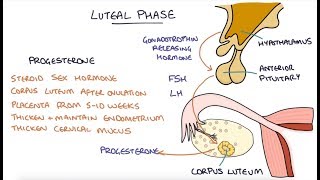
Understanding the Menstrual Cycle

Female Reproductive System - Menstrual Cycle, Hormones and Regulation

Menstrual Cycle Walkthrough: Phases & Hormonal Regulation
💬 Discuss this Topic
Have a doubt or want to share something? Drop a comment below!
0 Discussion(s)
You must be logged in to join the discussion.