
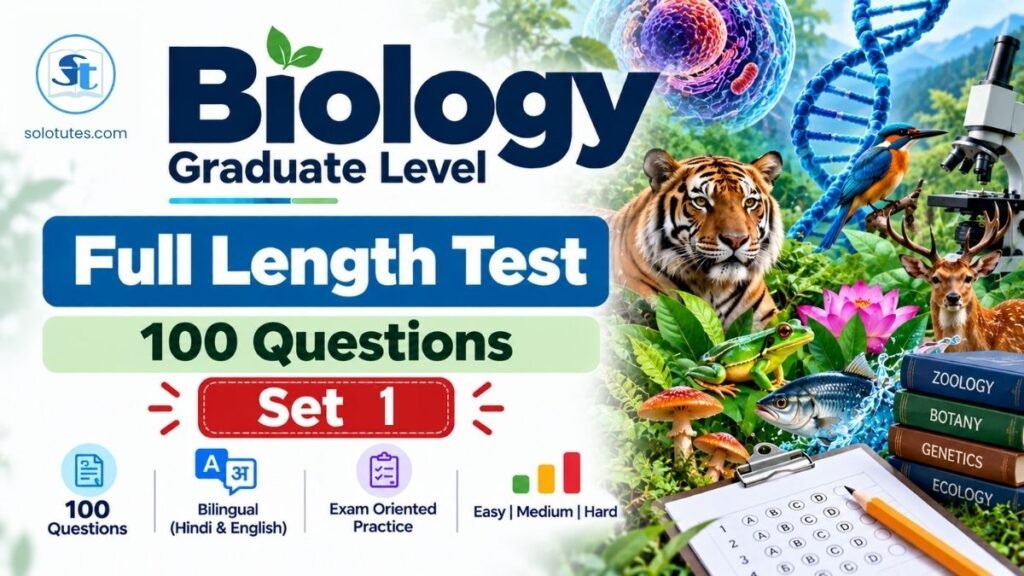
Biology Practice Test 29 – Complete Syllabus Full Length (SET 1/2)
Practice Mode
Solve instantly below. Get immediate feedback and detailed explanations without any timer.
Start Practice ↓Full Exam Mode
Take this test in a strict timed environment with negative marking and detailed analytics.
Take Assessment →🔒 Premium Assessment Locked
This test is part of a premium package. Unlock it to access practice questions, detailed explanations, and full exam mode.
Login to UnlockBiology Graduate Level (Unit Wise)
This test is part of a larger series. Explore other tests in this bundle.
-
Biology Practice Test 29 – Complete Syllabus Full Length (SET 1/2)Coming Soon
-
Biology Practice Test 30 – Complete Syllabus Full Length (SET 2/2)Coming Soon
About this Assessment
Complete Biology Full-Length Practice Test 1 (Advanced B.Sc. Standard)
Accelerate your competitive exam preparation with our Complete Biology Full-Length Mock Test 1. Carefully curated for aspirants of prestigious exams like State Lab Assistant, Forest Inspector, and Agriculture Department exams, this premium test strictly adheres to the university-level B.Sc. syllabus (IGNOU/UOU standards).
To provide a highly organized test-taking experience, we have strategically compressed and mapped the complete 7 Units of the official Biology syllabus into 4 comprehensive sections (25 Questions each). Here is exactly what you will find inside this 100-question test:
Section 1: Cell Biology, Genetics, Molecular Biology & Evolution
(Covers original syllabus units dedicated to Cytology, Heredity, and Evolutionary Biology)
- Cell Biology: Structure and functions of cell organelles (Mitochondria, Chloroplast, ER, Ribosomes), Cell membrane models, and phases of the Cell Cycle (Mitosis & Meiosis).
- Genetics: Mendelian inheritance, Non-Mendelian interactions (Epistasis, Pleiotropy), Linkage, Crossing over, Sex-linked inheritance, and Chromosomal aberrations (Down, Turner, Klinefelter syndromes).
- Molecular Biology: DNA replication mechanisms, Transcription, Translation, Genetic Code, and Operon models.
- Evolution: Origin of life (Miller-Urey), Theories of evolution (Lamarckism, Darwinism), Genetic drift, Hardy-Weinberg equilibrium, and Speciation.
Section 2: Diversity of Life & Taxonomy (Botany & Zoology)
(Covers original syllabus units dedicated to Plant and Animal Diversity)
- Plant Taxonomy: Classification from Algae, Fungi, and Bryophytes to Pteridophytes, Gymnosperms, and Angiosperms. Includes ICBN rules, inflorescence types, and diagnostic features of major families (Fabaceae, Asteraceae, Brassicaceae, etc.).
- Animal Taxonomy: Comprehensive classification of Non-Chordates (Porifera to Echinodermata) and Chordates. Covers symmetry, coelom types, unique larval forms, and specialized organs (like nematocysts, malpighian tubules).
Section 3: Plant & Animal Physiology and Biochemistry
(Covers original syllabus unit 5 and Biochemistry modules)
- Plant Physiology: Water relations (Osmosis, Water potential), Ascent of sap, Transpiration, Photosynthesis (C3, C4, CAM pathways), Respiration (Glycolysis, Krebs cycle), and Phytohormones (Auxins, Gibberellins, Cytokinins).
- Animal Physiology: Mechanisms of Digestion, Respiratory gas exchange (Bohr/Haldane effects), Blood circulation & cardiac cycle, Excretory systems (Nephron function, Urine formation), and Neural/Endocrine coordination.
- Biochemistry: Structure of Biomolecules (Proteins, Carbohydrates, Lipids) and Enzyme kinetics (Michaelis-Menten, Inhibition).
Section 4: Ecology, Embryology & Applied Biology
(Covers original syllabus units dedicated to Environmental Science, Developmental Biology, and Biotech)
- Ecology: Ecosystem structure, Ecological pyramids, Food chains, Population dynamics (Carrying capacity, r/K selection), Ecological succession, and Environmental pollution (Acid rain, Biomagnification).
- Developmental Biology (Embryology): Gametogenesis, Fertilization, Cleavage patterns, Gastrulation morphogenetic movements, Extraembryonic membranes, and Placentation.
- Applied Biology & Biotechnology: Recombinant DNA technology, Restriction enzymes, Cloning vectors (Plasmids, Ti plasmid), PCR, Bioremediation, and economic biology (Apiculture, Sericulture).
Key Features of this Test:
- Includes varied question formats: Direct Conceptual MCQs, Match the Following, Assertion-Reason, and “Find the Incorrect Statement”.
- Features standard Image-based practical questions to test visual and analytical memory.
- Provided with detailed bilingual explanations (English & authentic academic Hindi) for every single question to clear your doubts instantly.

Categorized Under
💬 Discuss this Topic
Have a doubt or want to share something? Drop a comment below!
Related Similar Tests
Organisms and Populations : Biology (Class 12th) Revision Test |…
📅 May 17, 2022 4.8k views
Biomolecules : Biology Revision Test (Class 11th) | MCQs for…
📅 May 8, 2022 6.3k views
Biology Practice Test 1 – Unit 1 (Cell Biology &…
📅 September 19, 2026 196 views
Human health and Disease : class 12th biology practice test…
📅 May 11, 2022 5.3k views
Ready to Practice More?
Explore notes, one-liners, and other materials related to this topic.
 one_liner
NCERT Class 11 Biology Chapter 1 One-Liners – The Living…
 note
note
Fat Soluble Vitamins: Vitamin A, D, E, And K
 one_liner
100 Biology Questions: Plant Physiology and Taxonomy | Botany One…
Biology Revision Set 7 – Taxonomy, Systematics & Evolution –…
📺 Watch & Learn
Visual explanations and related video classes.
🎥 Video Resources
How to complete Whole Syllabus in one Week!! 📚🏫 #study #exam #motivation #studytips #starbean

How to complete Whole Syllabus in one Week!! 📚🏫 #study #exam #motivation #studytips #starbean

How to study Biology? 🧬 🧪

How to Finish Your Exams Faster

Cbse English Paper Extra Sheet Bardeya#viralgirl#cbse#lkgukgpaper#sstpaper#shorts#exam#school#study

How to study 1 day before Exams📚 ||#starbean #study #fypシ゚#exams #aesthetic #imyours #yesstyle

How to get A+ in Math exams
0 Discussion(s)
You must be logged in to join the discussion.