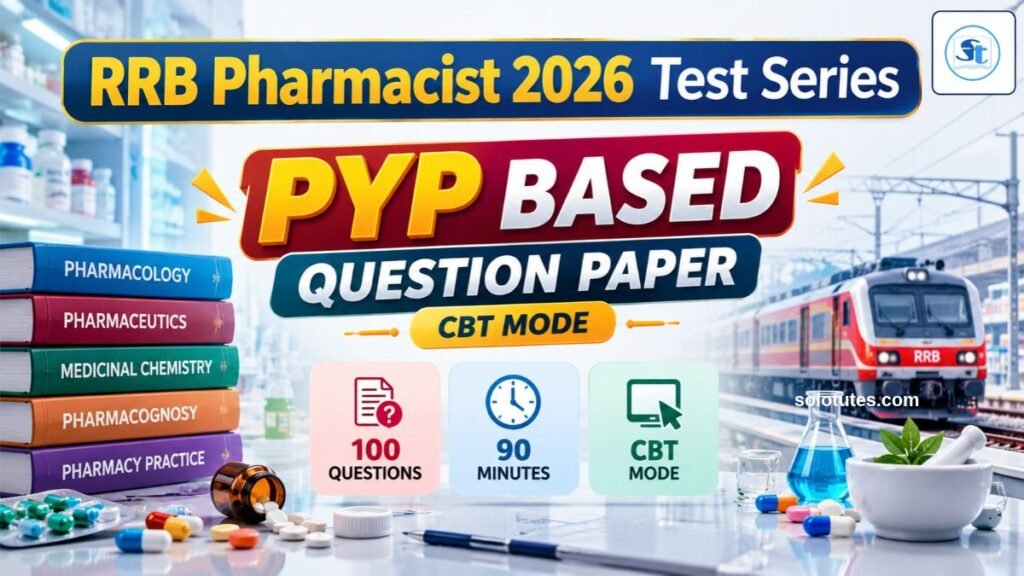
Smart Online Assessments For Serious Exam Preparation
Start Assessment ➔

What do you want to learn today?

RRB Pharmacist PYQ Special Mock Test: From Official PYPs

RRB Pharmacist PYQ Special Mock Test: From Official PYPs

Diksha Bhatla October 28, 2026 51 views 100 Questions
Download PDF
🎯 Practice: Earn +4 Pts for right answers, auto-save wrong ones (-1 Pt) to your Mistake Bank & unlock +50 Daily Bonus! Login to Track Streak →
⚡

Practice Mode (+4 / -1 Pts)

Solve instantly below with live points (+4 Right, -1 Wrong), detailed explanations & Mistake Bank sync.

Start Practice ↓
🎯

Full Exam Mode

Take this test in a strict timed environment with negative marking and detailed analytics.

Take Assessment →
- Advertisement -
Guest User
Score 0 / 100
Pts 0
Q1. The volume of blood pumped out by each ventricle of the heart per minute is clinically defined as:
Q2. Which of the following cellular components in the nervous system is directly responsible for generating the protective myelin sheath around peripheral neuronal axons?
Q3. A patient in the trauma unit sustains a blunt injury to the spinal cord. At which vertebral level does the spinal cord typically terminate as the conus medullaris in a normal adult?
Q4. According to the British and Indian Pharmacopoeias, the term 'Very Slightly Soluble' refers to a substance requiring how many parts of solvent to dissolve 1 part of solute?
Q5. In the formulation of pharmaceutical suspensions, the primary driving force responsible for the undesirable growth of large crystals at the expense of smaller particles upon storage is termed:
Q6. Match List-I (Dosage Form / Packaging) with List-II (Specific Quality Control Apparatus):
List-I
A. Tablet Friability
B. Tablet Disintegration
C. Suppository Hardness
D. Parenteral Particulate Matter
List-II
1. Basket-rack assembly in 37 degrees water bath
2. Roche drum revolving at 25 rpm
3. Light obscuration / microscopic particle counter
4. Krowczynski fracture penetration tester
Q7. Which specific type of glass container is officially specified by the Pharmacopoeia as being treated by sulfur dioxide (SO2) dealkalization to reduce surface alkali release?
Q8. What is the primary pharmacological antidote administered intravenously to counteract life-threatening cardiac dysrhythmias and seizures caused by Tricyclic Antidepressant (TCA) toxicity?
Q9. A patient receiving chronic treatment for leprosy develops acute hemolytic anemia, dark-colored urine, and cyanosis due to methemoglobinemia. Which antileprotic drug is primarily associated with this adverse effect?
Q10. Which of the following antianginal medications works selectively by inhibiting the late inward sodium current (I_Na-late) in ischemic myocardial cells without reducing heart rate or arterial blood pressure?
Q11. Match List-I (Pharmacological Drug) with List-II (Specific Structural Receptor / Target Site):
List-I
A. Montelukast
B. Ondansetron
C. Finasteride
D. Sildenafil
List-II
1. 5-alpha-reductase enzyme
2. Phosphodiesterase type-5 (PDE-5)
3. Cysteinyl leukotriene-1 (CysLT1) receptor
4. Serotonin 5-HT3 receptor
Q12. A 45-year-old male with chronic asthma is initiated on Theophylline. Serum therapeutic drug monitoring (TDM) is ordered. What is the standard therapeutic reference window for serum theophylline concentrations in adults?
Q13. In the structural chemistry of penicillins, the bicyclic core nucleus (6-aminopenicillanic acid, 6-APA) is biosynthetically composed of which two condensed amino acids?
Q14. What is the systematic IUPAC chemical name for the loop diuretic medication Furosemide?
Q15. In the compendial Limit Test for Heavy Metals according to the Indian Pharmacopoeia, which reagent generates the standard brown coloration for visual comparative evaluation against lead sulfide?
Q16. Match List-I (Inorganic Pharmaceutical Compound) with List-II (Clinical / Diagnostic Utility):
List-I
A. Barium Sulfate
B. Sodium Nitroprusside
C. Potassium Permanganate
D. Ferrous Fumarate
List-II
1. Potent peripheral vasodilator in hypertensive emergencies
2. Antiseptic and astringent oxidizing agent
3. Oral hematinic for iron deficiency anemia
4. Insoluble radiopaque contrast agent for GI tract fluoroscopy
Q17. Which diagnostic microscopic characteristic is pathognomonic for identifying powdered Ephedra (Ephedra sinica) stems in Pharmacognosy?
Q18. What is the specific diagnostic histochemical color reaction produced when powdered Nux-Vomica (Strychnos nux-vomica) seeds are treated with concentrated Nitric Acid?
Q19. Match List-I (Phytochemical Secondary Metabolite) with List-II (Biological Plant Source):
List-I
A. Sennosides A and B
B. Vincristine and Vinblastine
C. Quinine and Quinidine
D. Diosgenin
List-II
1. Catharanthus roseus (Vinca)
2. Cinchona succirubra
3. Cassia angustifolia (Senna)
4. Dioscorea deltoidea (Wild Yam)
Q20. The non-enzymatic condensation of unesterified reducing sugars with amino acids in solid dosage forms, which results in tablet discoloration and mottling, is termed the:
Q21. Under the Drugs and Cosmetics Act 1940, what is the statutory minimum duration of practical experience required for an individual to be officially appointed as a Government Analyst?
Q22. Under the Pharmacy Act 1948, how many members are elected by the University Grants Commission (UGC) from among the teaching staff of Indian pharmacy colleges to serve on the Pharmacy Council of India (PCI)?
Q23. Match List-I (Statutory Form under D&C Rules 1945) with List-II (Regulatory Purpose / Document):
List-I
A. Form 13
B. Form 15
C. Form 17
D. Form 20
List-II
1. Notice from Drug Inspector for seizing physical drug stocks
2. Report of result of test or analysis issued by the Government Analyst
3. License to sell, stock, or distribute drugs other than Schedule C/C1/X by retail
4. Official memorandum accompanying drug sample dispatched to Government Analyst
Q24. In hospital clinical biochemistry, which specific isoenzyme of Creatine Kinase (CK) is localized primarily within cardiac myocytes and is routinely evaluated during suspected acute myocardial infarction?
Q25. In routine clinical urinalysis, what is the principle of Rothera's test used to detect pathological ketone bodies in urine?
Q26. Which chromatographic term quantifies the degree of peak asymmetry calculated as the distance from the peak midpoint to the trailing edge divided by the distance to the leading edge at 10% of total peak height?
Q27. In complexometric titrimetry using Disodium Edetate (EDTA), which metal-ion indicator is utilized to identify the stoichiometric equivalence point during the volumetric determination of water hardness?
Q28. What is the clinical role of the Pharmacy and Therapeutics Committee (PTC) regarding the institutional management of Adverse Drug Reactions (ADRs)?
Q29. In hospital inventory management, what does the VED classification system categorize pharmaceuticals based upon?
Q30. According to the Economic Order Quantity (EOQ) model, what happens to total annual order placement costs when the individual order lot size is increased?
Q31. Reserpine, an antihypertensive and tranquilizing alkaloid, is extracted from the roots of:
Q32. The active antineoplastic alkaloids Vincristine and Vinblastine are obtained from which plant?
Q33. Mayer's reagent, widely used in qualitative alkaloid detection, chemically consists of:
Q34. Dragendorff's reagent for alkaloid identification yields which characteristic precipitate color?
Q35. Eugenol is the principal volatile oil constituent present in which crude spice drug?
Q36. Which heterocyclic ring system is present in the chemical nucleus of Pyridine?
Q37. What is the primary mechanism of action of Penicillin antibiotics against susceptible bacteria?
Q38. Which adverse effect is notoriously associated with Aminoglycoside antibiotics like Gentamicin and Streptomycin?
Q39. Peripheral neuropathy induced by long-term Isoniazid (INH) anti-tubercular therapy is prevented by co-administering:
Q40. Tendonitis and tendon rupture (especially Achilles tendon) is a rare black-box warning adverse effect associated with:
Q41. The antimalarial drug Artemisinin is chemically classified as a:
Q42. Organophosphate poisoning management requires immediate administration of which specific antimuscarinic drug?
Q43. Digitalis toxicity is aggravated by which electrolyte imbalance in cardiac patients?
Q44. Sublingual administration of Nitroglycerin in acute angina pectoris is preferred primarily because it:
Q45. Which drug is co-administered with Levodopa in Parkinson's disease to inhibit peripheral dopa-decarboxylase?
Q46. Morphine overdose causes severe respiratory depression, pinpoint pupils, and coma. Which specific pure antagonist is indicated?
Q47. Under the Drugs and Cosmetics Rules 1945, Schedule H1 was introduced to curb misuse of:
Q48. Schedule X under Drugs and Cosmetics Rules 1945 mandates special storage and licensing for which category of drugs?
Q49. Pharmacy Council of India (PCI) is constituted by the Central Government every how many years under the Pharmacy Act 1948?
Q50. In hospital inventory management, VED analysis categorizes pharmaceutical stock on the basis of:
Q51. In ABC inventory classification, 'Category A' items typically represent:
Q52. The displacement value of a medicinal substance in suppository formulation is defined as:
Q53. The HLB (Hydrophilic-Lipophilic Balance) value range for water-in-oil (W/O) emulsifying agents is typically:
Q54. What is the primary diagnostic laboratory test used to monitor oral Warfarin anticoagulant therapy?
Q55. What is the primary laboratory test utilized to monitor unfractionated Heparin therapy?
Q56. Which drug is the specific pharmacological antidote for unfractionated Heparin overdose?
Q57. The diagnostic conversion factor between Glycated Hemoglobin (HbA1c) and diabetes diagnosis is an HbA1c level of:
Q58. The red color complex formed in Jaffe's reaction for creatinine estimation is due to the reaction of creatinine with:
Q59. In complexometric titrations with Disodium EDTA, which metal-ion indicator is commonly used for determining calcium/magnesium hardness?
Q60. In Thin Layer Chromatography (TLC), the Retardation factor (Rf) is defined as:
Q61. Which vitamin is chemically known as Cyanocobalamin and contains a cobalt atom?
Q62. Deficiency of Vitamin B1 (Thiamine) leads to which classic nutritional deficiency disease?
Q63. Pellagra is characterized by dermatitis, diarrhea, and dementia caused by severe dietary deficiency of:
Q64. Which heterocyclic system is present in the chemical structure of Histamine?
Q65. The primary physiological pacemaker of the human heart is the:
Q66. How many pairs of cranial nerves originate from the human brain and brainstem?
Q67. Which hormone is synthesized by the beta-cells of the islets of Langerhans in the pancreas?
Q68. The basic functional microscopic filtration unit of the human kidney is the:
Q69. Which cranial nerve (CN X) is the longest and provides extensive parasympathetic autonomic innervation to thoracic and abdominal viscera?
Q70. Which drug schedule under Drugs & Cosmetics Rules 1945 specifies life periods and expiry dates of pharmaceutical products?
Q71. Narora Atomic Nuclear Power Station is located in which Indian State? /नरोरा परमाणु ऊर्जा संयंत्र किस भारतीय राज्य में स्थित है?
Q72. Which of the following elemental molecules exists naturally in homonuclear diatomic form? /निम्नलिखित में से कौन-सा तात्विक अणु प्राकृतिक रूप से समनाभिकीय द्विपरमाण्विक (diatomic) रूप में मौजूद होता है?
Q73. Chemical bleaching powder commonly used for water disinfection is represented by: /जल शोधन और विसंक्रमण के लिए आमतौर पर उपयोग किया जाने वाला रासायनिक विरंजक चूर्ण (ब्लीचिंग पाउडर) किस सूत्र द्वारा दर्शाया जाता है?
Q74. A train travels at 35 km/h for a distance and 40 km/h on return. If time difference is 36 mins, find the distance. /एक रेलगाड़ी किसी दूरी को तय करते समय 35 किमी/घंटा और वापसी में 40 किमी/घंटा की गति से चलती है। यदि दोनों यात्राओं के समय में 36 मिनट का अंतर है, तो वह दूरी ज्ञात कीजिए।
Q75. Which State topped the overall medal tally in the Khelo India Youth Games 2019? /खेलो इंडिया यूथ गेम्स 2019 की समग्र पदक तालिका में किस राज्य ने शीर्ष स्थान प्राप्त किया था?
Q76. What is the SI unit of power? /शक्ति का अंतर्राष्ट्रीय (SI) मात्रक क्या है?
Q77. Sound waves cannot travel through which of the following media? /ध्वनि तरंगें निम्नलिखित में से किस माध्यम में यात्रा नहीं कर सकती हैं?
Q78. Which gas is liberated when an active metal reacts with dilute hydrochloric acid? /जब कोई सक्रिय धातु तनु हाइड्रोक्लोरिक अम्ल के साथ अभिक्रिया करती है, तो कौन-सी गैस मुक्त होती है?
Q79. Find the missing number in the series: 4, 9, 25, 49, 121, ? /दी गई शृंखला में अगला लुप्त पद ज्ञात कीजिए: 4, 9, 25, 49, 121, ?
Q80. If A is the brother of B, B is the sister of C, and C is the father of D, how is A related to D? /यदि A, B का भाई है; B, C की बहन है; और C, D का पिता है, तो A का D से क्या संबंध है?
Q81. The Constitution of India was adopted by the Constituent Assembly on: /संविधान सभा द्वारा भारत के संविधान को किस तिथि को अंगीकृत (adopt) किया गया था?
Q82. What is the value of 15% of 60% of 2000? /2000 के 60% का 15% कितना होगा?
Q83. Who is known as the 'Father of Indian Railways'? /'भारतीय रेलवे का जनक' किसे कहा जाता है?
Q84. The process of conversion of solid directly into vapor without passing through liquid state is: /किसी ठोस पदार्थ के बिना द्रव अवस्था में बदले सीधे वाष्प में परिवर्तित होने की प्रक्रिया क्या कहलाती है?
Q85. If '+' means multiplication, '-' means division, '*' means addition, evaluate: 20 + 5 * 10 - 2: /यदि '+' का अर्थ गुणा, '-' का अर्थ भाग, '*' का अर्थ जोड़ है, तो 20 + 5 * 10 - 2 का मान ज्ञात कीजिए:
Q86. The tropic of cancer does NOT pass through which of the following Indian states? /कर्क रेखा निम्नलिखित में से किस भारतीय राज्य से होकर नहीं गुजरती है?
Q87. In an examination, 35% students failed in Mathematics and 45% failed in English. If 20% failed in both, find percentage passed in both. /एक परीक्षा में 35% छात्र गणित में अनुत्तीर्ण हुए और 45% छात्र अंग्रेजी में अनुत्तीर्ण हुए। यदि 20% छात्र दोनों में अनुत्तीर्ण हुए, तो दोनों विषयों में उत्तीर्ण होने वाले छात्रों का प्रतिशत क्या है?
Q88. Which cell organelle is known as the 'Powerhouse of the Cell'? /किस कोशिकांग को 'कोशिका का शक्तिगृह' (पावरहाउस) कहा जाता है?
Q89. Sucrose, or common table sugar, is a disaccharide composed of: /सुक्रोज (सामान्य घरेलू चीनी) एक डाइसैकराइड है जो किन दो मोनोसैकराइड इकाइयों से बना होता है?
Q90. Ayushman Bharat - Pradhan Mantri Jan Arogya Yojana (PM-JAY) provides health coverage up to how much per family per year? /आयुष्मान भारत - प्रधानमंत्री जन आरोग्य योजना (PM-JAY) के तहत प्रत्येक पात्र परिवार को प्रति वर्ष कितना कैशलेस स्वास्थ्य बीमा कवरेज प्रदान किया जाता है?
Q91. The speed of light in vacuum is approximately equal to: /निर्वात में प्रकाश की चाल लगभग किसके बराबर होती है?
Q92. What is the chemical name of Vitamin C? /विटामिन सी (Vitamin C) का रासायनिक नाम क्या है?
Q93. The simple interest on Rs. 5000 for 3 years at 10% per annum is: /5000 रुपये की धनराशि पर 10% वार्षिक दर से 3 वर्ष का साधारण ब्याज क्या होगा?
Q94. Point out the odd one out: 64, 125, 216, 343, 512, 729, 1000: /दी गई संख्याओं में से विषम संख्या (Odd one out) का चयन कीजिए: 64, 125, 216, 343, 512, 729, 1000:
Q95. Who is the ex-officio Chairman of the Rajya Sabha in India? /भारत में राज्य सभा का पदेन सभापति कौन होता है?
Q96. The pH of human arterial blood is normally maintained between: /मानव धमनीय रक्त का pH मान सामान्यतः किस सीमा के मध्य नियंत्रित रहता है?
Q97. If a car travels a distance of 180 km in 3 hours, its speed in meters per second (m/s) is: /यदि कोई कार 3 घंटे में 180 किमी की दूरी तय करती है, तो उसकी चाल मीटर प्रति सेकंड (m/s) में क्या होगी?
Q98. Which organ is primarily responsible for the production of Bile in the human digestive system? /मानव पाचन तंत्र में पित्त (Bile) का निर्माण मुख्य रूप से किस अंग द्वारा किया जाता है?
Q99. Sound travels fastest through which of the following states of matter? /ध्वनि पदार्थ की किस अवस्था में सबसे तीव्र गति से गमन करती है?
Q100. The headquarters of the Indian Railway Catering and Tourism Corporation (IRCTC) is situated in: /इंडियन रेलवे कैटरिंग एंड टूरिज्म कॉरपोरेशन (IRCTC) का मुख्यालय कहाँ स्थित है?
RRB Pharmacist 2026 34 tests in this series · Click to view included tests ₹149₹299
Prepare systematically for the Railway Recruitment Board (RRB) Pharmacist (Entry Grade) Computer Based Test (CEN 05/2026) with our structured 37-test series. Designed strictly according to the latest official RRB syllabus and exam pattern (100 Questions, 90 Minutes, 1/3rd negative marking), this series includes 28 Chapter-Wise Technical Tests, 4 Non-Technical Tests (Bilingual), and 5 Full-Length CBT Mock Tests with detailed explanations for every question. How We Divided the Official Syllabus into Units To help you cover all B.Pharm and D.Pharm subjects mentioned in the official RRB notification without confusion, we have organized the entire syllabus into 10 structured units: Unit 1: Human Anatomy & Physiology (Tests 1–4) — Covers Cell & Molecular Biology, Tissue Histology, Skeletal, Cardiovascular, Respiratory, Renal, Nervous, and Endocrine Systems, along with Pathophysiology and Remedial Biology basics. Unit 2: Pharmaceutics (Tests 5–8) — Covers General Dispensing, Physical Pharmaceutics, Liquid, Semisolid & Solid Dosage Forms, Industrial Pharmacy, Pharmaceutical Engineering, Novel Drug Delivery Systems (NDDS), Cosmetic Science, Posology, and Sterilization. Unit 3: Pharmacology (Tests 9–13) — Covers General Pharmacology, Biopharmaceutics & Pharmacokinetics, ANS, CNS, CVS, Renal Drugs, Chemotherapy, Toxicology, and Experimental Pharmacology. Unit 4: Pharmaceutical & Medicinal Chemistry (Tests 14–17) — Covers Pharmaceutical Inorganic Chemistry (Limit Tests, Electrolytes), Pharmaceutical Organic Chemistry (Nomenclature, Heterocycles), Medicinal Chemistry (SAR & Synthesis of Drugs), and Computer-Aided Drug Design basics. Unit 5: Pharmacognosy & Phytochemistry (Tests 18–21) — Covers Crude Drug Evaluation, Alkaloids, Glycosides, Volatile Oils, Tannins, Resins, Herbal Drug Technology, Standardization of Herbals, and Dietary Supplements & Nutraceuticals. Unit 6: Pharmaceutical Jurisprudence & Regulatory Science (Tests 22–23) — Covers the Drugs & Cosmetics Act 1940, Pharmacy Act 1948, NDPS Act, DPCO, Pharmaceutical Ethics, Regulatory Science, and Pharma Marketing Management. Unit 7: Hospital, Clinical & Community Pharmacy (Tests 24–25) — Covers Hospital Pharmacy Management, Inventory Control (ABC/VED), Pharmacy Practice, Therapeutic Drug Monitoring (TDM), Pharmacovigilance, Social & Preventive Pharmacy (Health Education), and Computer Applications in Pharmacy. Unit 8: Biochemistry, Microbiology & Clinical Pathology (Tests 26–27) — Covers Biomolecules, Metabolic Pathways, Vitamins, Pharmaceutical Microbiology, Biotechnology, Diagnostic Organ Function Tests (LFT/RFT), Urinalysis, and Environmental Sciences. Unit 9: Pharmaceutical Analysis & Quality Assurance (Test 28) — Covers Aqueous & Non-Aqueous Titrations, Instrumental Methods of Analysis (UV-Vis, HPLC, GC), Quality Assurance, GMP/GLP, and Biostatistics & Research Methodology. Unit 10: Non-Technical Section (Tests 29–32) — Covers CBSE Class 10 General Science (Physics, Chemistry, Biology), General Arithmetic & Remedial Mathematics, General Intelligence & Reasoning, and General Awareness (English & Hindi). Full-Length CBT Mock Tests (Tests 33–37) — 5 complete 100-question mock papers (70 Technical + 30 Non-Technical) matching the exact RRB exam interface. Buy Series
  • Pharmaceutics Practice Test 1: Liquid Dosage Forms & Stability Kinetics
    Coming 24 Oct 2026 • 10:00 AM
    Coming Soon
  • Pharmaceutics Practice Test 2: Semisolid Dosage Forms & Suppositories
    Coming 24 Oct 2026 • 6:00 PM
    Coming Soon
  • Pharmaceutics Practice Test 3: Solid Dosage Forms (Tablets & Capsules)
    Coming 25 Oct 2026 • 10:00 AM
    Coming Soon
  • Pharmaceutics Practice Test 4: Posology, Sterilization & Packaging
    Coming 25 Oct 2026 • 6:00 PM
    Coming Soon
  • Pharmacology Practice Test 1: General Pharmacology & Pharmacokinetics
    Coming 26 Oct 2026 • 10:00 AM
    Coming Soon
  • Pharmacology Practice Test 2: Autonomic Nervous System (ANS)
    Coming 26 Oct 2026 • 6:00 PM
    Coming Soon
  • Pharmacology Practice Test 3: Central Nervous System (CNS)
    Coming 27 Oct 2026 • 10:00 AM
    Coming Soon
  • Pharmacology Practice Test 4: Cardiovascular & Renal Systems
    Coming 27 Oct 2026 • 6:00 PM
    Coming Soon
  • Pharmacology Practice Test 5: Chemotherapy, Antimicrobials & Toxicology
    Coming 28 Oct 2026 • 10:00 AM
    Coming Soon
  • Pharmaceutical Chemistry Practice Test 1: Inorganic Chemistry & Limit Tests
    Coming 28 Oct 2026 • 6:00 PM
    Coming Soon
  • Pharmaceutical Chemistry Practice Test 2: Organic Chemistry & Heterocycles
    Coming 29 Oct 2026 • 10:00 AM
    Coming Soon
  • Medicinal Chemistry Practice Test 1: SAR of Analgesics & Antibiotics
    Coming 29 Oct 2026 • 6:00 PM
    Coming Soon
  • Medicinal Chemistry Practice Test 2: SAR of Cardiovascular & Chemotherapeutic Agents
    Coming 30 Oct 2026 • 10:00 AM
    Coming Soon
  • Pharmacognosy Practice Test 1: Crude Drugs Classification & Evaluation
    Coming 30 Oct 2026 • 6:00 PM
    Coming Soon
  • Pharmacognosy Practice Test 2: Alkaloids & Phytochemical Tests
    Coming 31 Oct 2026 • 10:00 AM
    Coming Soon
  • Pharmacognosy Practice Test 3: Glycosides & Cardioactive Drugs
    Coming 31 Oct 2026 • 6:00 PM
    Coming Soon
  • Pharmacognosy Practice Test 4: Volatile Oils, Tannins, Resins & Ayurveda
    Coming 01 Nov 2026 • 10:00 AM
    Coming Soon
  • Pharmaceutical Jurisprudence Practice Test 1: Drugs & Cosmetics Act 1940 & Rules 1945
    Coming 01 Nov 2026 • 6:00 PM
    Coming Soon
  • Pharmaceutical Jurisprudence Practice Test 2: Pharmacy Act 1948 & Allied Statutory Acts
    Coming 02 Nov 2026 • 10:00 AM
    Coming Soon
  • Hospital Pharmacy Practice Test 1: Organization, PTC & Drug Distribution Systems
    Coming 02 Nov 2026 • 6:00 PM
    Coming Soon
  • Clinical Pharmacy Practice Test 1: Inventory Control, Drug Interactions & TDM
    Coming 03 Nov 2026 • 10:00 AM
    Coming Soon
  • Biochemistry Practice Test 1: Carbohydrate, Lipid & Protein Metabolism
    Coming 03 Nov 2026 • 6:00 PM
    Coming Soon
  • Clinical Pathology Practice Test 1: Diagnostic Organ Function Tests & Urinalysis
    Coming 04 Nov 2026 • 10:00 AM
    Coming Soon
  • Pharmaceutical Analysis Practice Test 1: Titrations, Spectroscopy, Chromatography & GMP
    Coming 04 Nov 2026 • 6:00 PM
    Coming Soon
  • General Science Practice Test 1: CBSE Class 10 Physics
    Coming 05 Nov 2026 • 10:00 AM
    Coming Soon
  • General Science Practice Test 2: CBSE Class 10 Chemistry & Biology
    Coming 05 Nov 2026 • 6:00 PM
    Coming Soon
  • General Arithmetic Practice Test 1: Mathematics & Quantitative Aptitude
    Coming 06 Nov 2026 • 10:00 AM
    Coming Soon
  • General Intelligence & Reasoning Practice Test 1: Logical Reasoning & Current GK
    Coming 06 Nov 2026 • 6:00 PM
    Coming Soon

About this Assessment

Share with Your Friends too

This full-length online practice test is exclusively compiled from official Railway Recruitment Board (RRB) Paramedical Pharmacist computer-based previous year examination papers (including CEN 02/2019 Shift 1 & Shift 2, and 2015 CBTs). Delivering authentic exam difficulty and real past-year questions, this test allows candidates to evaluate their preparation against genuine Railway standards. The test consists of 100 questions (Q1–Q70 Technical Pharmacy Domain in English + Q71–Q100 Non-Technical Section in Bilingual English & Hindi).

Syllabus Covered

  1. Technical Pharmacy Domain (70 Questions): Human Anatomy and Physiology (Cardiac output, Schwann cells, Conus medullaris L1-L2, Vagus nerve CN X, Cranial nerves), Pharmaceutics (Compendial solubility, Ostwald ripening, Hardness testers, Type II glass, Displacement values, Tablet defect mottling/sticking), Pharmacology & Medicinal Chemistry (TCA sodium bicarbonate antidote, Dapsone hemolysis, Ranolazine Late INa, 6-APA biosynthesis, Furosemide IUPAC, Schedule H1/P/X rules, Opioid naloxone reversal), Pharmacognosy (Ephedra sunken stomata, Nux-vomica brucine test, Catharanthus vincristine, Cinchona fluorescence, Sarpagandha reserpine), Pharmaceutical Analysis & Jurisprudence (Heavy metals limit test, Karl Fischer stoichiometry, Government analyst qualifications, PCI tenure, TLC Rf values), and Clinical Pathology (Rothera’s ketone test, Creatine kinase isoenzymes, Creatinine Jaffé assay).
  2. General Science (10 Questions – Bilingual): High-yield past RRB questions covering Homonuclear diatomic molecules (O2), Bleaching powder (CaOCl2), SI unit of Power (Watt), Speed of light in vacuum, Vitamin C ascorbic acid, Arterial blood pH (7.35-7.45), Bile hepatic synthesis, and Speed of sound in solids.
  3. General Arithmetic (10 Questions – Bilingual): Real past questions on Train relative speed distance equations, Percentage successions, Sublimation physics, Simple interest on principal, Car speed m/s conversions, and Venn-based exam failure ratios.
  4. General Intelligence & General Awareness (10 Questions – Bilingual): Prime number sequence series (169), Blood relations uncle logic, Narora Atomic Power Station (UP), Indian Constitution adoption date (26 November 1949), Lord Dalhousie Father of Railways, Ayushman Bharat PM-JAY coverage (5 Lakh), Vice-President Rajya Sabha chairmanship, and IRCTC New Delhi headquarters.

Applicable Examinations

  1. RRB Paramedical Recruitment (Pharmacist Entry Grade – CEN 05/2026)
  2. Central Health Boards: DSSSB Pharmacist, ESIC Pharmacist, AIIMS Paramedical, CGHS
  3. State Paramedical Recruitment Boards, Directorate of Health Services (DHS), and Railway Level-5 Recruitment Examinations

Test Instructions & Features

Structure: 100 Questions (70 Technical Domain + 30 Non-Technical Domain)
Duration: 90 Minutes (Timed Online CBT Simulation)
Marking Scheme: 1 Mark per correct answer; 1/3 negative marking per incorrect response
Review: Comprehensive step-by-step scientific and mathematical explanations for every question
Analytics: Instant scorecard, percentile ranking, and subject-wise accuracy breakdown on Solotutes.com.
Access : FREE

Written & Verified by Diksha Bhatla

Expert Faculty

Diksha Bhatla is a Pharmacy graduate and a passionate academic content creator currently pursuing higher studies in Pharmacy. She contributes to SoloTutes by creating educational content, practice tests, and study resources for students preparing for NEET and Pharmacy examinations. With a strong understanding of **Biology, Chemistry, and Pharmacy**, Diksha focuses on developing clear, exam-oriented content that helps students strengthen their concepts and improve their preparation. At SoloTutes, she writes educational articles and develops practice questions and tests designed to support students in their learning and competitive exam preparation.

Ratings & Reviews

Share your experience and help other students.

★★★★★No reviews yet

Please log in to your SoloTutes account to rate and review this resource.

Student reviews ★★★★★0 total

No reviews yet. Be the first to share your feedback.

- Advertisement -

💬 Discuss this Topic

Have a doubt or want to share something? Drop a comment below!

0 Discussion(s)

  1. No discussions yet. Be the first to share your thoughts!

Ready to Practice More?

Explore notes, one-liners, and other materials related to this topic.

📺 Watch & Learn

Visual explanations and related video classes.

🎥 Video Resources

Free Mock Test For All Competitive Exams || Testbook Live Mock Test Kaise de ? #mocktest #ssc #rrb
Free Mock Test For All Competitive Exams || Testbook Live Mock Test Kaise de ? #mocktest #ssc #rrb

RRB Pharmacist Previous Year Question Paper | All Non-Pharma | RRB Pharmacist PYQs Solution
90% लोग Mock test गलत लगाते हैं 🤭 Gagan Pratap Sir #ssc #cgl #mocktest #strategy

Aditya ranjan sir marriage #adityaranjansirmotivation #adityaranjan

How do Toppers use Testbook App for SSC EXAMS?

Testbook trial / #mock test/ mock test in Testbook #ssccgl #testbook #reasoning

Scroll to Top