
The Hijri Calendar Explained: How the Islamic Lunar Year Works
Table of Contents
Welcome back to the Solotutes World Calendar Series! In our last lesson, we learned about the Gregorian calendar, which is a Pure Solar calendar based entirely on the Sun.
But today, we are going to explore a completely different way of measuring time. We are going to look at a Pure Lunar Calendar—a calendar that follows only the Moon and completely ignores the Sun! This is the Islamic Hijri Calendar.
1. What is the Hijri Calendar?
The Islamic calendar is known as the Hijri Calendar. The word “Hijri” comes from the Arabic word Hijrah, which means “migration” or “journey.”
The calendar starts its counting from a very important historical event: the year the Prophet Muhammad migrated from the city of Mecca to the city of Medina. In the English (Gregorian) calendar, this event happened in the year 622 CE.
When you see an Islamic year written down, it usually has “AH” next to it. AH stands for Anno Hegirae (in Latin), which simply means “in the year of the Hijrah.”
2. The Science of a “Pure Lunar” Calendar
Do you remember how the Hindu calendar (Vikram Samvat) adds an extra month (Adhik Maas) to stay in sync with the Earth’s seasons? The Hijri calendar does not do this. It is strictly based on the phases of the Moon.
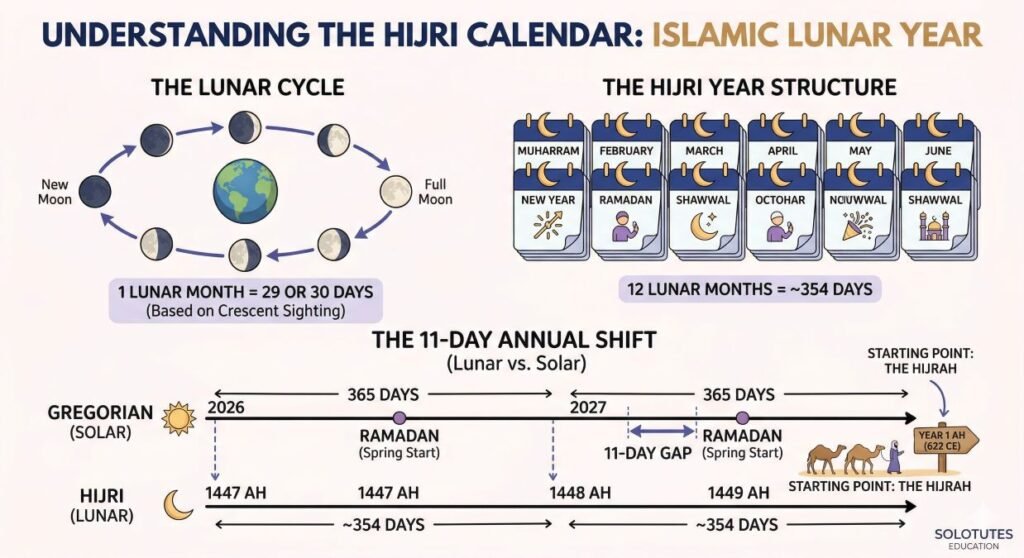
- It takes the Moon about 29.5 days to orbit the Earth.
- Because you can’t have half a day in a calendar, Islamic months are either 29 or 30 days long.
- If you multiply 29.5 by 12 months, you get exactly 354 or 355 days in a Hijri year.
3. Why Do Islamic Festivals Keep Moving?
Because the Hijri year is only 354 days long, it is about 11 days shorter than the Solar year (which is 365 days). This creates a very interesting effect!
Every year, Islamic dates arrive 11 days earlier than they did the year before on the English calendar. For example, if the holy month of Ramadan starts on March 20th this year, next year it will start around March 9th.
Because of this 11-day shift, Islamic months are not tied to the seasons. Ramadan could happen in the freezing winter, and 16 years later, it will happen in the blazing hot summer! It takes about 33 years for the Islamic calendar to cycle through all the four seasons completely.
4. The 12 Months of the Hijri Calendar
The Hijri calendar has 12 months. The start of every new month depends on the physical sighting of the new crescent moon in the sky. If the moon is not seen on the 29th night (due to clouds), the current month completes 30 days.
| Month No. | Name of the Month | Meaning / Significance |
|---|---|---|
| 1 | Muharram | A sacred month of remembrance and the start of the New Year. |
| 2 | Safar | Meaning “empty,” historically when homes were empty as people gathered food. |
| 3 | Rabi al-Awwal | The month the Prophet Muhammad was born. |
| 4 | Rabi al-Thani | The second month of Spring (in ancient times). |
| 5 | Jumada al-Awwal | The first month of dry land. |
| 6 | Jumada al-Thani | The second month of dry land. |
| 7 | Rajab | A sacred month of respect where fighting was forbidden. |
| 8 | Sha’ban | The month of preparation before the fasts of Ramadan. |
| 9 | Ramadan | The holiest month. Muslims fast from sunrise to sunset. |
| 10 | Shawwal | The month that begins with the celebration of Eid al-Fitr. |
| 11 | Dhu al-Qadah | A sacred month of peace and resting. |
| 12 | Dhu al-Hijjah | The month of the Hajj pilgrimage to Mecca, ending with Eid al-Adha. |
Conclusion
The Hijri Calendar is a beautiful reminder of the Moon’s cycle. While solar calendars keep us tied to the Earth’s seasons for farming and business, the pure lunar calendar ensures that religious observances are experienced in every season of the year over a person’s lifetime.
Explore Our World Calendar Series!
Did you miss our guide on the solar calendars? Discover the history of the 10 lost days and why we have Leap Years!
👉 Read Part 3: The Story of the Gregorian & Julian Calendars
We have looked at Indian, European, and Islamic calendars. But what about the oldest continuous calendar in the world? In our next article, we will explore the Chinese Lunar Calendar and find out what the “Year of the Dragon” actually means!
👉 Read Part 5: The Chinese Zodiac and Lunar Calendar!

Categorized Under:
Ready for More?
Test your knowledge with these related materials.




📺 Watch & Learn
Visual explanations and related video classes for better understanding.
🎥 Video Resources
WHY DO MUSLIMS FOLLOW THE LUNAR CALENDAR INSTEAD OF THE SOLAR CALENDAR? - DR ZAKIR NAIK

WHY DO MUSLIMS FOLLOW THE LUNAR CALENDAR INSTEAD OF THE SOLAR CALENDAR? - DR ZAKIR NAIK
The Islamic Calendar (Detailed Explanation)

Why the Islamic Calendar Matters | Snapshots with Imam Tom Facchine

Why Muslims Use the Lunar Calendar and Its Practicality Explained! #muslimteachings #christianbelief

How the Islamic (Hijri) Calendar Began: The Story of Its Creation

When & Why Islam Embraced the Lunar Calendar: A Journey Through History and Science
💬 Discuss this Topic
Have a doubt or want to share something? Drop a comment below!
0 Discussion(s)
You must be logged in to join the discussion.