
The Chinese Lunar Calendar & Zodiac Animals Explained
Table of Contents
1. Is it Lunar or Solar? (The Lunisolar Secret)
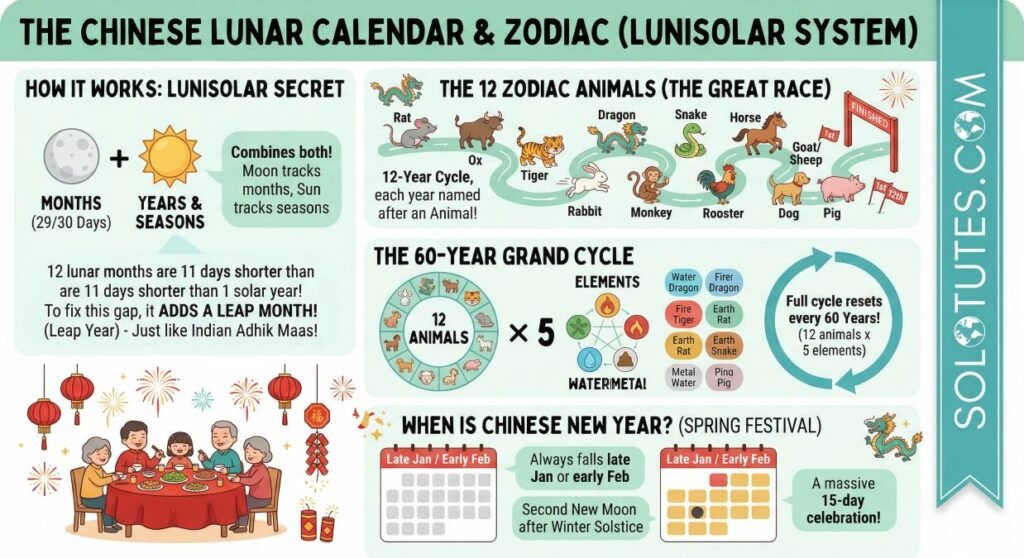
Even though people call it the “Chinese Lunar Calendar,” it is actually a Lunisolar calendar. This means it is very similar to the Indian Vikram Samvat!
- It uses the Moon to decide the length of a month (29 or 30 days).
- It uses the Sun to decide the length of a year and the changing of the seasons.
Because 12 moon cycles are about 11 days shorter than a solar year, the Chinese calendar adds an extra leap month every two or three years to keep the seasons perfectly aligned. This is just like the Indian Adhik Maas!
2. The 12 Zodiac Animals
The most famous feature of the Chinese calendar is the Shengxiao, or the Chinese Zodiac. Instead of numbering their years normally, the Chinese calendar names each year after an animal. There is a 12-year repeating cycle, and each year is represented by one of these animals in a strict order.
The Legend of the Great Race
According to ancient Chinese mythology, the Jade Emperor invited all the animals to a great race across a rushing river. The first 12 animals to reach the finish line were chosen to guard the calendar. The smart Rat rode on the Ox’s back and jumped off at the last second to win first place!
| Order | Zodiac Animal | Personality Traits (Mythology) |
|---|---|---|
| 1 | Rat | Quick-witted, smart, and resourceful. |
| 2 | Ox | Hardworking, honest, and reliable. |
| 3 | Tiger | Brave, confident, and competitive. |
| 4 | Rabbit | Quiet, elegant, and responsible. |
| 5 | Dragon | Confident, intelligent, and powerful. |
| 6 | Snake | Wise, mysterious, and thoughtful. |
| 7 | Horse | Active, energetic, and independent. |
| 8 | Goat (or Sheep) | Calm, gentle, and sympathetic. |
| 9 | Monkey | Sharp, smart, and very curious. |
| 10 | Rooster | Observant, hardworking, and courageous. |
| 11 | Dog | Loyal, honest, and kind. |
| 12 | Pig | Compassionate, generous, and easy-going. |
3. The 60-Year Grand Cycle (The Five Elements)
To make things even more scientific, the Chinese calendar pairs the 12 animals with five basic elements of nature: Wood, Fire, Earth, Metal, and Water.
For example, if you have the “Year of the Dragon,” it could be a Water Dragon or a Fire Dragon! Because there are 12 animals and 5 elements, it takes exactly 60 years to complete one full cycle (12 x 5 = 60). After 60 years, the entire calendar resets and starts over again.
4. When is the Chinese New Year?
Because the calendar depends on the moon, the date of the Chinese New Year changes every year on the English calendar. It always falls on the second New Moon after the Winter Solstice. This means the Chinese New Year always happens somewhere between January 21 and February 20.
The celebration is also known as the Spring Festival. It is a massive 15-day celebration filled with red lanterns, family dinners, fireworks, and the famous Dragon Dance!
Explore Our World Calendar Series!
Did you miss our guide on the Pure Lunar calendar? Discover why dates in the Islamic calendar shift by 11 days every year.
👉 Read Part 4: The Secrets of the Islamic Hijri Calendar
We have explored Asia and Europe. But what about the ancient Americas? In our final chapter, we will uncover the mysteries of the Ancient Mayan Calendar—the most complex stone calendar ever built!
👉 Read Part 6: The Ancient Mayan Calendar!

Categorized Under:
More Study Notes on this Topic


Ready for More?
Test your knowledge with these related materials.



📺 Watch & Learn
Visual explanations and related video classes for better understanding.
🎥 Video Resources
The myth behind the Chinese zodiac - Megan Campisi and Pen-Pen Chen
The myth behind the Chinese zodiac - Megan Campisi and Pen-Pen Chen
Zodiac Origin Story | The Story of the Great Race for Kids! | Lunar New Year | Chinese New Year

The Chinese zodiac, explained | ShaoLan

What's your Chinese zodiac sign?

The Messed Up Origins of The Chinese Zodiac | Astrology Explained

How to find out your Chinese zodiac animal
💬 Discuss this Topic
Have a doubt or want to share something? Drop a comment below!
0 Discussion(s)
You must be logged in to join the discussion.