Smart Online Assessments For Serious Exam Preparation
Start Assessment ➔

What do you want to learn today?

Home Test › UKSSSC Pashudhan Prasar Adhikari Mock Test 1: Part 2 (Biology / जीव विज्ञान)

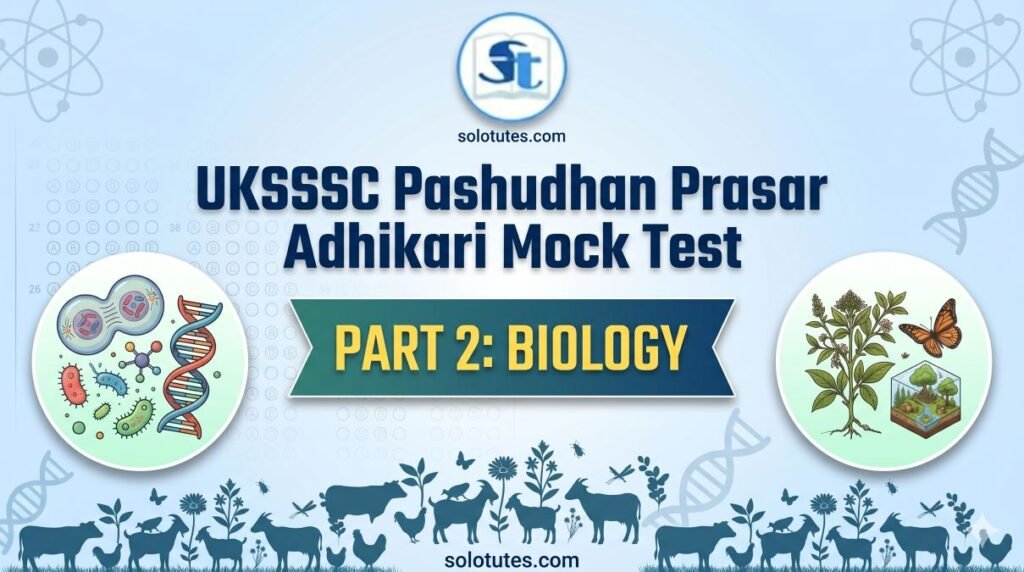
UKSSSC Pashudhan Prasar Adhikari Mock Test 1: Part 2 (Biology / जीव विज्ञान)

UKSSSC Pashudhan Prasar Adhikari Mock Test 1: Part 2 (Biology / जीव विज्ञान)

Prakash Joshi May 13, 20267 views 70 Questions

UKSSSC Pashudhan Prasar Adhikari (Livestock Extension Officer) – Biology Mock Test
यह मॉक टेस्ट उन कैंडिडेट्स के लिए है जिन्होंने UKSSSC पशुधन प्रसार अधिकारी परीक्षा के Part-2 में ‘जीव विज्ञान (Biology)’ को अपने वैकल्पिक विषय के रूप में चुना है।
इस सेट में बॉटनी और जूलॉजी से 70 महत्वपूर्ण और पिछले वर्षों के परीक्षा पैटर्न पर आधारित प्रश्न शामिल किए गए हैं।

कुल प्रश्न: 70

कुल अंक: 70

माध्यम: हिंदी और English
Practice Mode

Solve questions instantly below. Get immediate feedback and detailed explanations without any timer.

Start Practice ↓
🎯

Full Exam Mode

Take this test in a strict timed environment with negative marking and detailed analytics.

Take Assessment →
- Advertisement -
Your Score: 0 Total: 70 Questions

Questions

Q1. Which organelle is known as the suicidal bag of the cell? /किस अंगक को कोशिका की 'आत्मघाती थैली' कहा जाता है?
📘 Explanation: Lysosomes contain hydrolytic enzymes that digest cellular waste. /लाइसोसोम में जल अपघटनीय एंजाइम होते हैं जो कोशिका को नष्ट कर सकते हैं।
Q2. In which phase of the cell cycle does DNA replication occur? /कोशिका चक्र के किस चरण में डीएनए प्रतिकृति (Replication) होती है?
📘 Explanation: DNA replication occurs during the Synthesis (S) phase. /डीएनए प्रतिकृति संश्लेषण (S) चरण के दौरान होती है।
Q3. The fluid mosaic model of the cell membrane was proposed by: /कोशिका झिल्ली का 'द्रव मोज़ेक मॉडल' (Fluid mosaic model) किसने प्रस्तावित किया था?
📘 Explanation: Singer and Nicolson proposed it in 1972. /सिंगर और निकोलसन ने इसे 1972 में प्रस्तावित किया था।
Q4. Which nitrogenous base is not found in RNA? /आरएनए (RNA) में कौन सा नाइट्रोजनस क्षार नहीं पाया जाता है?
📘 Explanation: RNA contains Uracil instead of Thymine. /RNA में थाइमिन के स्थान पर यूरेसिल होता है।
Q5. Crossing over occurs during which stage of meiosis? /अर्धसूत्री विभाजन (Meiosis) के किस चरण में क्रॉसिंग ओवर होता है?
📘 Explanation: Crossing over takes place in the Pachytene stage of Prophase I. /क्रॉसिंग ओवर प्रोफेज I के पैकिटीन चरण में होता है।
Q6. The site of protein synthesis in a cell is: /कोशिका में प्रोटीन संश्लेषण का स्थल है:
📘 Explanation: Ribosomes are the protein factories of the cell. /राइबोसोम कोशिका के प्रोटीन कारखाने हैं।
Q7. Who is credited with the Human Genome Project? /मानव जीनोम परियोजना (HGP) का श्रेय किसे दिया जाता है?
📘 Explanation: HGP was a major international scientific research project. /यह एक प्रमुख अंतरराष्ट्रीय वैज्ञानिक अनुसंधान परियोजना थी।
Q8. DNA fingerprinting technique was developed by: /डीएनए फिंगरप्रिंटिंग तकनीक किसके द्वारा विकसित की गई थी?
📘 Explanation: Alec Jeffreys developed DNA profiling in 1984. /एलेक जेफ्रीस ने 1984 में डीएनए प्रोफाइलिंग विकसित की।
Q9. What is a nucleosome? /न्यूक्लियोसोम क्या है?
📘 Explanation: Nucleosome is the basic structural unit of DNA packaging. /न्यूक्लियोसोम डीएनए पैकेजिंग की मूल संरचनात्मक इकाई है।
Q10. Which is the longest phase of mitosis? /समसूत्री विभाजन (Mitosis) का सबसे लंबा चरण कौन सा है?
📘 Explanation: Prophase is the longest phase of mitosis. /प्रोफेज समसूत्री विभाजन का सबसे लंबा चरण है।
Q11. Which bacteria is responsible for Typhoid fever? /टाइफाइड बुखार के लिए कौन सा जीवाणु जिम्मेदार है?
📘 Explanation: Typhoid is caused by Salmonella typhi. /टाइफाइड साल्मोनेला टाइफी के कारण होता है।
Q12. AIDS is caused by which type of virus? /एड्स (AIDS) किस प्रकार के वायरस के कारण होता है?
📘 Explanation: HIV is a retrovirus containing RNA as genetic material. /HIV एक रेट्रोवायरस है जिसमें आनुवंशिक सामग्री के रूप में RNA होता है।
Q13. Malaria is caused by: /मलेरिया किसके कारण होता है?
📘 Explanation: Malaria is caused by Plasmodium, a protozoan. /मलेरिया प्लास्मोडियम (एक प्रोटोजोआ) के कारण होता है।
Q14. Ringworm disease in humans is caused by: /मनुष्यों में दाद (Ringworm) रोग किसके कारण होता है?
📘 Explanation: Ringworm is a fungal infection of the skin. /दाद त्वचा का एक कवक (फंगल) संक्रमण है।
Q15. A virus that infects a bacterium is called: /जीवाणु को संक्रमित करने वाले वायरस को क्या कहा जाता है?
📘 Explanation: Bacteriophages are viruses that parasitize bacteria. /बैक्टीरियोफेज ऐसे वायरस हैं जो बैक्टीरिया को संक्रमित करते हैं।
Q16. Which of the following is an infectious protein? /निम्नलिखित में से कौन एक संक्रामक प्रोटीन (Infectious protein) है?
📘 Explanation: Prions are misfolded proteins that can cause disease. /प्रायोन असामान्य प्रोटीन हैं जो बीमारी का कारण बन सकते हैं।
Q17. Transfer of genetic material from one bacterium to another through a virus is called: /वायरस के माध्यम से एक जीवाणु से दूसरे में आनुवंशिक सामग्री का स्थानांतरण क्या कहलाता है?
📘 Explanation: Transduction is mediated by bacteriophages. /पारक्रमण बैक्टीरियोफेज द्वारा मध्यस्थ होता है।
Q18. Which of the following is responsible for Pneumonia? /निमोनिया के लिए निम्नलिखित में से कौन जिम्मेदार है?
📘 Explanation: Pneumonia is primarily caused by Streptococcus pneumoniae. /निमोनिया मुख्य रूप से स्ट्रेप्टोकोकस निमोनिया जीवाणु के कारण होता है।
Q19. Widal test is used for the diagnosis of: /विडाल परीक्षण (Widal test) का उपयोग किसके निदान के लिए किया जाता है?
📘 Explanation: Widal test is a serological test for enteric fever (Typhoid). /विडाल परीक्षण टाइफाइड के लिए एक सीरोलॉजिकल टेस्ट है।
Q20. Elephantiasis (Filariasis) is caused by: /हाथीपांव (फाइलेरिया) किसके कारण होता है?
📘 Explanation: Filariasis is caused by the parasitic nematode Wuchereria. /फाइलेरिया परजीवी नेमाटोड वुचेरेरिया के कारण होता है।
Q21. Which of the following is a characteristic of Chordates? /निम्नलिखित में से कौन कॉर्डेट्स (Chordates) की एक विशेषता है?
📘 Explanation: Presence of pharyngeal gill slits is a key chordate feature. /ग्रसनी गिल दरारों की उपस्थिति एक प्रमुख कॉर्डेट विशेषता है।
Q22. The term 'Species' was coined by: /'प्रजाति' (Species) शब्द किसके द्वारा गढ़ा गया था?
📘 Explanation: John Ray first introduced the biological concept of species. /जॉन रे ने सबसे पहले प्रजातियों की जैविक अवधारणा पेश की थी।
Q23. Which phylum shows radial symmetry in adult stage but bilateral symmetry in larval stage? /कौन सा संघ वयस्क अवस्था में अरीय सममिति (Radial symmetry) लेकिन लार्वा अवस्था में द्विपक्षीय सममिति (Bilateral) दिखाता है?
📘 Explanation: Echinoderms like starfish exhibit this property. /स्टारफिश जैसे एकाइनोडर्म यह गुण प्रदर्शित करते हैं।
Q24. Water vascular system is a characteristic feature of: /जल संवहनी तंत्र (Water vascular system) किसकी एक विशेषता है?
📘 Explanation: It helps echinoderms in locomotion, food capture, and respiration. /यह एकाइनोडर्म्स को गति और श्वसन में मदद करता है।
Q25. Which is the largest phylum of Animalia? /एनिमेलिया का सबसे बड़ा संघ (Phylum) कौन सा है?
📘 Explanation: Arthropoda includes insects, making it the largest phylum. /आर्थ्रोपोडा में कीड़े शामिल हैं, जो इसे सबसे बड़ा संघ बनाता है।
Q26. Excretory organs in Platyhelminthes (Flatworms) are: /प्लैटीहेल्मिन्थीज (चपटे कृमि) में उत्सर्जी अंग कौन से हैं?
📘 Explanation: Flame cells are specialized for osmoregulation and excretion. /ज्वाला कोशिकाएं उत्सर्जन के लिए विशिष्ट होती हैं।
Q27. Which vertebrate class has a three-chambered heart? /किस कशेरुकी वर्ग में तीन कक्षीय (Three-chambered) हृदय होता है?
📘 Explanation: Amphibians and most reptiles have a 3-chambered heart. /उभयचरों और अधिकांश सरीसृपों में 3-कक्षीय हृदय होता है।
Q28. Mammals are unique in possessing: /स्तनधारियों (Mammals) की विशिष्ट पहचान क्या है?
📘 Explanation: Presence of mammary glands is the fundamental characteristic of mammals. /स्तन ग्रंथियों की उपस्थिति स्तनधारियों की मूलभूत विशेषता है।
Q29. Binomial nomenclature system was given by: /द्विनाम पद्धति (Binomial nomenclature) प्रणाली किसके द्वारा दी गई थी?
📘 Explanation: Carl Linnaeus introduced the binomial naming system. /कार्ल लिनिअस ने द्विनामकरण प्रणाली की शुरुआत की थी।
Q30. Pseudocoelom is found in: /कूटगुहा (Pseudocoelom) किसमें पाई जाती है?
📘 Explanation: Aschelminthes (roundworms) possess a pseudocoelom. /राउंडवर्म्स में एक कूटगुहा होती है।
Q31. Enzyme pepsin acts in: /एंजाइम पेप्सिन कहाँ कार्य करता है?
📘 Explanation: Pepsin digests proteins in the highly acidic environment of the stomach. /पेप्सिन पेट के अत्यधिक अम्लीय वातावरण में प्रोटीन को पचाता है।
Q32. Exchange of gases in the human lungs occurs in the: /मानव फेफड़ों में गैसों का आदान-प्रदान कहाँ होता है?
📘 Explanation: Alveoli are the primary sites of gas exchange in the lungs. /एल्वियोली फेफड़ों में गैस विनिमय के प्राथमिक स्थल हैं।
Q33. Which node is the pacemaker of the human heart? /मानव हृदय का पेसमेकर (Pacemaker) कौन सा नोड है?
📘 Explanation: The Sinoatrial (SA) node initiates the heartbeat. /साइनोएट्रियल (SA) नोड हृदय की धड़कन शुरू करता है।
Q34. The basic functional unit of the human kidney is: /मानव गुर्दे की मूल कार्यात्मक इकाई क्या है?
📘 Explanation: Nephrons filter blood to form urine. /नेफ्रॉन रक्त को छानकर मूत्र बनाते हैं।
Q35. Which part of the human brain controls voluntary movements and balance? /मानव मस्तिष्क का कौन सा भाग स्वैच्छिक संचालन और संतुलन को नियंत्रित करता है?
📘 Explanation: The cerebellum coordinates voluntary movements, posture, and balance. /सेरिबैलम स्वैच्छिक संचालन , मुद्रा और संतुलन का समन्वय करता है।
Q36. Insulin is secreted by which cells of the pancreas? /इंसुलिन अग्न्याशय की किन कोशिकाओं द्वारा स्रावित होता है?
📘 Explanation: Beta cells of the Islets of Langerhans secrete insulin. /लैंगरहैंस के आइलेट्स की बीटा कोशिकाएं इंसुलिन स्रावित करती हैं।
Q37. The hormone responsible for the 'fight or flight' response is: /'फाइट या फ्लाइट' (लड़ो या उड़ो) प्रतिक्रिया के लिए जिम्मेदार हार्मोन है:
📘 Explanation: Adrenaline (Epinephrine) is released during stress situations. /तनाव की स्थिति के दौरान एड्रेनालाईन जारी किया जाता है।
Q38. Bile juice is stored in the: /पित्त रस (Bile juice) कहाँ जमा होता है?
📘 Explanation: Bile is produced by the liver and stored in the gallbladder. /पित्त यकृत द्वारा निर्मित होता है और पित्ताशय में जमा होता है।
Q39. Which of the following blood cells play a major role in blood clotting? /निम्नलिखित में से कौन सी रक्त कोशिकाएं रक्त का थक्का जमने में प्रमुख भूमिका निभाती हैं?
📘 Explanation: Platelets (thrombocytes) are crucial for blood coagulation. /प्लेटलेट्स रक्त के थक्के जमने के लिए महत्वपूर्ण हैं।
Q40. The sliding filament theory explains the mechanism of: /स्लाइडिंग फिलामेंट सिद्धांत किसके तंत्र की व्याख्या करता है?
📘 Explanation: It explains how actin and myosin filaments slide past each other during muscle contraction. /यह बताता है कि संकुचन के दौरान मांसपेशी फिलामेंट कैसे खिसकते हैं।
Q41. The physical expression of a trait is known as: /किसी लक्षण की भौतिक अभिव्यक्ति को क्या कहा जाता है?
📘 Explanation: Phenotype refers to the observable characteristics. /फेनोटाइप का अर्थ अवलोकन योग्य विशेषताएं है।
Q42. Mendel's law of segregation is also known as the law of: /मेंडल के पृथक्करण के नियम को किस अन्य नाम से जाना जाता है?
📘 Explanation: During gamete formation, alleles segregate, ensuring gametes are pure for a trait. /युग्मक निर्माण के दौरान, युग्मकों की शुद्धता सुनिश्चित होती है।
Q43. In Mirabilis jalapa, a cross between red and white flowers produces pink flowers. This is an example of: /मिराबिलिस जलापा में लाल और सफेद फूलों के बीच संकरण से गुलाबी फूल पैदा होते हैं। यह किसका उदाहरण है?
📘 Explanation: Incomplete dominance results in a blended intermediate phenotype. /अपूर्ण प्रभाविता के परिणामस्वरूप एक मिश्रित फेनोटाइप होता है।
Q44. Human blood group AB is an example of: /मानव रक्त समूह AB किसका उदाहरण है?
📘 Explanation: Both A and B alleles are fully expressed in the AB blood group. /AB रक्त समूह में A और B दोनों एलील पूरी तरह से व्यक्त होते हैं।
Q45. The phenomenon where closely located genes on a chromosome are inherited together is called: /वह घटना जहां एक गुणसूत्र पर करीब से स्थित जीन एक साथ वंशागत होते हैं, क्या कहलाती है?
📘 Explanation: Linkage is the tendency of DNA sequences that are close together on a chromosome to be inherited together. /सहलग्नता का अर्थ है गुणसूत्र पर पास स्थित जीनों का एक साथ आगे बढ़ना।
Q46. How many pairs of autosomes are there in a normal human cell? /एक सामान्य मानव कोशिका में ऑटोसोम (Autosomes) के कितने जोड़े होते हैं?
📘 Explanation: Humans have 22 pairs of autosomes and 1 pair of sex chromosomes. /मनुष्यों में 22 जोड़े ऑटोसोम और 1 जोड़ा सेक्स गुणसूत्र होता है।
Q47. Which of the following acts as a vector in genetic engineering? /निम्नलिखित में से कौन आनुवंशिक इंजीनियरिंग में वाहक (Vector) के रूप में कार्य करता है?
📘 Explanation: Plasmids are circular DNA molecules used to transfer genes. /प्लाज्मिड गोलाकार डीएनए अणु हैं जिनका उपयोग जीन को स्थानांतरित करने के लिए किया जाता है।
Q48. Which enzyme is known as 'molecular scissors'? /किस एंजाइम को 'आणविक कैंची' (Molecular scissors) कहा जाता है?
📘 Explanation: Restriction enzymes cut DNA at specific recognition sequences. /प्रतिबंधन एंजाइम डीएनए को विशिष्ट स्थानों पर काटते हैं।
Q49. PCR (Polymerase Chain Reaction) is used for: /पीसीआर (PCR) का उपयोग किसके लिए किया जाता है?
📘 Explanation: PCR creates millions of copies of a specific DNA segment. /पीसीआर एक विशिष्ट डीएनए खंड की लाखों प्रतियां बनाता है।
Q50. Bt cotton contains a gene derived from: /बीटी कपास (Bt cotton) में प्राप्त जीन किससे लिया गया है?
📘 Explanation: It contains a gene from the bacterium Bacillus thuringiensis. /इसमें बैसिलस थुरिंजिएंसिस नामक जीवाणु का एक जीन होता है।
Q51. Which of the following are known as the 'amphibians of the plant kingdom'? /निम्नलिखित में से किसे 'पादप जगत का उभयचर' कहा जाता है?
📘 Explanation: Bryophytes need water for sexual reproduction despite living on land. /ब्रायोफाइट्स को जमीन पर रहने के बावजूद प्रजनन के लिए पानी की आवश्यकता होती है।
Q52. In Gymnosperms, seeds are: /जिम्नोस्पर्म में, बीज कैसे होते हैं?
📘 Explanation: Gymnosperms have naked seeds not enclosed in an ovary. /जिम्नोस्पर्म में नग्न बीज होते हैं जो अंडाशय में बंद नहीं होते हैं।
Q53. The male reproductive part of a flower is called: /फूल के नर प्रजनन भाग को क्या कहा जाता है?
📘 Explanation: The androecium consists of stamens. /पुमंग (Androecium) में पुंकेसर होते हैं।
Q54. Roots that develop from parts of the plant other than the radicle are called: /मूलांकुर (Radicle) के अलावा पौधे के अन्य भागों से विकसित होने वाली जड़ों को क्या कहते हैं?
📘 Explanation: Adventitious roots arise from stems or leaves. /अपस्थानिक जड़ें तने या पत्तियों से निकलती हैं।
Q55. Which tissue is responsible for secondary growth in plants? /पौधों में द्वितीयक वृद्धि (Secondary growth) के लिए कौन सा ऊतक जिम्मेदार है?
📘 Explanation: Lateral meristem (cambium) causes an increase in girth. /पार्श्व मेरिस्टेम (कैंबियम) पौधे की मोटाई बढ़ाता है।
Q56. Potato is a modified form of: /आलू किसका एक संशोधित रूप है?
📘 Explanation: Potato is a tuber, which is an underground modified stem. /आलू एक कंद है, जो एक भूमिगत संशोधित तना है।
Q57. Double fertilization is a characteristic feature of: /दोहरा निषेचन (Double fertilization) किसकी एक विशेषता है?
📘 Explanation: In angiosperms, one sperm fertilizes the egg and the other forms the endosperm. /एंजियोस्पर्म में दोहरा निषेचन एक अद्वितीय घटना है।
Q58. What is the study of Fungi called? /कवक (Fungi) के अध्ययन को क्या कहा जाता है?
📘 Explanation: Mycology is the branch of biology concerned with the study of fungi. /माइकोलॉजी जीव विज्ञान की वह शाखा है जो कवक के अध्ययन से संबंधित है।
Q59. Casparain strips are present in the: /कैस्पेरी पट्टियाँ (Casparian strips) किसमें मौजूद होती हैं?
📘 Explanation: Casparian strips are band-like thickenings in the root endodermis. /कैस्पेरी पट्टियाँ जड़ एंडोडर्मिस में मौजूद होती हैं।
Q60. Fleshy receptacle is the edible part of which fruit? /मांसल पुष्पासन (Fleshy receptacle) किस फल का खाने योग्य भाग है?
📘 Explanation: Apple is a false fruit where the thalamus/receptacle becomes fleshy. /सेब एक 'झूठा फल' है जहाँ पुष्पासन मांसल हो जाता है।
Q61. The process of loss of water in the form of liquid droplets from leaf margins is called: /पत्तियों के किनारों से तरल बूंदों के रूप में पानी के नुकसान की प्रक्रिया को क्या कहा जाता है?
📘 Explanation: Guttation occurs through special pores called hydathodes. /बिंदुस्राव जलरंध्र (hydathodes) नामक विशेष छिद्रों के माध्यम से होता है।
Q62. Which pigment is responsible for the red color in tomatoes? /टमाटर में लाल रंग के लिए कौन सा वर्णक जिम्मेदार है?
📘 Explanation: Lycopene is a carotenoid pigment that gives tomatoes their red color. /लाइकोपीन एक कैरोटीनॉयड वर्णक है जो लाल रंग देता है।
Q63. First stable product of the C3 cycle of photosynthesis is: /प्रकाश संश्लेषण के C3 चक्र का पहला स्थिर उत्पाद क्या है?
📘 Explanation: 3-Phosphoglyceric acid is the first stable product of the Calvin (C3) cycle. /C3 चक्र का पहला स्थिर उत्पाद 3-PGA है।
Q64. Which plant hormone is responsible for fruit ripening? /फलों के पकने के लिए कौन सा पादप हार्मोन जिम्मेदार है?
📘 Explanation: Ethylene is a gaseous hormone that promotes fruit ripening. /एथिलीन एक गैसीय हार्मोन है जो फलों को पकाने में मदद करता है।
Q65. The ultimate source of energy in an ecosystem is: /एक पारिस्थितिकी तंत्र (Ecosystem) में ऊर्जा का अंतिम स्रोत क्या है?
📘 Explanation: Solar energy is the primary source of energy for almost all ecosystems. /सौर ऊर्जा लगभग सभी पारिस्थितिक तंत्रों के लिए ऊर्जा का प्राथमिक स्रोत है।
Q66. Ten percent law of energy transfer in a food chain was given by: /खाद्य श्रृंखला में ऊर्जा हस्तांतरण का 'दस प्रतिशत नियम' किसने दिया था?
📘 Explanation: Raymond Lindeman introduced the 10% law in 1942. /रेमंड लिंडेमन ने 1942 में 10% नियम पेश किया था।
Q67. Mycorrhiza represents a symbiotic relationship between: /माइकोराइजा किसके बीच एक सहजीवी संबंध को दर्शाता है?
📘 Explanation: Mycorrhiza is a mutualistic association between fungi and plant roots. /यह कवक और पौधों की जड़ों के बीच एक सहजीवी संघ है।
Q68. Which of the following is NOT an in-situ conservation method? /निम्नलिखित में से कौन 'इन-सीटू' (in-situ) संरक्षण विधि नहीं है?
📘 Explanation: Zoological parks (Zoos) are ex-situ conservation methods. /प्राणि उद्यान एक्स-सीटू (बाह्य-स्थाने) संरक्षण के तरीके हैं।
Q69. Apical dominance in plants is mainly due to which hormone? /पौधों में 'शीर्षस्थ प्रभाविता' (Apical dominance) मुख्य रूप से किस हार्मोन के कारण होती है?
📘 Explanation: Auxins produced at the shoot tip inhibit the growth of lateral buds. /प्ररोह शीर्ष पर उत्पन्न ऑक्सिन पार्श्व कलियों के विकास को रोकते हैं।
Q70. The major component of biogas is: /बायोगैस का प्रमुख घटक क्या है?
📘 Explanation: Methane (CH4) makes up about 50-75% of biogas. /मीथेन बायोगैस का लगभग 50-75% हिस्सा बनाता है।
🎉 Well done! You attempted all 70 questions.
Ready for a bigger challenge? Try the Full Assessment now!
- Advertisement -

💬 Discuss this Topic

Have a doubt or want to share something? Drop a comment below!

Leave a Reply

Your email address will not be published. Required fields are marked *


- Advertisement -

📺 Watch & Learn

Visual explanations and related video classes for better understanding.

🎥 Video Resources

पशुधन प्रसार अधिकारी (LEO) 2026: जैव अणु और कोशिका विभाजन (Bio molecules & Cell Division) | Part-A

पशुधन प्रसार अधिकारी (LEO) 2026: जैव अणु और कोशिका विभाजन (Bio molecules & Cell Division) | Part-A

Biology Objective questions in Hindi |जीव विज्ञान | Biology Mcq| Biology| UKSSSC| Biology test

Cell Biology important question part -2|कोशिका विज्ञान महत्वपूर्ण प्रश्न| Uttarakhand Next Exam

15- Biology Important Question in Hindi|जीव विज्ञान|Biology Mcq in Hindi|Biology All Exam MCQ|UKSSSC

Biology Mcq |2020-Biology Objective Question in Hindi-26| उत्तराखंड पशुधन प्रसार अधिकारी 500+ E-Book

जीव विज्ञान से संबंधित महत्वपूर्ण प्रश्न | Biology objective Question| Biology in Hindi |Biology Gk

Scroll to Top