Download PDF – Biology Practice Test 30 – Complete Syllabus Full Length (SET 2/2)
star
5.0★★★★★1 review
download0 downloadsvisibility130 views
Biology Practice Test 30 – Complete Syllabus Full Length (SET 2/2)
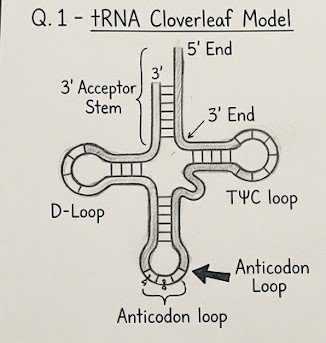
Observe the image carefully.
Q1. Based on the provided image of the tRNA 'cloverleaf' model, what is the specific biological function of the region pointed to by the arrow?
A) It covalently binds to a specific amino acid.
B) It recognizes and base-pairs with a complementary codon on the mRNA.
C) It attaches the tRNA molecule to the ribosome's large subunit.
D) It acts as a primer for RNA polymerase during transcription.
Q1. tRNA 'क्लोवरलीफ' मॉडल की प्रदान की गई छवि के आधार पर, तीर द्वारा इंगित क्षेत्र का विशिष्ट जैविक कार्य क्या है?
A) यह एक विशिष्ट अमीनो एसिड से सहसंयोजक (covalently) रूप से जुड़ता है।
B) यह mRNA पर एक पूरक कोडन (complementary codon) को पहचानता है और उसके साथ बेस-पेयर करता है।
C) यह tRNA अणु को राइबोसोम के बड़े सबयूनिट से जोड़ता है।
D) यह अनुलेखन (transcription) के दौरान आरएनए पोलीमरेज़ के लिए प्राइमर के रूप में कार्य करता है।
Answer: (B)
The bottom loop of the tRNA cloverleaf model is the 'Anticodon loop'. It contains a sequence of three bases that physically bind to the complementary mRNA codon during translation.
tRNA क्लोवरलीफ मॉडल का निचला लूप 'एंटीकोडॉन लूप' है। इसमें तीन बेसों का एक क्रम होता है जो अनुवादन (translation) के दौरान पूरक mRNA कोडन से जुड़ता है।
Find the incorrect statement.
Q2. During Meiosis, which of the following statements about the Prophase I sub-stages is incorrect?
A) In Zygotene, homologous chromosomes begin to pair, forming a synaptonemal complex.
B) In Pachytene, crossing over occurs between non-sister chromatids of homologous chromosomes.
C) In Diplotene, the dissolution of the synaptonemal complex occurs, and chiasmata become clearly visible.
D) In Diakinesis, homologous chromosomes separate entirely and move to opposite poles of the cell.
Q2. अर्धसूत्रीविभाजन (Meiosis) के दौरान, प्रोफ़ेज़ I के उप-चरणों के बारे में निम्नलिखित में से कौन सा कथन गलत है?
A) ज़ाइगोटीन (Zygotene) में, समजात गुणसूत्र (homologous chromosomes) जुड़ना शुरू करते हैं, जिससे एक सिनेप्टोनेमल कॉम्प्लेक्स बनता है।
B) पैचिटीन (Pachytene) में, समजात गुणसूत्रों के गैर-सिस्टर क्रोमैटिड्स के बीच क्रॉसिंग ओवर (crossing over) होता है।
C) डिप्लोटीन (Diplotene) में, सिनेप्टोनेमल कॉम्प्लेक्स का विघटन होता है, और चियास्माटा स्पष्ट रूप से दिखाई देने लगते हैं।
D) डायकाइनेसिस (Diakinesis) में, समजात गुणसूत्र पूरी तरह से अलग हो जाते हैं और कोशिका के विपरीत ध्रुवों पर चले जाते हैं।
Answer: (D)
This statement is FALSE. The complete separation and movement of homologous chromosomes to opposite poles happens during Anaphase I, not Diakinesis. Diakinesis is marked by the terminalization of chiasmata.
यह कथन गलत है। समजात गुणसूत्रों का पूर्ण अलगाव और विपरीत ध्रुवों की ओर गति एनाफेज I के दौरान होती है, डायकाइनेसिस में नहीं।
Match the theories with their scientists.
Q3. Match List-I (Evolutionary Concept / Theory) with List-II (Key Proponent): List-I A. Inheritance of Acquired Characters B. Theory of Natural Selection C. Mutation Theory List-II 1. Hugo de Vries 2. Jean-Baptiste Lamarck 3. Charles Darwin
A) A-2, B-3, C-1
B) A-3, B-1, C-2
C) A-1, B-2, C-3
D) A-2, B-1, C-3
Q3. सूची-I (विकासवादी अवधारणा / सिद्धांत) का सूची-II (प्रमुख प्रस्तावक) के साथ मिलान करें: सूची-I A. उपार्जित लक्षणों की वंशागति (Inheritance of Acquired Characters) B. प्राकृतिक चयन का सिद्धांत (Natural Selection) C. उत्परिवर्तन सिद्धांत (Mutation Theory) सूची-II 1. ह्यूगो डी व्रीज़ 2. जीन-बैप्टिस्ट लैमार्क 3. चार्ल्स डार्विन
A) A-2, B-3, C-1
B) A-3, B-1, C-2
C) A-1, B-2, C-3
D) A-2, B-1, C-3
Answer: (A)
Lamarck proposed the use and disuse of organs (acquired characters). Darwin and Wallace proposed Natural Selection. Hugo de Vries proposed the Mutation theory based on his work with Evening Primrose.
लैमार्क ने अंगों के उपयोग और अनुपयोग (उपार्जित लक्षण) का प्रस्ताव रखा। डार्विन ने प्राकृतिक चयन का प्रस्ताव रखा। ह्यूगो डी व्रीज़ ने उत्परिवर्तन सिद्धांत का प्रस्ताव रखा।
Q4. In molecular biology, which highly specialized enzyme catalyzes the formation of a phosphodiester bond between the 3'-OH end of one Okazaki fragment and the 5'-phosphate end of another during DNA replication?
A) DNA Polymerase III
B) Helicase
C) DNA Ligase
D) Topoisomerase
Q4. आणविक जीव विज्ञान में, कौन सा अत्यधिक विशिष्ट एंजाइम डीएनए प्रतिकृति (replication) के दौरान एक ओकाज़ाकी खंड (Okazaki fragment) के 3'-OH सिरे और दूसरे के 5'-फॉस्फेट सिरे के बीच फॉस्फोडिएस्टर बांड के निर्माण को उत्प्रेरित करता है?
A) डीएनए पोलीमरेज़ III
B) हेलिकेज
C) डीएनए लाइगेज (DNA Ligase)
D) टोपोइसोमेरेज़
Answer: (C)
DNA Ligase acts as molecular glue, physically joining the discontinuous Okazaki fragments on the lagging strand to create a continuous double helix.
डीएनए लाइगेज आणविक गोंद के रूप में कार्य करता है, एक निरंतर डबल हेलिक्स बनाने के लिए लैगिंग स्ट्रैंड पर असंतत ओकाज़ाकी खंडों को भौतिक रूप से जोड़ता है।
Read the assertion and reason carefully.
Q5. Assertion (A): The classic Mendelian Test Cross is performed by crossing an F1 individual with an individual having a homozygous dominant genotype. Reason (R): The test cross is strictly used to determine whether a dominant phenotype is homozygous or heterozygous.
A) Both A and R are true and R is the correct explanation of A
B) Both A and R are true but R is NOT the correct explanation of A
C) A is true but R is false
D) A is false but R is true
Q5. अभिकथन (A): क्लासिक मेंडेलियन परीक्षण संकरण (Test Cross) एक F1 व्यष्टि का समयुग्मजी प्रभावी जीनोटाइप (homozygous dominant) वाले व्यष्टि के साथ संकरण कराके किया जाता है। कारण (R): परीक्षण संकरण का उपयोग कड़ाई से यह निर्धारित करने के लिए किया जाता है कि एक प्रभावी फेनोटाइप समयुग्मजी है या विषमयुग्मजी (heterozygous)।
A) A और R दोनों सत्य हैं और R, A का सही स्पष्टीकरण है
B) A और R दोनों सत्य हैं लेकिन R, A का सही स्पष्टीकरण नहीं है
C) A सत्य है लेकिन R असत्य है
D) A असत्य है लेकिन R सत्य है
Answer: (D)
The Assertion is FALSE. A test cross involves crossing an individual of unknown genotype with a homozygous RECESSIVE parent, not a homozygous dominant one. The Reason statement is completely correct.
अभिकथन गलत है। एक परीक्षण संकरण (Test Cross) में अज्ञात जीनोटाइप वाले व्यष्टि को समयुग्मजी अप्रभावी (recessive) माता-पिता के साथ पार करना शामिल है, प्रभावी के साथ नहीं।
Analyze the image.
Q6. Based on the provided image of the Miller-Urey experiment apparatus, what did the sparking electrodes in the indicated spherical flask physically simulate in the context of the origin of life?
A) Volcanic eruptions
B) Intense solar ultraviolet (UV) radiation
C) Lightning storms in the primitive Earth's atmosphere
D) Geothermal heat from ocean vents
Q6. मिलर-यूरे (Miller-Urey) प्रयोग उपकरण की प्रदान की गई छवि के आधार पर, संकेतित गोलाकार फ्लास्क में चिंगारी वाले इलेक्ट्रोड ने जीवन की उत्पत्ति के संदर्भ में भौतिक रूप से किसका अनुकरण (simulate) किया?
A) ज्वालामुखी विस्फोट
B) तीव्र सौर पराबैंगनी (UV) विकिरण
C) आदिम पृथ्वी के वायुमंडल में बिजली के तूफान (Lightning storms)
D) समुद्री छिद्रों से भूतापीय गर्मी
Answer: (C)
Stanley Miller and Harold Urey used electrical sparks to simulate the frequent and intense lightning storms of the primitive, reducing atmosphere, providing the necessary activation energy to form amino acids.
स्टेनली मिलर और हेरोल्ड यूरे ने आदिम वायुमंडल के लगातार और तीव्र बिजली के तूफानों का अनुकरण करने के लिए विद्युत चिंगारी का उपयोग किया, जिससे अमीनो एसिड बनाने के लिए ऊर्जा मिली।
🔒
Unlock Full Document
Get instant access to all questions, solutions, and PDF download.
What You Will Get in Biology Practice Test 30 – Complete Syllabus Full Length (SET 2/2) PDF?
✔ A high-quality PDF of Biology Practice Test 30 – Complete Syllabus Full Length (SET 2/2) with proper formatting
✔ Easy to read offline on mobile, tablet, or desktop
✔ Great for revision, practice, and quick reference
✔ Additional learning support with related videos and resources linked on this page
✔ Supports our mission: “Knowledge for Everyone”
Why Choose Solotutes?
At Solotutes, we provide access to notes, quizzes, MCQs, one-liners, and tests for multiple exams. By downloading Biology Practice Test 30 – Complete Syllabus Full Length (SET 2/2) in PDF format, you not only get valuable material but also become part of a growing community of learners. We regularly update our posts with videos, explanations, and extra content to help you understand topics better.
FAQs – Biology Practice Test 30 – Complete Syllabus Full Length (SET 2/2) Download
Q. Is this PDF really free? ✅ Yes! Free resources are completely free. Premium resources require a one-time unlock or pass.
Q. Do I need to sign up? ❌ For free PDFs, no account is needed. For premium tests, login is required to verify your purchase.
Q. Can I share this PDF with my friends? ✔ Yes, please share and help others learn too.
About Solotutes
Solotutes.com is dedicated to students preparing for competitive exams, schools, and universities. We provide free PDFs, quizzes, MCQs, notes, and one-liners to make learning easy and accessible.
👑 Tired of Waiting and Ads? Go PRO!
Upgrade to the SoloTutes Pro Pass and supercharge your exam preparation.
🚫 Ad-Free Experience: Say goodbye to ads and 1-minute waiting timers.
📝 Custom PDF Generator: Build your own exam/subject-wise PDFs.
📚 PDF Library: Access 1000+ question eBooks.
🔓 Unlock Test Series: Get access to all current and upcoming paid test series.