
This test on Simple and Compound Interest contains 10+ multiple-choice questions designed to assess understanding of key financial concepts. The questions cover topics such as the formulas for simple and compound interest, the differences between them, and how interest is compounded over different periods. By completing this test, students will enhance their ability to calculate interest for various financial scenarios, solidifying their grasp of fundamental interest concepts.
Mathematics Practice Quiz on Simple and Compound Interest
Practice Mode
Solve questions instantly below. Get immediate feedback and detailed explanations without any timer.
Full Exam Mode
Take this test in a strict timed environment with negative marking and detailed analytics.
Your Score: 0
Total: 20 Questions
Questions
Direction for Q.No-1
Choose the correct formula for simple interest
Q1.
What is the formula for calculating simple interest?
📘 Explanation:
The correct formula for simple interest is (P x R x T) / 100
Direction for Q.No-2
Choose the correct representation of 'P' in the formula
Q2.
What does 'P' represent in the simple interest formula?
📘 Explanation:
'P' stands for the principal amount in the simple interest formula
Direction for Q.No-3
Calculate the simple interest for given values
Q3.
If the principal is ₹1,000, the rate of interest is 5% per annum, and the time is 2 years, what is the simple interest?
📘 Explanation:
Simple interest is calculated using SI = (P x R x T) / 100
Direction for Q.No-4
Choose the correct base for compound interest
Q4.
Compound interest is calculated on:
📘 Explanation:
Compound interest is calculated on both principal and accrued interest
Direction for Q.No-5
Choose the correct formula for compound interest
Q5.
What is the formula for calculating compound interest annually?
📘 Explanation:
Compound interest formula is A = P(1 + R/100)^T
Direction for Q.No-6
Calculate the final amount after 3 years
Q6.
If a sum of ₹2,000 is invested at an interest rate of 6% per annum compounded annually for 3 years, what will be the amount after 3 years?
📘 Explanation:
The final amount is calculated using the compound interest formula A = P(1 + R/100)^T
Direction for Q.No-7
Choose the correct difference
Q7.
The difference between simple interest and compound interest on ₹5,000 for 2 years at a rate of 5% per annum is:
📘 Explanation:
The difference is ₹12.50 due to the compound effect over 2 years
Direction for Q.No-8
Choose the correct number of compounding periods
Q8.
If the interest is compounded half-yearly, how many times per year is the interest compounded?
📘 Explanation:
Half-yearly compounding means the interest is compounded twice a year
Direction for Q.No-9
Choose the correct number of compounding periods
Q9.
In compound interest, if the interest is compounded quarterly, the number of compounding periods in a year is:
📘 Explanation:
Quarterly compounding means the interest is compounded 4 times a year
Direction for Q.No-10
Calculate the rate of interest
Q10.
A sum of money becomes ₹6,000 in 2 years and ₹6,600 in 3 years at compound interest. What is the rate of interest?
📘 Explanation:
The rate of interest is 10% based on the growth from ₹6,000 to ₹6,600 in one year
Direction for Q.No-11
SSC 2022 question
Q11.
A sum of ₹8,000 amounts to ₹9,261 in 2 years at compound interest. What is the rate of interest?
📘 Explanation:
The sum increased at a rate of 10% per annum
Direction for Q.No-12
SSC 2019 question
Q12.
The simple interest on a sum of ₹12,000 at 6% per annum for 4 years is:
📘 Explanation:
Simple interest is calculated using the formula SI = (P x R x T) / 100
Direction for Q.No-13
DSSSB 2020 question
Q13.
In how many years will a sum of ₹1,000 become ₹1,210 at 10% compound interest per annum?
📘 Explanation:
The sum will amount to ₹1,210 in 2 years at 10% compound interest
Direction for Q.No-14
SSC 2018 question
Q14.
The difference between compound interest and simple interest on a sum of ₹5,000 for 3 years at 8% per annum is:
📘 Explanation:
The difference is ₹40 due to compounding
Direction for Q.No-15
DSSSB 2021 question
Q15.
What is the compound interest on ₹10,000 at 5% per annum compounded yearly for 2 years?
📘 Explanation:
The compound interest after 2 years is ₹1,025
Direction for Q.No-16
SSC 2021 question
Q16.
At what rate of simple interest will a sum of money double itself in 12 years?
📘 Explanation:
The rate of interest should be 8.33% for the sum to double in 12 years
Direction for Q.No-17
SSC 2022 question
Q17.
If ₹6,000 becomes ₹7,200 in 2 years at simple interest, what is the rate of interest?
📘 Explanation:
The rate of interest is 10% using SI = (P x R x T) / 100
Direction for Q.No-18
SSC 2020 question
Q18.
At what rate will ₹10,000 amount to ₹11,000 in 2 years at compound interest?
📘 Explanation:
The rate is approximately 4.88%, calculated using the compound interest formula
Direction for Q.No-19
SSC 2019 question
Q19.
The simple interest on ₹5,000 at 8% per annum for 3 years is:
📘 Explanation:
The simple interest is calculated as ₹1,200
Direction for Q.No-20
DSSSB 2021 question
Q20.
The compound interest on ₹4,000 for 2 years at 5% per annum compounded annually is:
📘 Explanation:
The compound interest is ₹410 calculated using the compound interest formula
🎉 Well done! You attempted all 20 questions.
Ready for a bigger challenge? Try the Full Assessment now!
Ready for a bigger challenge? Try the Full Assessment now!
Categorized Under:
Related Similar Tests
📺 Watch & Learn
Visual explanations and related video classes for better understanding.
🎥 Video Resources
Aptitude Preparation for Campus Placements #10 | Simple Interest | Quantitative Aptitude

Aptitude Preparation for Campus Placements #10 | Simple Interest | Quantitative Aptitude
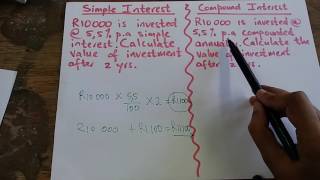
How To Calculate Simple and Compound Interest

Top 10 questions on Compound Interest and Simple Interest
TCS NQT Aptitude :Compound Interest | Solve any Compound Interest problem in 1minute

RRB PO

Compound Interest
💬 Discuss this Topic
Have a doubt or want to share something? Drop a comment below!