
Class – XI Biology Chapter 1 NCERT Solutions – Q&A
NCERT Class 11 Biology Chapter 1 “The Living World” important questions and answers covering classification of organisms, taxonomical hierarchy, scientific nomenclature, species concept, and taxa. Clear, exam-oriented answers prepared strictly as per the latest NCERT syllabus for CBSE Class XI Biology students.
Question No. 5
Given below is the scientific name of Mango. Identify the correctly written name.
Mangifera Indica
Mangifera indica
Answer: Mangifera indica
Explanation: In scientific nomenclature, the generic name begins with a capital letter, the specific epithet begins with a small letter, and both words are written in italics or underlined separately.
Question No. 7
Can you identify the correct sequence of taxonomical categories?
(a) Species → Order → Phylum → Kingdom
(b) Genus → Species → Order → Kingdom
(c) Species → Genus → Order → Phylum
Answer: (c) Species → Genus → Order → Phylum
Question No. 9
Define the following terms:
(i) Phylum: A group of related classes that share basic structural and organisational similarities.
(ii) Class: A group of related orders having common characteristics.
(iii) Family: A group of related genera with more similarities than differences.
(iv) Order: A group of related families.
(v) Genus: A group of closely related species.
Question No. 10
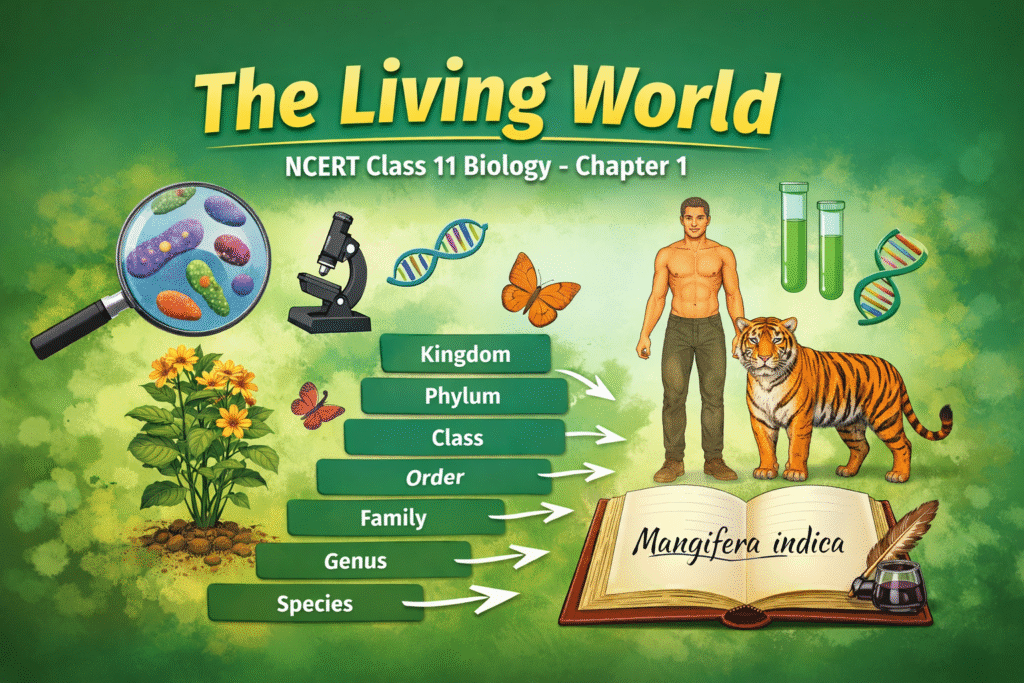
Illustrate the taxonomical hierarchy with suitable examples of a plant and an animal.
Example 1: Plant (Mango)
Kingdom   : Plantae
  ↓
Division  : Angiospermae
  ↓
Class     : Dicotyledonae
  ↓
Order     : Sapindales
  ↓
Family    : Anacardiaceae
  ↓
Genus     : Mangifera
  ↓
Species   : Mangifera indica
Example 2: Animal (Human)
Kingdom   : Animalia
  ↓
Phylum    : Chordata
  ↓
Class     : Mammalia
  ↓
Order     : Primates
  ↓
Family    : Hominidae
  ↓
Genus     : Homo
  ↓
Species   : Homo sapiens
Why are living organisms classified?
Why are the classification systems changing every now and then?
What different criteria would you choose to classify people that you meet often?
What do we learn from identification of individuals and populations?
Q6. Define a taxon. Give some examples of taxa at different hierarchical levels.
Examples of taxa at different levels:
Kingdom: Animalia,
Phylum: Chordata,
Class: Mammalia,
Order: Primates,
Family: Hominidae,
Genus: Homo,
Species: Homo sapiens
Q8. What is meant by the term ‘species’? Discuss its meaning in higher plants and animals and in bacteria.
In higher plants and animals: Species are defined based on reproductive isolation and the ability to interbreed.
In bacteria: Since reproduction is asexual, species are defined based on genetic similarity, biochemical characteristics, and DNA homology.
Why are living organisms classified?
Why are the classification systems changing every now and then?
What different criteria would you choose to classify people that you meet often?
What do we learn from identification of individuals and populations?
Q6. Define a taxon. Give some examples of taxa at different hierarchical levels.
Examples of taxa at different levels:
Kingdom: Animalia,
Phylum: Chordata,
Class: Mammalia,
Order: Primates,
Family: Hominidae,
Genus: Homo,
Species: Homo sapiens
Q8. What is meant by the term ‘species’? Discuss its meaning in higher plants and animals and in bacteria.
In higher plants and animals: Species are defined based on reproductive isolation and the ability to interbreed.
In bacteria: Since reproduction is asexual, species are defined based on genetic similarity, biochemical characteristics, and DNA homology.
More Q&A Bank on this Topic
Musculoskeletal System – Important Questions and Answers (LAQs)
-
Q: Compare and contrast the three types of muscles with examples.A: - Skeletal muscles: Striated, voluntary, attached…
-
Q: Explain the sliding filament theory in detail with role of…A: The sliding filament theory explains how…
Ready for More?
Test your knowledge with these related materials.


📺 Watch & Learn
Visual explanations and related video classes for better understanding.
🎥 Video Resources
The Living World - NCERT Solutions | Class 11 Biology Chapter 1 | CBSE 2025-26

The Living World - NCERT Solutions | Class 11 Biology Chapter 1 | CBSE 2025-26

The Living World Class 11 Biology | Revised NCERT Solutions | Bio Chapter 1 Questions 1-10

The Living World Class 11 CBSE NCERT Solutions Class 11 Biology Chapter 1

1. THE LIVING WORLD (Short Question Answer) | Class 11 Biology NCERT

The Living World - NCERT Solutions | Class 11 Biology Chapter 1 | LIVE

Completed NCERT Book📚 in a day🔥
💬 Discuss this Topic
Have a doubt or want to share something? Drop a comment below!