
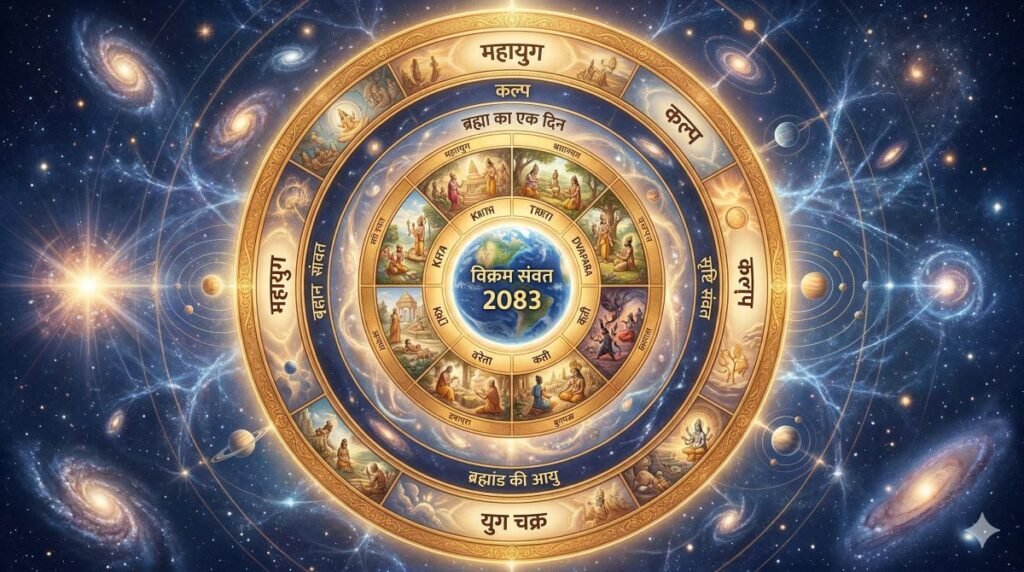
Hindu New Year – Science, Astronomy, and Cosmic Time
Table of Contents
- 1. What is Vikram Samvat? (The Math Behind the Year)
- 2. The Panchang: The Five Pillars of Time
- 3. Why Does 2083 Have 13 Months? (The Science of Adhik Maas)
- 4. The Six Seasons (Ritus) of Nature
- 5. Kaalganana: The Giant Wheel of Cosmic Time
- The Smallest Time (Micro Time)
- The Largest Time (The Yugas and Kalpas)
- 6. How India and the World Celebrate
- Did You Know? India’s Official National Calendar is Different!
Welcome to Solotutes! When we think of the “New Year,” we usually think of January 1st. But did you know there is a much older, highly scientific calendar that tracks the exact movements of the Sun, the Moon, and the stars? This is the Vedic calendar system of India.
On March 19, 2026, this ancient calendar enters the year Vikram Samvat 2083. In this complete guide, we will explore the fascinating science behind the Hindu New Year, how time is calculated, and why it is considered one of the most accurate systems in human history.
1. What is Vikram Samvat? (The Math Behind the Year)
The English calendar we use daily is called the Gregorian calendar. The traditional Hindu calendar is called Vikram Samvat. It was started by a great Indian king named Emperor Vikramaditya in the year 57 BCE (Before Common Era).
The New Year always begins in the season of Spring. Specifically, it starts on the first day (Pratipada) of the bright half of the moon (Shukla Paksha) in the month of Chaitra. This special day is known as Chaitra Shukla Pratipada.
2. The Panchang: The Five Pillars of Time
If you look at an English calendar, you only see the date and the day. But the Hindu calendar, known as the Panchang, is like a cosmic map. The word Panchang is made of two words: Pancha (Five) and Anga (Limbs). It tracks five different things happening in space every single day:
- Tithi (The Lunar Day): This is the date based on the distance between the Sun and the Moon. There are 30 Tithis in a month.
- Vaar (The Weekday): The 7 days of the week, named after the planets (For example, Somvaar for Monday/Moon, Ravivaar for Sunday/Sun).
- Nakshatra (The Star Constellation): As the Moon travels around the Earth, it passes through 27 different groups of stars. These are the Nakshatras.
- Yoga (The Sun-Moon Angle): A special mathematical calculation adding the positions of the Sun and the Moon.
- Karana (Half-Day): Exactly one-half of a Tithi.
3. Why Does 2083 Have 13 Months? (The Science of Adhik Maas)
This is where the Hindu calendar shows its pure genius. A normal calendar year has 12 months. But in the year Vikram Samvat 2083, there will be 13 months!
Why does this happen?
- A Solar Year (the Earth going around the Sun) takes about 365 days.
- A Lunar Year (12 cycles of the Moon) takes only 354 days.
Because the Moon is faster, the lunar calendar falls behind by 11 days every year. After 3 years, this gap becomes exactly one full month (33 days). To fix this gap and keep the calendar matched perfectly with nature, the ancient Indian scientists added an extra month every three years.
This “bonus month” is called Adhik Maas (Extra Month). In 2083, the month of Jyeshtha will repeat twice. Because of this brilliant system, festivals like Diwali always happen in Autumn, and Holi always happens in Spring!
4. The Six Seasons (Ritus) of Nature
While the Western world divides the year into 4 seasons (Spring, Summer, Autumn, Winter), the ancient Indian scientists observed nature more closely and divided the year into 6 Seasons, known as Ritus. Each season lasts for exactly two months.
| Sanskrit Name (Ritu) | English Meaning | Hindu Months |
|---|---|---|
| Vasant | Spring | Chaitra & Vaishakha |
| Grishma | Summer | Jyeshtha & Ashadha |
| Varsha | Monsoon (Rains) | Shravana & Bhadrapada |
| Sharad | Autumn | Ashwin & Kartika |
| Hemant | Pre-Winter | Margashirsha & Pausha |
| Shishir | Deep Winter | Magha & Phalguna |
5. Kaalganana: The Giant Wheel of Cosmic Time
Now, let’s zoom out. The Vedic science of time measurement is called Kaalganana. Ancient Indian astronomers did not just measure days and years; they measured the age of the universe.
The Smallest Time (Micro Time)
Long before modern atomic clocks, Vedic sages measured the smallest fractions of time:
- Truti: The time it takes for a needle to pierce a lotus leaf (about 0.30 microseconds).
- Nimesha: The time it takes to blink your eye.
- Muhurta: A block of 48 minutes. There are 30 Muhurtas in a single day.
The Largest Time (The Yugas and Kalpas)
Time in the Hindu system is not a straight line; it is a giant circle. The history of the world is divided into four massive eras called Yugas:
- Satya Yuga: The Age of Truth (1,728,000 years).
- Treta Yuga: The Age of Lord Rama (1,296,000 years).
- Dvapara Yuga: The Age of Lord Krishna (864,000 years).
- Kali Yuga: The Current Age of Machines and Technology (432,000 years).
When you add all four Yugas together, it becomes one Mahayuga (4.32 million years). And 1,000 Mahayugas make up one Kalpa. One Kalpa is equal to a single day in the life of the creator, Lord Brahma. A Kalpa is exactly 4.32 Billion Years long.
Amazing Fact: Modern scientists today estimate that the Earth is about 4.5 billion years old. The ancient Indian sages figured out this massive cosmic timeline thousands of years ago using pure mathematics and astronomy!
6. How India and the World Celebrate
Because India is so large and diverse, this same New Year is celebrated under different beautiful names across the country and even the world:
- Gudi Padwa: Celebrated in Maharashtra by raising a victory flag (the Gudi).
- Ugadi: Celebrated in Karnataka, Andhra Pradesh, and Telangana. People eat a special dish with 6 different tastes (sweet, sour, bitter, etc.) to remind them that life is a mixture of all feelings.
- Navreh: The New Year for the people of Kashmir.
- Nyepi: Celebrated far away in Bali, Indonesia. They celebrate the Hindu New Year with a “Day of Silence,” turning off all lights and sounds to respect nature.
Did You Know? India’s Official National Calendar is Different!
While we use the Vikram Samvat to decide the dates of all Hindu festivals like Diwali and Holi, the Government of India uses a different calendar for its official work. This is called the Saka Samvat.
- The Saka calendar started in the year 78 CE.
- It was adopted as the Official National Calendar of India on March 22, 1957.
- Unlike the Lunar system, the Saka calendar is mostly Solar, meaning it has exactly 365 days in a normal year, just like the English calendar!
Want to learn the amazing history of the Saka Samvat, the Hijri Calendar, or the Chinese Calendar?
👉 Click here to explore our complete “World Calendars Series”!
Categorized Under:
More Study Notes on this Topic

Ready for More?
Test your knowledge with these related materials.


📺 Watch & Learn
Visual explanations and related video classes for better understanding.
🎥 Video Resources
Hindu Calendar mystery explained😱 #calander #panchang #explained #secret #nasa

Hindu Calendar mystery explained😱 #calander #panchang #explained #secret #nasa

Could Betelgeuse DESTROY Earth? #shorts

Know About Calender | English Calender vs Hindu Calendar | Gregorian Calendar History #bharat

The Ending of Kali Yuga: What to Expect in 2082

Signs of Stock Market Upswing | Stock Market Astrology| Prashant Kapoor

WOW a Neutron star 🌟 #shorts #earth #star #space #cosmos
💬 Discuss this Topic
Have a doubt or want to share something? Drop a comment below!