
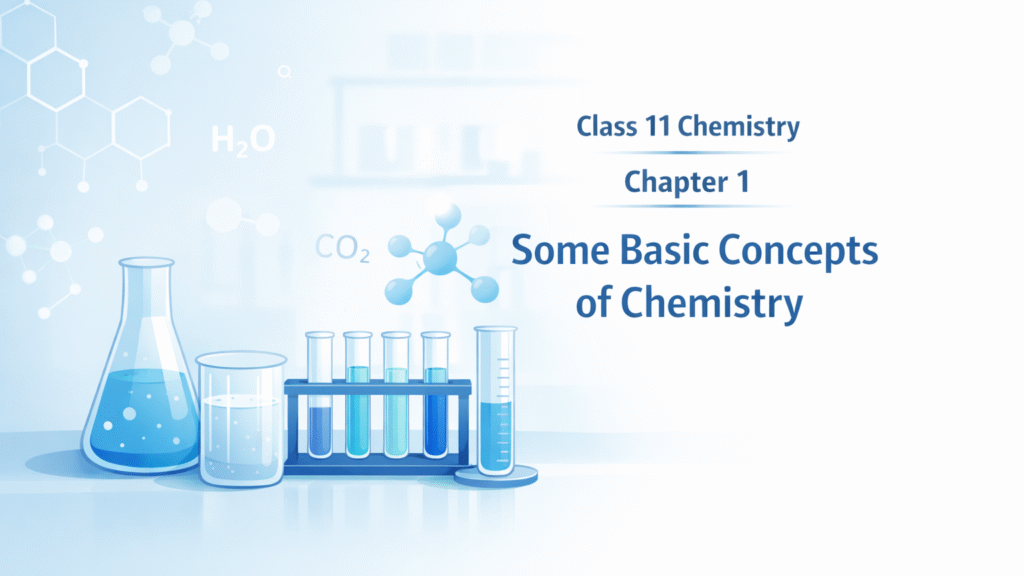
Class 11 Chemistry – Chapter 1 Some Basic Concepts of Chemistry (Complete NCERT Notes)
Chemistry is the branch of science that deals with the study of the composition, structure, properties, and transformations of matter.
1. Chemistry and Its Scope
- Used in medicine, agriculture, and industry
- Helps in understanding materials used in daily life
- Forms the basis of environmental science and biotechnology
2. Matter and Its Classification
Matter is anything that has mass and occupies space.
2.1 Physical Classification
- Solid: Fixed shape and volume
- Liquid: Fixed volume, variable shape
- Gas: Variable shape and volume
2.2 Chemical Classification
- Element: Cannot be decomposed chemically
- Compound: Elements combined in fixed ratio
- Mixture: Components mixed physically
3. Properties of Matter
Physical Properties
- Colour
- Density
- Melting point
- Boiling point
Chemical Properties
- Reactivity
- Combustion
- Rusting
4. Laws of Chemical Combination
4.1 Law of Conservation of Mass
Mass is neither created nor destroyed during a chemical reaction.
4.2 Law of Definite Proportions
A given compound always contains the same elements in the same fixed ratio by mass.
5. Dalton’s Atomic Theory
- Matter is composed of atoms
- Atoms of the same element are identical
- Atoms combine in simple whole-number ratios
- Atoms are conserved in chemical reactions
6. Atomic Mass and Molecular Mass
Atomic Mass
Atomic mass is expressed relative to 1/12th the mass of a carbon-12 atom.
Molecular Mass
Sum of atomic masses of all atoms in a molecule.
Example: H2O = 2×1 + 16 = 18 u
7. Mole Concept
One mole is the amount of substance containing 6.022 × 10²³ particles.
Avogadro Constant: 6.022 × 10²³ mol−1
Important Formulae
- Number of moles = Given mass / Molar mass
- Number of particles = Moles × Avogadro constant
8. Concentration of Solutions
8.1 Mass Percentage (% w/w)
% w/w = (Mass of solute / Mass of solution) × 100
8.2 Volume Percentage (% v/v)
% v/v = (Volume of solute / Volume of solution) × 100
8.3 Mass by Volume Percentage (% w/v)
% w/v = (Mass of solute / Volume of solution) × 100
9. Molarity (M)
Molarity is the number of moles of solute per litre of solution.
Formula: M = Moles of solute / Volume of solution (in litres)
Unit: mol L−1
Limitation: Changes with temperature.
10. Molality (m)
Molality is the number of moles of solute per kilogram of solvent.
Formula: m = Moles of solute / Mass of solvent (kg)
Advantage: Independent of temperature.
11. Mole Fraction (χ)
Mole fraction is the ratio of moles of a component to total moles in solution.
χA = Moles of A / Total moles of solution
12. Parts Per Million (ppm)
Used for very dilute solutions.
ppm = (Mass of solute / Mass of solution) × 106
14. Limiting Reagent
The reactant that is completely consumed first in a chemical reaction is called the limiting reagent.
It determines the maximum amount of product formed.
15. Empirical Formula and Molecular Formula
Empirical Formula
Simplest whole-number ratio of atoms in a compound.
Molecular Formula
Actual number of atoms of each element in a molecule.
16. Strength of Solution
Strength of solution is defined as the amount of solute present per litre of solution.
Unit: g L−1
More Study Notes on this Topic
Ready for More?
Test your knowledge with these related materials.


📺 Watch & Learn
Visual explanations and related video classes for better understanding.
🎥 Video Resources
11th chemistry chapter 1 Notes | some basic concepts of chemistry|#study #students #studystudio

11th chemistry chapter 1 Notes | some basic concepts of chemistry|#study #students #studystudio

Plus One Chemistry | Chapter 1 Some Basic Concepts Of Chemistry Summary | Eduport Plus One

Some Basic Concepts of Chemistry | Mole Concept | All formulas Short Notes

Some Basic Concepts of Chemistry Class 11 in One Shot | CBSE Class 11th Chemistry Chapter-1 Revision

Some Basic Concepts of Chemistry Class 11 | CBSE Class 11th Chemistry Chapter-1 in 1️⃣5️⃣ Mins

Some basic concepts of chemistry | class 11 chemistry handwritten notes | cbse | ncert | jee | neet
💬 Discuss this Topic
Have a doubt or want to share something? Drop a comment below!