
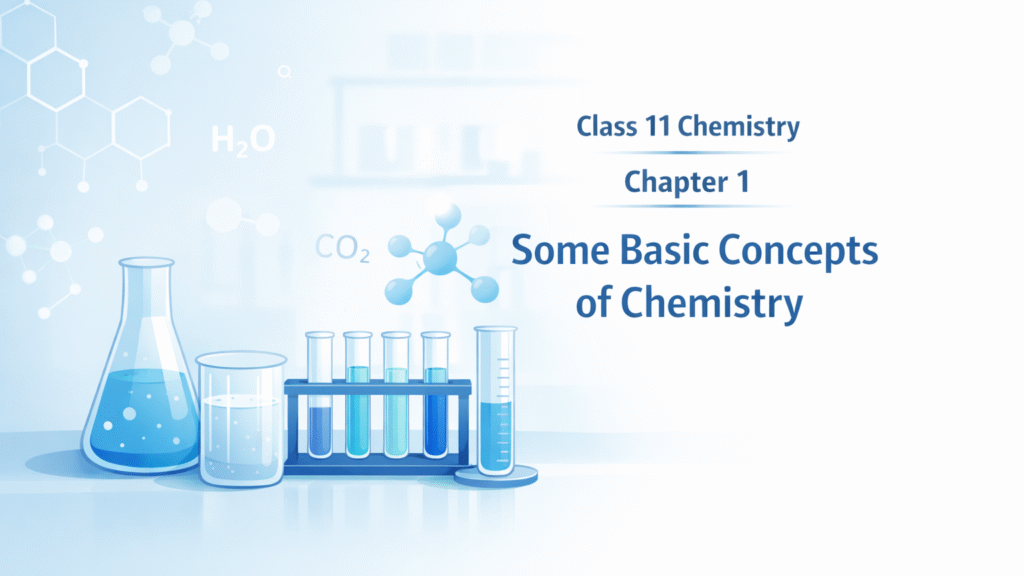
Class 11 Chemistry – Chapter 1 Some Basic Concepts of Chemistry (Complete NCERT Notes)
Table of Contents
- 1. Chemistry and Its Scope
- 2. Matter and Its Classification
- 3. Properties of Matter
- 4. Laws of Chemical Combination
- 5. Dalton’s Atomic Theory
- 6. Atomic Mass and Molecular Mass
- 7. Mole Concept
- 8. Concentration of Solutions
- 9. Molarity (M)
- 10. Molality (m)
- 11. Mole Fraction (χ)
- 12. Parts Per Million (ppm)
- 14. Limiting Reagent
- 15. Empirical Formula and Molecular Formula
- 16. Strength of Solution
Chemistry is the branch of science that deals with the study of the composition, structure, properties, and transformations of matter.
1. Chemistry and Its Scope
- Used in medicine, agriculture, and industry
- Helps in understanding materials used in daily life
- Forms the basis of environmental science and biotechnology
2. Matter and Its Classification
Matter is anything that has mass and occupies space.
2.1 Physical Classification
- Solid: Fixed shape and volume
- Liquid: Fixed volume, variable shape
- Gas: Variable shape and volume
2.2 Chemical Classification
- Element: Cannot be decomposed chemically
- Compound: Elements combined in fixed ratio
- Mixture: Components mixed physically
3. Properties of Matter
Physical Properties
- Colour
- Density
- Melting point
- Boiling point
Chemical Properties
- Reactivity
- Combustion
- Rusting
4. Laws of Chemical Combination
4.1 Law of Conservation of Mass
Mass is neither created nor destroyed during a chemical reaction.
4.2 Law of Definite Proportions
A given compound always contains the same elements in the same fixed ratio by mass.
5. Dalton’s Atomic Theory
- Matter is composed of atoms
- Atoms of the same element are identical
- Atoms combine in simple whole-number ratios
- Atoms are conserved in chemical reactions
6. Atomic Mass and Molecular Mass
Atomic Mass
Atomic mass is expressed relative to 1/12th the mass of a carbon-12 atom.
Molecular Mass
Sum of atomic masses of all atoms in a molecule.
Example: H2O = 2×1 + 16 = 18 u
7. Mole Concept
One mole is the amount of substance containing 6.022 × 10²³ particles.
Avogadro Constant: 6.022 × 10²³ mol−1
Important Formulae
- Number of moles = Given mass / Molar mass
- Number of particles = Moles × Avogadro constant
8. Concentration of Solutions
8.1 Mass Percentage (% w/w)
% w/w = (Mass of solute / Mass of solution) × 100
8.2 Volume Percentage (% v/v)
% v/v = (Volume of solute / Volume of solution) × 100
8.3 Mass by Volume Percentage (% w/v)
% w/v = (Mass of solute / Volume of solution) × 100
9. Molarity (M)
Molarity is the number of moles of solute per litre of solution.
Formula: M = Moles of solute / Volume of solution (in litres)
Unit: mol L−1
Limitation: Changes with temperature.
10. Molality (m)
Molality is the number of moles of solute per kilogram of solvent.
Formula: m = Moles of solute / Mass of solvent (kg)
Advantage: Independent of temperature.
11. Mole Fraction (χ)
Mole fraction is the ratio of moles of a component to total moles in solution.
χA = Moles of A / Total moles of solution
12. Parts Per Million (ppm)
Used for very dilute solutions.
ppm = (Mass of solute / Mass of solution) × 106
14. Limiting Reagent
The reactant that is completely consumed first in a chemical reaction is called the limiting reagent.
It determines the maximum amount of product formed.
15. Empirical Formula and Molecular Formula
Empirical Formula
Simplest whole-number ratio of atoms in a compound.
Molecular Formula
Actual number of atoms of each element in a molecule.
16. Strength of Solution
Strength of solution is defined as the amount of solute present per litre of solution.
Unit: g L−1
Categorized Under:
More Study Notes on this Topic
Ready for More?
Test your knowledge with these related materials.

📺 Watch & Learn
Visual explanations and related video classes for better understanding.
🎥 Video Resources
11th chemistry chapter 1 Notes | some basic concepts of chemistry|#study #students #studystudio

11th chemistry chapter 1 Notes | some basic concepts of chemistry|#study #students #studystudio

Plus One Chemistry | Chapter 1 Some Basic Concepts Of Chemistry Summary | Eduport Plus One

Some Basic Concepts of Chemistry | Mole Concept | All formulas Short Notes

Some Basic Concepts of Chemistry Class 11 in One Shot | CBSE Class 11th Chemistry Chapter-1 Revision

Some Basic Concepts of Chemistry Class 11 | CBSE Class 11th Chemistry Chapter-1 in 1️⃣5️⃣ Mins

Some basic concepts of chemistry | class 11 chemistry handwritten notes | cbse | ncert | jee | neet
💬 Discuss this Topic
Have a doubt or want to share something? Drop a comment below!