
Charged Particles in Matter | Electrons and Protons
Whenever we rub two objects together, they become electrically charged. This is because atoms divisible as they consists of charged particles.
Therefore, atoms can be further divided into proton, neutron and electron.
By 1900, it was known that the atom is not a simple and indivisible particle but contains at least one sub-atomic particle – the “electron”. This theory was proposed by J.J. Thomson.
He carried a “cathode Ray” experiment in which observed a stream of negatively charged particle coming out of cathode towards the anode, which ultimately known as electron.
In 1886, E. Goldstein discovered the presence of new radiation in a gas discharge and call them “canal rays” which were positively charged radiation.
This was observed in the same gas discharge tube, emitting positive particles from anode.
This ultimately led to the discovery of another sub-atomic particle which had a charge equal in magnitude but opposite in sign to that of electron and mass approximately 2000 times as that of the electron. It was given the name “proton”.
An electron is represented as ‘e–’on a proton as ‘p+’.
Neutrons were discovered by charge “James Chadwick” in 1932.
Atoms are made up of protons and electrons in equal or balanced proportion.
Categorized Under:
More Study Notes on this Topic
Ready for More?
Test your knowledge with these related materials.

📺 Watch & Learn
Visual explanations and related video classes for better understanding.
🎥 Video Resources
What is Electric Charge and How Electricity Works | Electronics Basics #1
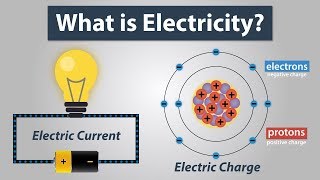
What is Electric Charge and How Electricity Works | Electronics Basics #1

What

Huge Misconception: Protons, Electrons, Atoms, and Ions

Protons Neutrons Electrons Isotopes - Average Mass Number
Electric Charge: Crash Course Physics #25

How To Calculate The Number of Protons, Neutrons, and Electrons - Chemistry