In 1811 seydler used the term in his work titled Analects Pharma Cognostica.
Q2. The source of Indian acacia is-
A) Acacia arabica
B) Gelidium amansii
C) Astragalus gummifur
D) Sterculia urens
Answer: (A) Acacia arabica
Acacia contains gallic acid, catechin, chlorogenic acid and gallolyated falvan-3,4-diole.
Q3. Ashwagandha is common name for-
A) Wthania somniferum
B) Holarrhena antidysentrica
C) Bacopa moneira
D) Centella asiatica
Answer: (A) Wthania somniferum
Withania somnifera, Indian ginseng is a plant in Solanaceae or nightshade family.
Q4. Quinine and quinidine is differ in-
A) Chemical structure
B) solubility
C) In rotating the plane of polarized light
D) none of the above
Answer: (C) In rotating the plane of polarized light
Quinine is levo isomer while quinidine is dextro isomer.
Q5. Cinchona belongs to family-
A) Rutaceae
B) Apocynaceae
C) Rubiaceae
D) Lauraceae
Answer: (C) Rubiaceae
Cinchona is a genus of about 38 species in the family Rubiaceae.
Q6. Which one of these is called a Indian tobacco?
A) Lobelia
B) Nicotina
C) Cocca leaves
D) none of the above
Answer: (A) Lobelia
Lobelia is also called Indian Tobacco is used as herbal remedy for respiratory condition such as asthma, bronchitis.
Q7. Sarpagandha is related to-
A) Rauwolfia
B) Arjuna
C) Nux-vomica
D) Physostigma
Answer: (A) Rauwolfia
Rauwolfia serpentina, commonly known as Indian Snak root or sarpagandha, contain ajmaline, reserpine extra.
Q8. Deadly night shade plant is related to-
A) Hyoscyamus niger
B) Datura stramonium
C) Belladonna
D) none of the above
Answer: (C) Belladonna
Atropa belladonna, commonly known as deadly night shade, is a perennial herbaceous plants in the family Solanaceae.
Q9. Which one of these reagent is used to indicate the presence of emetine?
A) Picric acid
B) Potassium chlorate
C) potassium bismuth iodide
D) Iodine in pottassium iodide solution
Answer: (B) Potassium chlorate
Emetine is shaken with water and small amount of HCL. To the filtrate pottasium chlorate is added. It goves a yellow colour changing to red.
Q10. Nux-vomica seed belongs to the family-
A) Rubiaceae
B) Loganiaceae
C) Papaveraceae
D) Apocynaceae
Answer: (B) Loganiaceae
Nux-vomica is also known as poison nut and quaker buttons.
Q11. Which one of these alkaloids is volatile in nature?
A) Narcotine
B) Papaverine
C) Nicotine
D) Thebaine
Answer: (A) Narcotine
Due to volatile nature of narcotine it is extracted out by steam distillation process.
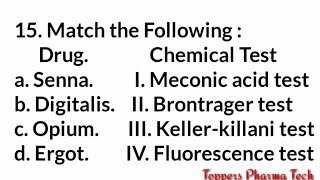
Q12. Keller-Killiani test is specified for-
A) Aglycon part of digitalis glycosides
B) Glycon part of Digitalis glycosides
C) Both Glycon and Aglycon part
D) none of the above
Answer: (B) Glycon part of Digitalis glycosides
Cardiac glycoside + CH3COOH + H2SO4 +FeCl3 → brown colour.
Q13. which one of these is adulterant of digitalis leaves?
A) Verbasscum thapsus
B) Digitalis lutea
C) Digitalis thapsi
D) none of the above
Answer: (A) Verbasscum thapsus
The leaves of Verbascum thapsus belonging to the family Scrophulareae are usually mixed with digitalis leaves which may be identified and distinguised by the abundant presence of huge woody and branched candelabra trichomes. Pemula vulgaris is another adultrant.
Q14. Revand chini is common name for-
A) Aloe
B) Rhubarb
C) Cascara
D) Cinnamon
Answer: (B) Rhubarb
Revand Chini is the common name for Rhubarb (Rheum emodi) in Hindi language.
Q15. Amylum is synonym for-
A) starch
B) cellulose
C) sodium alginate
D) isaphgol mucilage
Answer: (A) starch
The word 'starch' means to stiffen. The 'amylum' is dried from greek greek word 'amylon' means not ground at a mill.
Q16. The marmelosin is constituent of-
A) Agar
B) Acacia gum
C) Bael
D) Karaya gum
Answer: (C) Bael
Bael contains shikimmianine, lupeol, cineol, marmelosin, etc.
Q17. Urginea maritimma is used as-
A) Purgative
B) Astringent
C) Cardiotonic
D) Anti-infective
Answer: (C) Cardiotonic
due to presence of Scillarene B, it is used as cardiotonic. It also has diuretic and expectorant actions.
Q18. Vasaka is used as-
A) Expectorant
B) sedative
C) stimulant
D) cardiac tonic
Answer: (A) Expectorant
vasaka shows bonchodilatory activity due to presence of alkaloids vasicine and vasicinone.
Q19. Camphor is obtained from which plant?
A) Eucalyptus globulus
B) Cinnammonnum camphora
C) Chenopodium ambrosoids
D) none of the above
Answer: (B) Cinnammonnum camphora
Camphor is obtained from the wood of Camphor laurel (Cinnammonnum camphora).
Q20. Cymbopogon citratus belongs to the family-
A) Graminae
B) Lauraceae
C) Myrtaceae
D) Rubiaceae
Answer: (A) Graminae
Cymbopogon citratus, commony known as lemon grass, is tropical plants from southeast Asia. It belongs to the family Graminae or poaceae.
Q21. Terpentine oil contains mainly-
A) citral
B) α-pinene
C) Limonene
D) Phellandrene
Answer: (B) α-pinene
Terpentine oil contains mainly terpenes, alpha-pinene and beta-pinene with lesser amounts of camphene dipentene and terpinolene.
Q22. Peppermint oil is synonym for-
A) Mentha oil
B) Chenopodium oil
C) Cardamom oil
D) Lemon oil
Answer: (A) Mentha oil
Mentha oil obtained by steam distillation of mentha arensis leaves.
Q23. Which part of the Dill fruit contains oil?
A) Entire fruit
B) Endosperm
C) Vittae
D) Mericarp
Answer: (C) Vittae
Dill fruits are oval compressed, winged about one tenth wide, with three longitudinal ridges on the bark and three dark lines or oil cells (vittae) between them and two on the flat surface.
Q24. Pale and black catechu are differentiated on the basis of presence/ absence of-
A) Catechin
B) Quercetin
C) Gambier fluorecin
D) Gums
Answer: (C) Gambier fluorecin
Alcoholic extract of the drug when treated with NaOH and light petrolium ether, Pale catechu shows green fluorescence due to the presence of Gambier fluorecin.
Q25. Triterpenoid saponins are present in-
A) Arjuna Bark
B) Black catechu
C) Bahera
D) none of the above
Answer: (A) Arjuna Bark
The terpenoidal saponins are arjunic acid, arjunolic acid, and arjugenins.
Q26. Pungency of chilies is due to the presence of?
A) Capsaicin
B) Capsanthin
C) Carotene
D) Pungent protein
Answer: (A) Capsaicin
pungency is due to the group of coumpounds named capsicinoids.
Q27. Turmeric possess saffron colour due to presence of-
A) Curcumin
B) Turmerone
C) Curcumens
D) Phellandrene
Answer: (A) Curcumin
Turmeric contains group of compounds called curcuminoids, which includes curcumin (diferucoylmehane), dimethoxycurcumin, and bisdimethoxycurcumin. Curcumin impart saffron colour to it.
Q28. Free cinnamic acid is present in-
A) Colophony
B) Storax
C) Asafoetida
D) Balsam of tolu
Answer: (D) Balsam of tolu
The balsam contains a fairly large amount of benzyl and cinnamylester of benzoic acid and cinnamic acid.
Q29. Bees wax mainly contains-
A) Palmitin
B) Myricin
C) Stearin
D) Cerotic acid
Answer: (B) Myricin
Myricin is present in beeswax.
Q30. Silk fibres obtained from-
A) seeds of goissypium
B) Cacoons of Bombyx mori
C) Synthetic source
D) Corchorus cupsularin
Answer: (B) Cacoons of Bombyx mori
Silk is natural protein fiber, some forms of which can be wooven into textiles. The best known type of silk is obtained from cocoons of larvae of the mulberry silkworm, Bombyx mori.
PHARMACOGNOSY-CH 1-MCQ 01-10-INTRODUCTION OF PHARMACOGNOSY
MCQs from Pharmacognosy for Pharmacist exam / MCQs for pharmacist exam 2021
Pharmacognosy || Most important Questions for Exams According to New Syllabus || Long || short
pharmacognosy mcqs questions with answer for 1st sessional exam of d pharmacy
How to Get PDF from Solotutes.com?
Getting your study material in PDF format from Solotutes is very simple:
Open any post you want to download in PDF format.
Just below the title, you will see a Download PDF button or link.
Click on it and you will be redirected to this download page.
Here, you will need to wait for 1 minute before the PDF button becomes active.
Meanwhile, you can explore other resources available on this page such as related notes, quizzes, one-liners, or even watch relevant YouTube videos embedded here for better understanding.
Once the timer ends, click on the Download Now button and your PDF will start downloading.
Why 1 Minute Wait?
⚡ To generate a clean, optimized, and printer-friendly PDF copy of Pharmacognosy Practice test #1 | MCQs for Pharmacy Exams.
💡 To support Solotutes with ads during this time, ensuring that our resources remain 100% free for students worldwide.
What You Will Get in Pharmacognosy Practice test #1 | MCQs for Pharmacy Exams PDF?
✔ A high-quality PDF of Pharmacognosy Practice test #1 | MCQs for Pharmacy Exams with proper formatting
✔ Easy to read offline on mobile, tablet, or desktop
✔ Great for revision, practice, and quick reference
✔ Additional learning support with related videos and resources linked on this page
✔ Supports our mission: “Knowledge for Everyone”
Why Choose Solotutes?
At Solotutes, we provide free access to notes, quizzes, MCQs, one-liners, and tests for multiple exams. By downloading Pharmacognosy Practice test #1 | MCQs for Pharmacy Exams in PDF format, you not only get valuable material but also become part of a growing community of learners.
We regularly update our posts with videos, explanations, and extra content to help you understand topics better. Exploring these while waiting for your PDF ensures you don’t waste a single minute.
FAQs – Pharmacognosy Practice test #1 | MCQs for Pharmacy Exams Download
Q. Is this PDF really free? ✅ Yes! All downloads on Solotutes are completely free for students.
Q. Do I need to sign up? ❌ No, you don’t need to create any account. Just wait for 1 minute and click download.
Q. Can I share this PDF with my friends? ✔ Yes, please share and help others learn too.
Q. Can I access other resources while waiting? 👍 Yes, you can scroll down to check related quizzes, notes, and YouTube videos while your download is getting ready.
About Solotutes
Solotutes.com is dedicated to students preparing for competitive exams, schools, and universities.
We provide free PDFs, quizzes, MCQs, notes, and one-liners to make learning easy and accessible. Our aim is to save your time, keep you motivated, and ensure you always have the best study material — anytime, anywhere.