
The History of the Gregorian and Julian Calendars Explained
Table of Contents
Welcome back to the Solotutes History and Calendars series! In our previous lessons, we explored the fascinating science behind India’s Vikram Samvat and Saka Samvat. But have you ever wondered why almost every country in the world uses the same dates today?
Why do we celebrate New Year on January 1st? Why does February get an extra day every four years? To answer these questions, we need to travel back in time to ancient Rome and uncover the story of the Julian and Gregorian Calendars.
1. The First Attempt: The Julian Calendar
Before our modern calendar existed, the Romans had a very confusing calendar that was often changed by politicians to stay in power longer. To fix this mess, the famous Roman leader Julius Caesar introduced the Julian Calendar in the year 46 BCE.
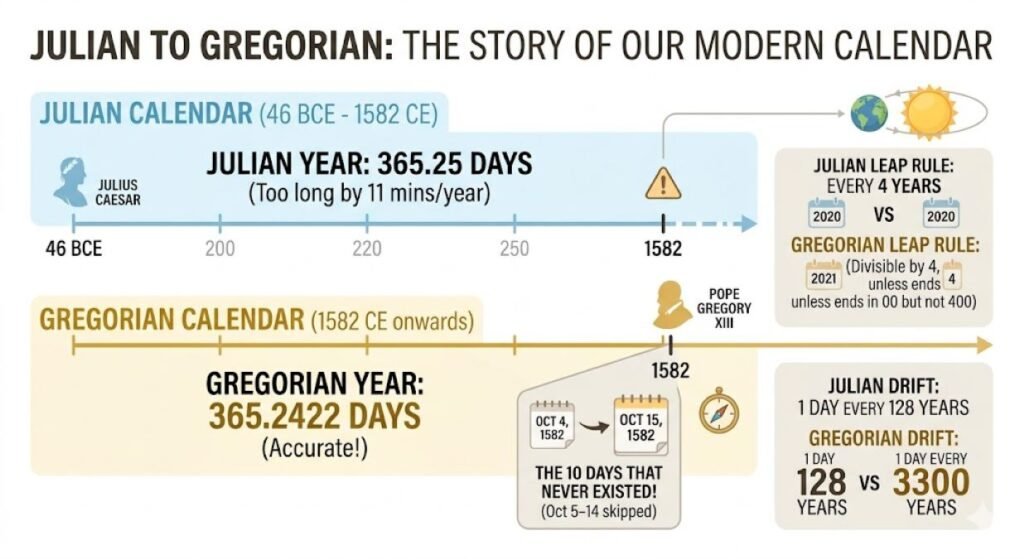
With the help of an astronomer named Sosigenes, Julius Caesar figured out that it takes the Earth about 365.25 days to orbit the Sun. To handle that extra quarter (0.25) of a day, he invented a brilliant rule:
- A normal year will have 365 days.
- Every fourth year will have an extra day added to February, making it 366 days. This was the birth of the Leap Year!
2. The Big Mistake: 11 Minutes Too Long!
The Julian calendar was a great invention, but it had a tiny mathematical flaw. The actual time it takes the Earth to orbit the Sun is not exactly 365.25 days. It is actually 365.24219 days.
Because of this, the Julian calendar was too long by exactly 11 minutes and 14 seconds every year. This seems like a tiny mistake, right? But over hundreds of years, those 11 minutes added up!
By the 1500s, the calendar was 10 days out of sync with the actual seasons. The Spring season was arriving on March 11th instead of March 21st. This caused huge problems for farmers and religious leaders trying to calculate the date of Easter.
3. The Solution: The Gregorian Calendar (1582 CE)
To fix this problem, Pope Gregory XIII introduced a highly accurate, updated calendar in October 1582. We still use this calendar today, and it is known as the Gregorian Calendar.
Did You Know? The 10 Days That Disappeared!
To reset the calendar back to the correct seasons, Pope Gregory had to skip 10 days. In October 1582, people went to sleep on Thursday, October 4th, and woke up the next morning on Friday, October 15th! Those 10 days simply never existed in history.
4. The New Leap Year Rule
To make sure the calendar never drifted away from the seasons again, the Gregorian system changed the Leap Year rule slightly. It is no longer just “every four years.” Here is the modern mathematical rule:
- A year is a leap year if it can be divided evenly by 4.
- EXCEPTION: If the year ends in “00” (like 1700, 1800, 1900), it is NOT a leap year.
- EXCEPTION TO THE EXCEPTION: If the “00” year can be divided by 400, it IS a leap year (This is why the year 2000 was a leap year, but 2100 will not be!).
This brilliant rule makes the Gregorian Calendar so accurate that it will only be off by one day every 3,300 years!
5. Fun Fact: How the Months Got Their Names
The names of our 12 months are filled with ancient Roman history. Have you ever noticed that “Octo” means 8 (like Octopus), but October is the 10th month? Here is why:
| Month Name | The Meaning Behind It |
|---|---|
| January | Named after Janus, the Roman god of doorways and new beginnings (he had two faces, looking at the past and the future). |
| July | Named in honor of Julius Caesar after his death. |
| August | Named in honor of Augustus Caesar, the first Emperor of Rome. |
| Sept, Oct, Nov, Dec | In the very old Roman calendar, March was the 1st month. So, September was the 7th, October was the 8th, November the 9th, and December the 10th! Even though we added Jan and Feb later, we kept the old number names. |
Conclusion
Today, the Gregorian Calendar is the international standard for business, aviation, and global communication. It is a pure solar calendar that shows us how human beings have continuously used science and mathematics to understand our planet’s exact movement around the sun.
Explore Our World Calendar Series!
⏮️ Previous Lesson:
Missed our last article? Learn about the Saka Samvat, the highly scientific Official National Calendar of India, and how to calculate its dates.
👉 Read Part 2: The Saka Samvat (India’s National Calendar)
⏭️ Next Up:
We have explored Solar and Lunisolar calendars. But how does a Pure Lunar Calendar work? Why do dates for festivals like Eid and Ramadan move backwards by 11 days every year?
👉 Read Part 4: The Secrets of the Islamic Hijri Calendar!

Categorized Under:
More Study Notes on this Topic

Ready for More?
Test your knowledge with these related materials.


📺 Watch & Learn
Visual explanations and related video classes for better understanding.
🎥 Video Resources
The Calendar's 10,000 Year History | World History | Extra History

The Calendar's 10,000 Year History | World History | Extra History
The History of the Modern Calendar

Gregorian vs Julian Calendars: Why the Big Fuss?

The Gregorian Calendar | JRE & Neil deGrasse Tyson

The #gregorian and #julian #calendar . #time #newyear #juliuscaesar #popegregory #churchhistory #god

Tracking Time: The Julian to Gregorian Calendar Transition Explained | Neil Degrasse Tyson #1159
💬 Discuss this Topic
Have a doubt or want to share something? Drop a comment below!
0 Discussion(s)
You must be logged in to join the discussion.