
The National Calendar of India: A Simple Guide to Saka Samvat
Table of Contents
Welcome back to Solotutes! In our previous article, we learned about the Vikram Samvat, which we use to celebrate our beautiful festivals. But did you know that the Government of India uses a completely different calendar for its official work? This is called the Saka Samvat.
In this guide, we will explore the history of the Saka calendar, how it works, and learn the names of all its months. Let’s dive in!
1. What is the Saka Samvat?
The Saka Samvat is the official National Calendar of India. When the country became independent, there were over 30 different local calendars being used across different states. This caused a lot of confusion in government offices.
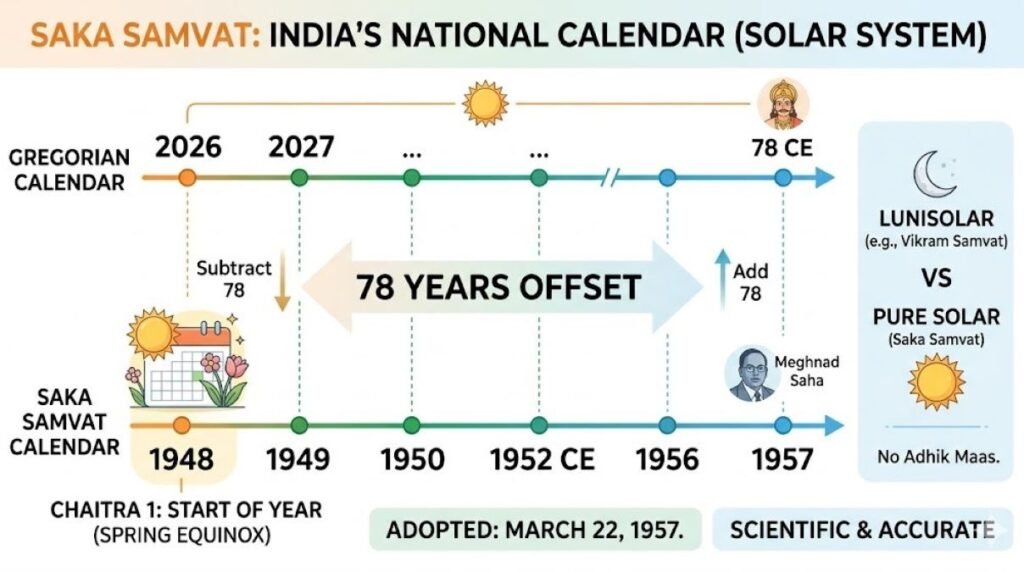
To solve this, the government formed a Calendar Reform Committee in 1952. It was led by the brilliant Indian astrophysicist, Meghnad Saha. They chose the ancient Saka calendar, made it perfectly scientific to match the solar year, and officially adopted it on March 22, 1957.
2. The History: How Did It Start?
The Saka era is a very proud part of Indian history. It was started by King Shalivahana of the great Satavahana dynasty in the year 78 CE (Common Era) to celebrate his major military victories. Because it started 78 years after the English (Gregorian) calendar, the Saka year is always 78 years behind.
To find the current Saka year, simply subtract 78 from the current English year.
2026 (English Year) – 78 = 1948 (Saka Year)
3. How is it Different from the Festival Calendar?
The festival calendar (Vikram Samvat) follows the Moon, which means its dates keep moving around every year (which is why Diwali dates change). But the Saka Samvat is a Pure Solar Calendar. It strictly follows the Earth’s movement around the Sun.
- Just like the English calendar, the Saka calendar has exactly 365 days in a normal year.
- In a Leap Year, it has exactly 366 days.
- Because it is tied to the Sun, the dates of the Saka calendar always match exactly with the English calendar dates!
4. The 12 Months of the Saka Calendar
This is the most interesting part. The names of the months are similar to our festival calendar, but their days are strictly fixed. The first month is always Chaitra.
| No. | Sanskrit Name | Number of Days | Starts on (English Date) |
|---|---|---|---|
| 1 | Chaitra | 30 Days (31 in Leap Year) | March 22 (March 21 in Leap Year) |
| 2 | Vaishakha | 31 Days | April 21 |
| 3 | Jyeshtha | 31 Days | May 22 |
| 4 | Ashadha | 31 Days | June 22 |
| 5 | Shravana | 31 Days | July 23 |
| 6 | Bhadrapada | 31 Days | August 23 |
| 7 | Ashwin | 30 Days | September 23 |
| 8 | Kartika | 30 Days | October 23 |
| 9 | Margashirsha (Agrahayana) | 30 Days | November 22 |
| 10 | Pausha | 30 Days | December 22 |
| 11 | Magha | 30 Days | January 21 |
| 12 | Phalguna | 30 Days | February 20 |
Notice a cool pattern? In the middle of the year (Summer and Monsoon), the months have 31 days. In the Winter, they have 30 days. This makes it a perfectly balanced and scientific calendar!
5. Where is the Saka Calendar Used Today?
Even though we might not use it in our daily lives to wish someone “Happy New Year,” the Saka Samvat is very important. You can see it being used in:
- The Gazette of India: The official public journal of the Indian Government.
- All India Radio (AIR): News broadcasts always announce the Saka date alongside the English date.
- Government Documents: All official notices and communications issued by the Government of India use this calendar.
Conclusion
The Saka Samvat is a proud symbol of India’s ancient mathematical wisdom combined with modern science. While the Vikram Samvat keeps us connected to our beautiful festivals and nature’s cycles, the Saka Samvat keeps our nation’s official work running smoothly and accurately.
Explore Our World Calendar Series!
⏮️ Previous Lesson:
Did you miss our guide on the festival calendar? Learn the science behind Adhik Maas, the Panchang, and the Vedic Cosmic Time.
👉 Read Part 1: The Complete Guide to Vikram Samvat
⏭️ Next Up:
Now you know about the two main calendars of India. But what about the calendar the whole world uses today? How did ‘July’ and ‘August’ get their names? And who invented the ‘Leap Year’?
👉 Read Part 3: The Story of the Gregorian and Julian Calendars!

Categorized Under:
More Study Notes on this Topic

Ready for More?
Test your knowledge with these related materials.


📺 Watch & Learn
Visual explanations and related video classes for better understanding.
🎥 Video Resources
What date is it, really? The Hindu Calendar

What date is it, really? The Hindu Calendar

Vikram Samvat - The Calendar Before Shak Samvat | Indian Mythology | Mytho World

Know About Calender | English Calender vs Hindu Calendar | Gregorian Calendar History #bharat

All question about Indian national calendar (samwath).
Brief on Indian Calendars

The Ancient Indian Calendar
💬 Discuss this Topic
Have a doubt or want to share something? Drop a comment below!
0 Discussion(s)
You must be logged in to join the discussion.