
Gudi Padwa, Ugadi & Nyepi: How the World Celebrates Hindu New Year
Table of Contents
- 1. Gudi Padwa: The Flag of Victory (Maharashtra)
- 2. Ugadi: The Six Tastes of Life (South India)
- 3. Navreh: The Tray of Good Luck (Kashmir)
- 4. Nyepi: The Global Connection in Bali, Indonesia
- The Day Before: The Monsters (Ogoh-Ogoh)
- The Day of Nyepi: The Four Rules of Silence
- Why Do They Do This? (The Science and Philosophy)
- Conclusion
- Explore More in Our Calendar Series!
Welcome back to the Solotutes History & Calendar series! We already learned how the incredibly accurate Vikram Samvat calendar works. We know that the Hindu New Year starts on the first day of the Spring season.
But here is the most beautiful part: because the world is so large and diverse, this exact same mathematical day is celebrated in very different, wonderful ways. From eating sweet-and-sour dishes in South India to observing a complete “Day of Silence” in Indonesia, let’s explore the global celebration of the Vedic New Year!
1. Gudi Padwa: The Flag of Victory (Maharashtra)
In the state of Maharashtra, the New Year is celebrated as Gudi Padwa. The word Padwa comes from the Sanskrit word Pratipada (the first day of the moon).
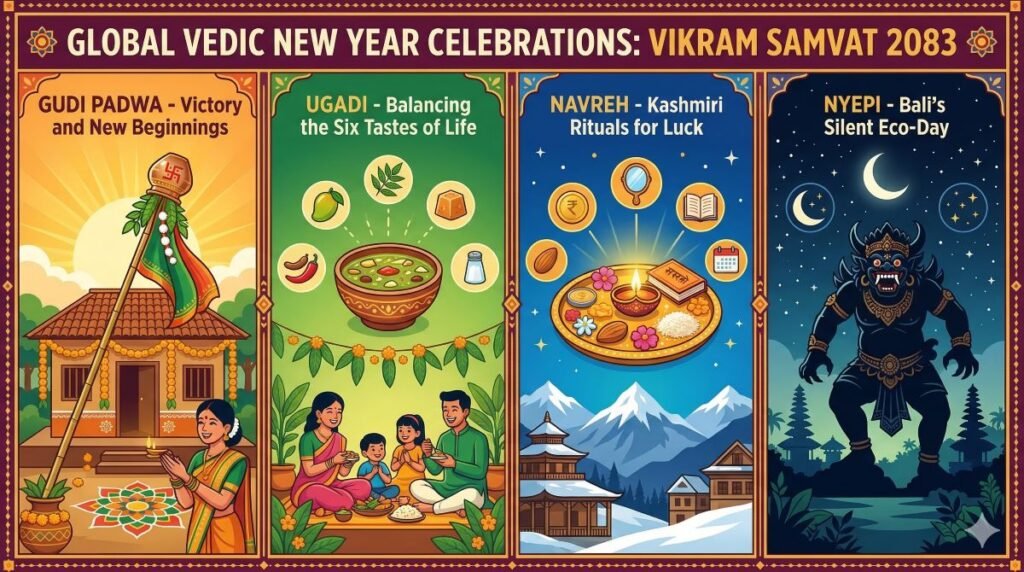
- How it is celebrated: People tie a bright piece of cloth, neem leaves, and a garland of sugar crystals to a long bamboo stick. A silver or copper pot is placed upside down on top of it. This is called the Gudi.
- The Meaning: The Gudi is raised outside windows or roofs like a flag. It is a symbol of Lord Rama’s victory over Ravana and his return to Ayodhya. It is meant to bring good luck and keep evil away from the house.
2. Ugadi: The Six Tastes of Life (South India)
In Karnataka, Andhra Pradesh, and Telangana, the festival is known as Ugadi (or Yugadi, meaning the “Start of a New Age”).
The most amazing tradition of Ugadi is the special food prepared on this day, called Ugadi Pachadi. It is a dish made using six different ingredients, each representing a different flavor and a different emotion in life:
| Ingredient | Taste | What it Teaches Us About Life |
|---|---|---|
| Jaggery | Sweet | Happiness and Joy |
| Neem Buds | Bitter | Sadness and Difficulties |
| Tamarind | Sour | Disgust or Bad Surprises |
| Green Chilli | Spicy / Hot | Anger |
| Salt | Salty | Fear |
| Unripe Mango | Tangy / Astringent | Surprise and New Challenges |
The Lesson: When you eat this, you accept that the coming year will be a mixture of all these feelings, and you must face them all with an equal, peaceful mind.
3. Navreh: The Tray of Good Luck (Kashmir)
Far up in the snowy mountains of Kashmir, the Kashmiri Pandits celebrate Navreh (meaning “New Year”).
On the night before the New Year, a special Thali (tray) is prepared. It is filled with unhusked rice, bread, a little yogurt, salt, a silver coin, a pen, a mirror, and the new calendar (Panchang). The tradition is that this tray is the very first thing a person must look at when they wake up in the morning! It symbolizes a wish for wealth, knowledge, and enough food for the whole year.
4. Nyepi: The Global Connection in Bali, Indonesia
Did you know that you don’t have to be in India to see the Hindu calendar at work? In the beautiful island of Bali, Indonesia, the Hindu New Year is known as Nyepi.
But unlike the loud, colorful celebrations in India, Bali celebrates the New Year in a way that shocks the whole world: They celebrate it with absolute Silence.
The Day Before: The Monsters (Ogoh-Ogoh)
On the evening before the New Year, the streets of Bali are filled with loud music, fire torches, and giant, scary statues of demons called Ogoh-Ogoh. People carry these monsters through the streets making as much noise as possible to wake up the evil spirits, and then they burn the statues to purify the environment.
The Day of Nyepi: The Four Rules of Silence
When the sun rises on the New Year, the entire island goes completely dead silent for 24 hours. The local guards (called Pecalang) patrol the streets to make sure everyone follows the four strict rules, known as Catur Brata Penyepian:
- No Fire or Light (Amati Geni): No fires can be lit, and at night, no electricity or lights are turned on. The island is pitch black.
- No Work (Amati Karya): All shops, offices, and businesses are closed.
- No Travel (Amati Lelunganan): Nobody is allowed on the streets. Even the international airport of Bali is completely shut down for 24 hours!
- No Entertainment (Amati Lelanguan): No TVs, no loud talking, no internet, and no music.
Why Do They Do This? (The Science and Philosophy)
There are two beautiful reasons behind Nyepi:
- Mythological: They believe that by making the island completely dark and silent, the evil spirits will think Bali is empty and will fly away to somewhere else!
- Scientific & Spiritual: It is a day of deep self-reflection (meditation). It gives human beings a break from their busy lives. More importantly, it gives Mother Nature a 24-hour break from pollution, cars, and human noise. It is the ultimate eco-friendly holiday.
Conclusion
Whether you are raising a victory flag in Maharashtra, tasting the bitterness of neem in South India, or sitting in the peaceful darkness of Bali, the Vedic New Year connects millions of people to the natural cycles of the Earth. It teaches us to respect time, our emotions, and our planet.
Explore More in Our Calendar Series!
⏮️ Missed the Beginning?
If you want to understand the deep science, the Panchang, and the amazing cosmic time calculations behind all these beautiful festivals, make sure to read the first part of our series!
👉 Read Part 1: The Complete Guide to Hindu New Year 2083 & Vedic Cosmic Time
⏭️ Coming Up Next: The Saka Samvat!
We have seen how the Lunisolar calendar guides our festivals. But did you know the Government of India uses a completely different calendar for its official work? In the next part of our series, we will uncover the history and science of the Saka Samvat (India’s National Calendar).
Stay tuned to Solotutes History for the next chapter!

Categorized Under:
More Study Notes on this Topic
-800x447.jpg)


Ready for More?
Test your knowledge with these related materials.

📺 Watch & Learn
Visual explanations and related video classes for better understanding.
🎥 Video Resources
The History of Ugadi and Gudi Padwa Festivals #ugadi #gudipadwa #happyugadi

The History of Ugadi and Gudi Padwa Festivals #ugadi #gudipadwa #happyugadi

Ugadi - Real Clips

NYEPI : The Silent Day... How the Balinese new year is celebrated on the Island of the Gods!

Day of Silence in Bali #shorts #unknownplacesfacts #facts

Traditional New Year celebration around the world | Traditional | Camping, Tour

Ugadi Theme baby Photography at home | Gudi Padwa baby photography
💬 Discuss this Topic
Have a doubt or want to share something? Drop a comment below!
0 Discussion(s)
You must be logged in to join the discussion.