
We are going to explore the Ancient Mayan Calendar. The Maya people were master astronomers and mathematicians. They built massive stone pyramids that acted like giant clocks, and their calendar system is considered one of the most complex ever created in human history!
1. Not Just One Calendar, But Three!
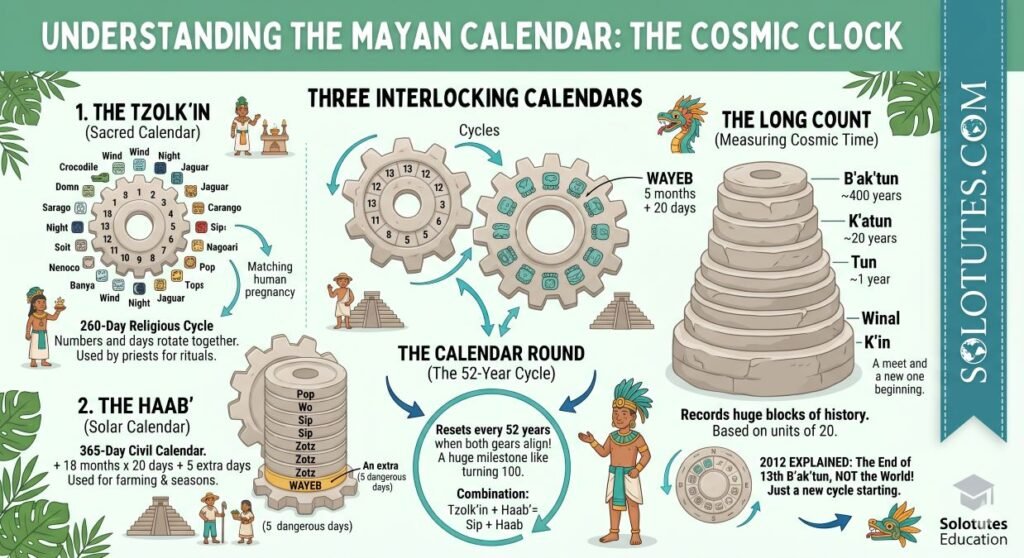
When we say “the Mayan Calendar,” we are actually talking about three different calendars that worked together like the gears of a giant clock. They did not just measure days and months; they tracked the Sun, the Moon, and even the planet Venus.
Let’s look at the three main parts of this amazing time machine.
2. The Tzolk’in: The Sacred Calendar (260 Days)
The first calendar is the Tzolk’in (pronounced Zol-keen). This was a sacred, religious calendar used by Mayan priests to plan festivals and make predictions.
- It is exactly 260 days long.
- Instead of months, it uses two repeating cycles: a number from 1 to 13, and a set of 20 named days (like Crocodile, Wind, Night, and Jaguar).
Scientists believe they chose 260 days because it closely matches the length of a human pregnancy, making it the perfect calendar for tracking human life and religious rituals.
3. The Haab’: The Solar Calendar (365 Days)
The second calendar is the Haab’. This was the civil calendar used for farming, tracking the seasons, and everyday life. It is very similar to the Solar calendars we use today!
The Haab’ is 365 days long, but the Maya divided it very differently than we do:
- They had 18 months in a year.
- Each month had exactly 20 days (18 x 20 = 360 days).
- To make it 365, they added 5 extra days at the very end of the year.
These 5 extra days were called the Wayeb’. The Maya believed these 5 days were very unlucky and dangerous, as the barrier between the human world and the spirit world was open. People would stay home and avoid hard work during the Wayeb’!
4. The Calendar Round (The 52-Year Cycle)
Because the Maya used the 260-day Tzolk’in and the 365-day Haab’ at the exact same time, any given day had two names. Imagine saying today is “Tuesday, October 10th” on one calendar and “Day 4, Jaguar” on another.
It took exactly 52 years for the same combination of dates to repeat. This 52-year cycle was called the Calendar Round. For the Maya, reaching the age of 52 was a huge milestone, kind of like celebrating a century today!
5. The Long Count: Measuring Cosmic Time (and the 2012 Mystery)
What if the Maya wanted to record history from thousands of years ago? The 52-year Calendar Round was too short. So, they created a massive system called the Long Count Calendar.
Just like the ancient Indian Vedic calendar tracks cosmic time in huge Yugas, the Mayan Long Count tracked time in massive blocks:
| Mayan Unit | Meaning | Number of Days |
|---|---|---|
| K’in | 1 Day | 1 |
| Winal | 1 Month (20 K’ins) | 20 days |
| Tun | 1 Solar Year (18 Winals) | 360 days |
| K’atun | 20 Years (20 Tuns) | 7,200 days |
| B’ak’tun | 400 Years (20 K’atuns) | 144,000 days (approx. 394 years) |
The Year 2012 Explained
Do you remember when people thought the world was going to end on December 21, 2012? This rumor started because the Mayan Long Count calendar reached the end of its 13th B’ak’tun on that exact date. But the Maya never predicted the end of the world! To them, it was just the end of one huge cosmic cycle and the beautiful beginning of a brand new one.
Conclusion
The ancient Maya did not have telescopes, computers, or modern science. Yet, by simply watching the sky from their stone pyramids, they created a calendar system that is still incredibly accurate today. They showed us that time is not just a straight line, but a beautiful, turning wheel.
Explore Our World Calendar Series!
⏮️ Previous Lesson:
Did you miss our guide on the Asian calendars? Find out how the Chinese Zodiac works and the secret behind the Lunisolar year!
👉 Read Part 5: The Chinese Lunar Calendar & Zodiac
⏭️ Next Up:
We have traveled across the world, but we still need to visit one of the oldest civilizations of all! Next time, we will explore the hot sands of Africa to uncover the secrets of the Ancient Egyptian Calendar—and how the flooding of the Nile River created the 365-day year we use today!
👉 Read Part 7: The Ancient Egyptian Calendar!